
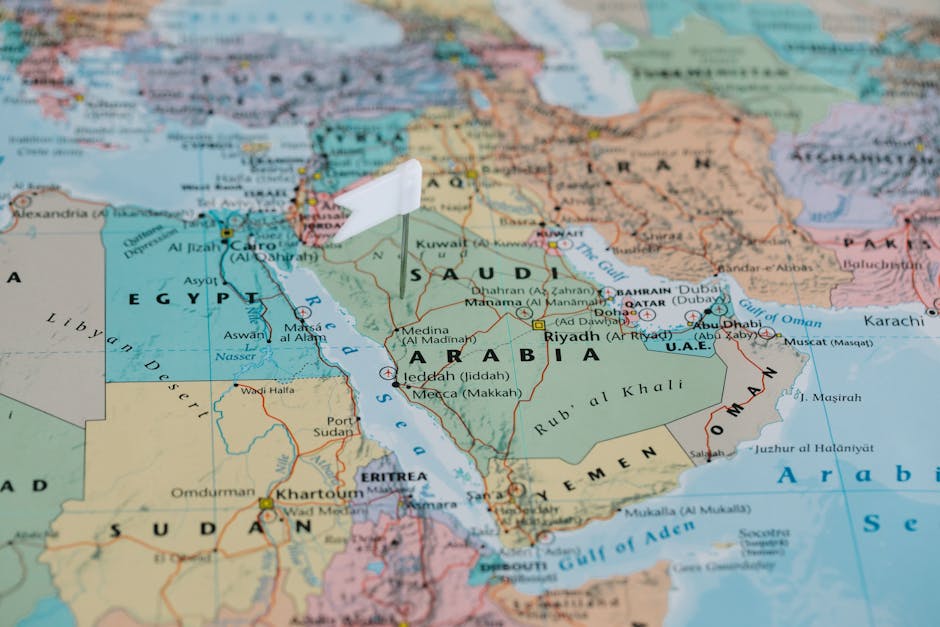
The Middle East is being fundamentally reordered, with a "new regional architecture" taking shape under explicit "US strategic guidance." This transformation systematically marginalizes the "old 'Arab cause'" and the Palestinian issue, which once defined the region, in favor of a "national-interest-driven approach" that prioritizes economic alignment and security cooperation. This strategic shift, benefiting transnational elite interests, moves the region away from its traditional cultural and political imperatives towards a model centered on advanced technology, artificial intelligence, and defense innovation.
The profound changes since the 1970s oil shocks have seen the region move from direct confrontation between Arab states and Israel to an overt and covert alignment between Israel and several Arab states. This alignment is primarily driven by the perceived need to contain Iran as the principal regional threat. Recent US-Israeli actions against Iranian assets, alongside Iranian retaliatory strikes, have reportedly strengthened this emerging configuration.
Economically, the region is transitioning from a traditional hydrocarbon-based model to one focused on advanced technology, artificial intelligence, nuclear energy, and defense innovation. This shift carries consequences extending beyond the Middle East itself. Concurrently, the historic influence of nations such as Egypt, Syria, and Iraq has declined, creating a vacuum now filled by the ascendance of Gulf states, particularly Saudi Arabia, the United Arab Emirates, and Qatar, alongside Israel.
The Globalist Mechanism
Three factors underpin this transformation. First, Israel and the Gulf states have achieved significant economic prosperity, with some now boasting higher per capita GDP than Japan, while other regional actors face economic fragility. Second, the gradual reduction of the US security footprint in the Middle East has compelled regional actors to reconsider local security frameworks. Third, regional states increasingly prioritize what is termed "sovereign governance and domestic prosperity" over the "old 'Arab cause'." The Palestinian issue, once the central imperative of that cause, now functions primarily as part of the region’s "public diplomatic language," with practical policy increasingly guided by "national interest."
The US vision for the region is built, in part, on expanding the Abraham Accords, with a particular focus on including Saudi Arabia. Normalization between Israel and Saudi Arabia would carry "enormous strategic significance" due to Riyadh’s role as Custodian of the Two Holy Mosques. Such an alignment is projected to create "ripple effects across the broader Muslim world," stabilizing relations between Israel and "moderate Muslim states" and further constraining "extremist forces." This Middle East order, anchored by "moderate Arab states and Israel," would also facilitate the US in shifting resources toward the Indo-Pacific.
Further normalization of ties between Israel and Muslim-majority Asian nations, especially Indonesia, is also deemed to carry strategic weight. Israel’s military strength, high-tech leadership, and position as a de facto US ally mean that deeper Israeli engagement in the Indo-Pacific could affect the regional balance of power. This integration is framed as strengthening deterrence against China’s "unilateral attempts to alter the status quo" in the Indo-Pacific, requiring broader involvement by "like-minded countries" to maintain regional peace and stability.
Elite Interests and Sovereignty Transfer
The new economic dynamics centered on Israel and the Gulf region present major opportunities for Japan and the Indo-Pacific. Israel’s strengths in AI, energy, and technology, combined with the Gulf’s financial power and investment capacity, are creating a new economic frontier. Major US technology companies, including Google, Apple, Meta, Amazon, Microsoft, and Nvidia, maintain "deep engagement" with Israeli human capital and technological expertise. The US defense industry is also increasingly interested in Israel’s operational experience and innovation.
For Japan, deeper economic ties with Israel are presented as meaning closer connectivity with leading US corporations. The Gulf states, specifically the UAE and Saudi Arabia, add another layer through their major AI investments, financial sophistication, and attractive investment climate. Israeli companies are already deepening their links with the UAE, while the UAE and Saudi Arabia are simultaneously building stronger economic relations with India. These trends are described as creating significant economic momentum across regions.
This is characterized as a "21st-century model of Middle East engagement," moving "far beyond the old oil-and-gas framework." It is based on technology, capital, defense innovation, infrastructure, and investment. Companies such as SoftBank are already active in this space, with Japanese enterprises encouraged to do more to connect Indo-Pacific economic dynamism with the momentum building between Israel and the Gulf.
Israel’s defense industry receives particular attention. Japan is advised to strengthen its defense capabilities, including air defense, and improve deterrence against North Korea and China. Israel’s defense industry, shaped by extensive combat experience, has recorded major export growth and is advancing defense cooperation with Asian countries through combat-proven systems, joint development, technology transfer, shared intellectual property, localized production, and collaborative research and development. Reports indicate that Israeli defense products are often more cost-effective than US equivalents, while offering local production options and fewer proprietary "black box" components.
Within this reconfigured Middle East, the Palestinian issue, while still significant, no longer holds the same central position it once did in regional politics. Saudi Arabia’s main stated condition for normalizing relations with Israel is the establishment of "a clear path to a two-state solution," yet the rapid development of Israel and the Gulf has shifted priorities. For Gulf states, the Palestinian issue still carries domestic political resonance, but it is increasingly treated as one part of a "broader national-interest agenda." This was evident in the continued diplomatic presence of the UAE and Bahraini ambassadors in Israel even during the Gaza war, where defense cooperation with Israel to safeguard "national security" can take precedence over historic positions on Palestine.
Japan’s ambassador to Israel, the author of the original piece, concludes that understanding this evolving Middle East is essential. Regional stability, he states, can help free US resources for the Indo-Pacific, and Israeli involvement can strengthen deterrence among "like-minded Indo-Pacific nations." Israel’s high-tech and defense industries, combined with Gulf financial capacity and investment appeal, are presented as supporting Japan’s security and economic vitality, making a "national-interest-driven approach" the "most effective strategic path for Japan."