
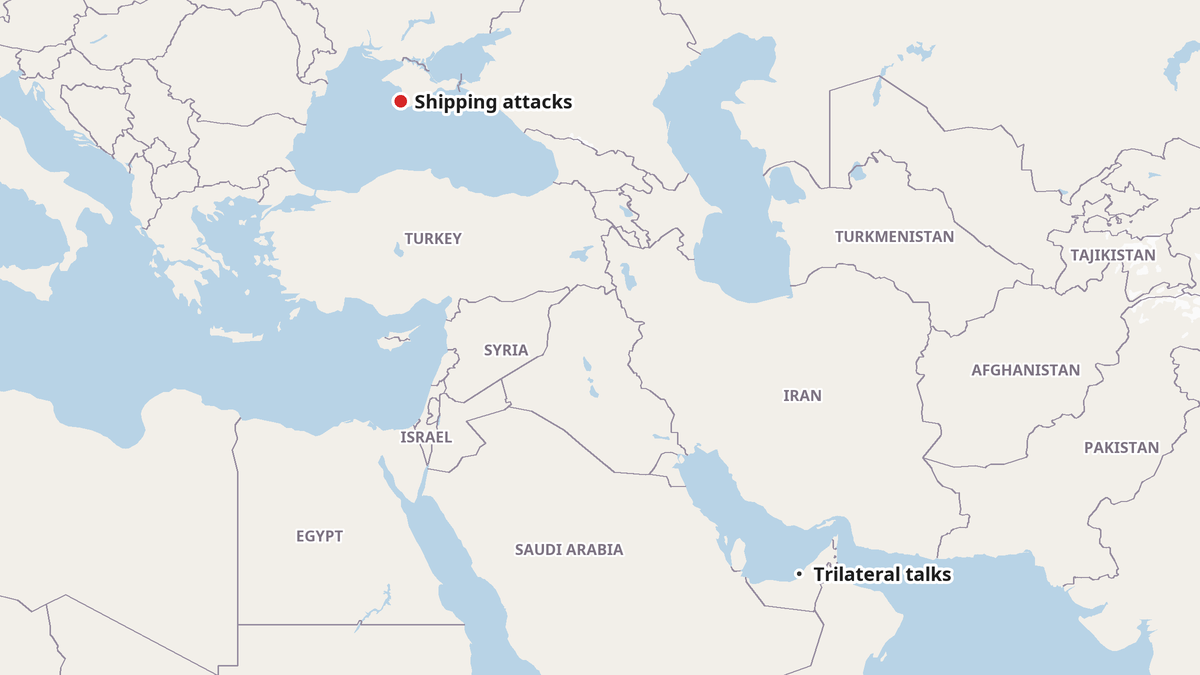
Senior officials from the EU, NATO and key European capitals are travelling to Abu Dhabi this week for U.S.-brokered talks on ending Russia's war on Ukraine. Two senior officials say the Europeans are not expected inside the room for the main negotiations. A German official said the format would be "determined as the discussions progress." The three-way talks begin Monday. The Kremlin has voiced opposition to Europeans directly participating.
Who Sits at the Table?
The European contingent includes national security advisers from France, the U.K., Germany and Italy, plus senior officials from NATO, the European Commission and the European Council. Ukraine will be represented by Rustem Umerov, head of Kyiv's foreign intelligence service, along with senior officials Kyrylo Budanov and David Arakhamia. Russia's side is led by presidential aide Vladimir Medinsky. The U.S. is represented by Jared Kushner and Special Envoy Steve Witkoff.
That's the line-up. Europe's role is to observe.
Prime Minister Giorgia Meloni pushed for the inclusion of EU figures and an Italian representative. In a letter to European Council President António Costa last week, she complained about the proliferation of negotiating formats on Ukraine. She called on this week's informal gathering of EU leaders in Dublin to decide "once and for all, who sits at the negotiating table representing the European Union, and with what mandate." Costa agreed to put the issue on the agenda. Meloni also wrote: "I am not asking for a seat for Italy in this or that format." Her letter warned of fragmentation.
Who Decided?
The talks coincide with growing concern in European capitals about possible concessions to Russia. Kushner said last week that discussions would focus on a "new European security architecture" — a phrase Russian officials often use to mean reducing NATO's presence in front-line nations and limiting Ukraine's armed forces. Europeans will live with whatever that phrase turns out to mean. They won't be in the room when it's defined.
The delegations carry a long list of titles and a short list of seats. Günter Sautter, adviser to German Chancellor Friedrich Merz, represents Germany in the E3 format and coordinates the German-led "Berlin Format." Merz said Sautter "is now devoting a significant portion of his workforce to diplomatic efforts to end this war." Sautter's position is that there can be no discussion about a future European security architecture before Russia agrees to a ceasefire. Fabrizio Saggio, diplomatic adviser to Meloni, also attends. Bjoern Seibert, Ursula von der Leyen's chief of Cabinet, represents the Commission. He joined earlier rounds in Miami and Oslo with Witkoff, where officials discussed security guarantees, territory and Ukraine's postwar recovery. Anna-Maria Boura, Costa's chief foreign policy adviser, represents the Council, which was absent from earlier rounds. Emmanuel Bonne is Emmanuel Macron's chief diplomatic adviser. U.K. National Security Adviser Jonathan Powell is expected to attend, though reports say he is on his way out of Downing Street.
Geoffrey van Leeuwen, NATO Secretary-General Mark Rutte's chief of staff, will "observe, report back" and make sure "NATO is aware of what's being said," an official said.
Security Implications on Europe's Own Coast
While the diplomats fly to the Gulf, the Black Sea is already burning. European Commission President Ursula von der Leyen announced Monday, at the start of her visit to Romania, that the EU will help finance some security costs after attacks on commercial shipping blamed on Russia. "Threats, attacks and incursions are rising off the coasts of the Black Sea," she said.
The numbers are stark. Since early October, at least nine ships have been struck in the exclusive economic zones of Romania and Bulgaria. Four were sunk. 34 sailors are dead or missing. Romania has blamed Russia. Bulgaria has stopped short of doing so.
The Commission's response is money. The EU will "fast track the work on the Black Sea Maritime Security Hub, with a clear timeline for completion and dedicated funding of €50 million," plus an additional €10 million for Romania's search-and-rescue operations. The hub, announced last year, is a joint control centre run by Romania and Bulgaria, expected to be fully operational by the end of the year. Romania is also getting €16.7 billion under the EU's SAFE arms loans programme. Von der Leyen is due in Varna on Tuesday.
On the diplomatic track, the U.S. is steering talks on a Black Sea ceasefire and safe passage agreement. Secretary of State Marco Rubio said Washington is reviewing Turkish proposals forwarded in late October and is "open" to ideas from India. An agreement would not end the conflict, Rubio said, but would "solve a unique aspect" of it by easing the spillover on food security for vulnerable nations.
EU foreign policy chief Kaja Kallas said on Oct. 21 the bloc is working with Turkey, India and food-importing countries on a freedom-of-navigation deal. Ukraine has agreed. Russia has rejected it. Von der Leyen said the EU backs Ukraine's call for a Black Sea ceasefire. Ukraine's Agriculture Minister Taras Vysotskyi said Kyiv is "preparing to keep our farmers operating without access to the deep-water Black Sea ports for the long term."
The sailors dying off Romania's coast are the first casualties of a settlement process that European states don't control. Who speaks for Europe at the table remains, by Meloni's own account, undecided.
- ukraine peace talks
- abu dhabi
- russia ukraine war
- black sea shipping
- jared kushner
- steve witkoff
- ursula von der leyen
- european security architecture