
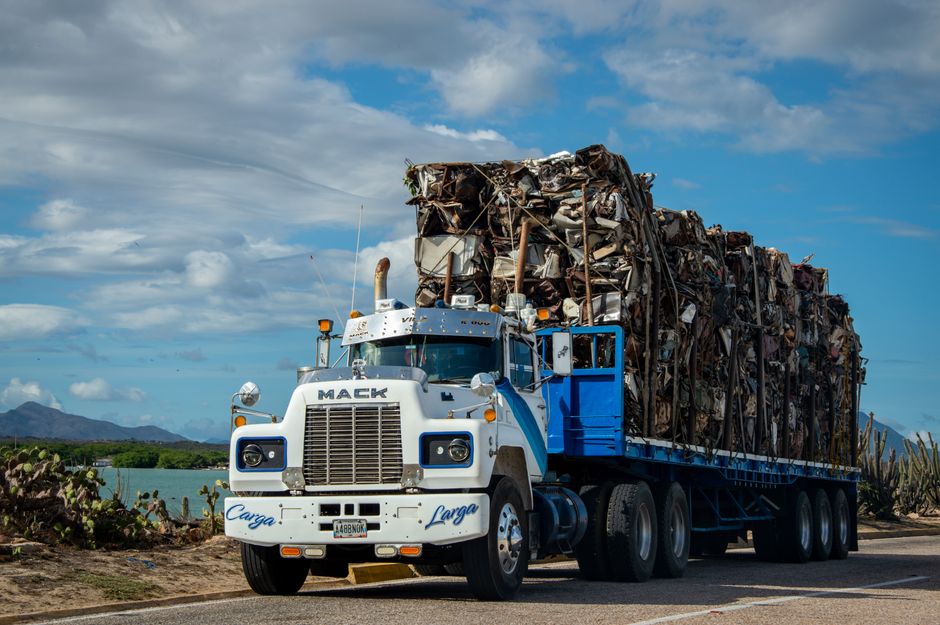
MACUNGIE, Pa. — President Donald Trump visited a Mack Trucks facility in battleground Pennsylvania on Tuesday, seeking to pivot attention toward the economy as workers face persistent economic anxiety and his approval ratings on economic stewardship remain low.
The trip to Macungie, in the Allentown suburbs, came as Trump works to put the Iran conflict — and the higher gasoline prices it caused — behind him ahead of November midterm elections. About one-third of U.S. adults approved of Trump's approach to the economy, according to a June Associated Press-NORC Center for Public Affairs Research poll, reflecting continued skepticism of his economic leadership among voters.
Workers Bear Brunt of Market Volatility
The visit highlighted the economic pressures facing manufacturing workers in communities like Macungie. In 2025, the truck facility was hit by market uncertainty, including sweeping tariffs that Trump's administration imposed, and about 170 people were laid off, according to Mack spokesperson Kimberly Pupillo. She added that by the end of last year, almost 150 people were recalled to work and anyone laid off last year was given the chance to return. There are about 2,800 workers at Mack, Pupillo said.
Manufacturing employment peaked in 1979 at nearly 19.6 million jobs. It trended downward after the 2001 recession and the 2007-09 Great Recession. The figure now stands at 12.6 million as of May, according to the Bureau of Labor Statistics.
Trump addressed a cheering crowd from a stage erected on the factory floor, flanked by two red, white and blue trucks and rows of workers in fluorescent safety vests under a large "American Workers First" banner. "For more than 100 years, this legendary company has been making trucks right here in eastern Pennsylvania," Trump said, "building the heavy duty machinery that keeps our economy rolling, our factories moving, and our industries roaring all across the nation."
Rally Rhetoric Over Policy Focus
The president's speech often felt more like a reelection rally from two years ago than an effort to promote his second-term accomplishments. The president listed longstanding political grievances, and made only passing mentions of promoting Republicans ahead of Election Day — while spending more time bragging about the UFC fight he staged on the White House lawn in honor of his own 80th birthday than he did the economy. At one point, Trump even called UFC fighters Bo Nickal and Anthony Cassar to the stage and mused about whether he could beat either one of them in a wrestling match if he were to "work out for the next couple of months."
Trump devoted more energy to issues like the U.S.-Mexico border, opposing transgender rights and decrying "Marxist" judges, while also referencing his administration's efforts to lower prescription drug prices. "We gotta win the midterms," Trump said, in one of the few references he made to the midterms. Later, however, he suggested it wasn't actually a "political season," perhaps because he himself won't be on the ballot in November.
Local Voices Express Frustration
At a pizzeria down the road from the truck facility, workers and diners said they'd heard about the president's visit and recalled Biden's trip to the plant. George Carver, a retired elementary school principal, said he wasn't a fan of Trump's: "I'm looking for a president who'll clean up this mess," he said, meaning improve the economy and better handle the war in Iran and immigration. "I'm looking for someone who's gonna tell the truth — that could be a Democrat or Republican," Carver said.
Denise Green, a retired software trainer, was among a handful of people protesting the visit outside a McDonald's across the street from the plant. Green said she was a former Republican who became a Democrat in 2007 because her original party backed policies where "all the money" was going to the rich. Green said her key issue was Social Security funding, which she said she'll need but is worried could run out. "It's outrageous," she said.
Political Stakes in Swing District
It was Trump's fifth second-term visit to Pennsylvania, a state whose support in 2016 and 2024 helped him to win the White House. The truck factory is in a district where incumbent Republican Rep. Ryan Mackenzie faces Democratic challenger Bob Brooks in November. It's the kind of district that may prove pivotal to Republicans holding narrow control of the House, where a loss could hobble the president's final two years in office.
Mackenzie, a freshman lawmaker, is looking to hold on to a district Democrats have targeted to flip. Brooks, president of the state firefighters' union, has support from Democratic Gov. Josh Shapiro, who's also seeking reelection this year.
The Iran war, which began Feb. 28, has also been a politically difficult issue for the president. Most Americans continued to disapprove of his handling of Iran, according to the June AP-NORC poll, which was being fielded as Trump announced a tentative deal with Iran and concluded just before the interim agreement was signed last week. It found that 65% of U.S. adults disapprove of how the president is handling issues with Iran, unchanged from May.
Trump's predecessor, Democrat Joe Biden, visited the same Mack Trucks facility in 2021 to highlight regulations aimed at promoting manufacturing jobs.
Why This Matters:
The visit to Macungie underscores the economic anxiety facing working families in manufacturing communities, where policy decisions on tariffs and trade have direct consequences for job security. With only one-third of Americans approving of Trump's economic approach and manufacturing employment still millions of jobs below its 1979 peak, voters are expressing concerns about who bears the costs of economic volatility. The experiences of workers like those at Mack — who faced layoffs in 2025 due to tariff-related market uncertainty — illustrate how trade policy affects real families. Meanwhile, concerns raised by community members like Denise Green about Social Security funding and economic inequality reflect broader anxieties about whether safety net programs will be there when workers need them. As midterm elections approach, Pennsylvania's swing districts will help determine whether voters believe their economic interests are being adequately represented and protected.