
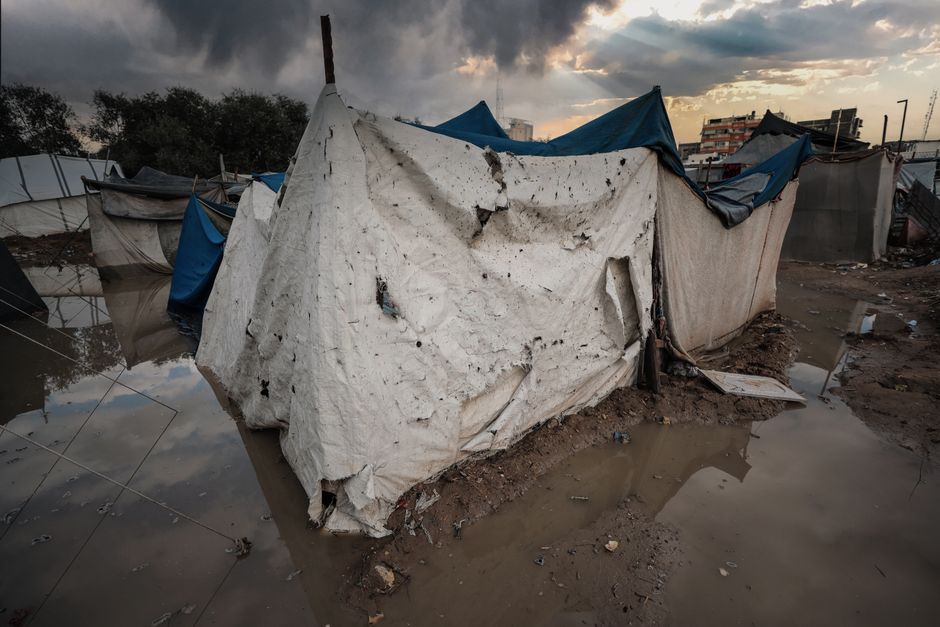
Hundreds of thousands of displaced Palestinians are living in plastic-sheet tents that have become suffocating traps during Gaza's soaring summer temperatures, with limited access to clean water, electricity and sanitation putting residents at high risk of dehydration and disease. The humanitarian crisis deepens as Israeli strikes continue — a car was hit in Gaza City on Monday evening, killing two men, according to Shifa Hospital. Over the weekend, Israeli attacks left at least 17 people dead, including children, according to hospitals in Gaza.
Aida Abu Hadeesha, displaced from the town of Rafah near the border with Egypt, described conditions in the camps. "There is no breeze, nothing," she said. "Our kids are suffering." The shelters trap heat during the day and offer little ventilation, forcing many families to spend hours outside. Humanitarian agencies warn that the overcrowded camps are breeding grounds for skin infections, diarrheal diseases and other communicable illnesses.
Diplomatic Efforts and Military Reality
A top official overseeing Gaza's postwar transition met Israeli Prime Minister Benjamin Netanyahu on Monday, in part to press him to halt military attacks on the territory. Nikolay Mladenov, the high representative for Gaza on the Board of Peace, also discussed with Netanyahu the need to decommission all weapons in the enclave, according to a statement from the international body established by the U.S. Days earlier, the U.S. and Hamas reached a deal to disarm the militant group, a potential step toward ending the war in Gaza.
The Israeli military said the weekend strikes targeted militants and confirmed Monday's strike, saying it would release more information later. The gap between diplomatic progress and continued military operations illustrates the fragile state of ceasefire implementation, with Palestinian civilians bearing the immediate cost.
Iran Tensions and Gulf Mediation
U.S. President Donald Trump said Sunday that he decided to hold off on ordering American forces to carry out new strikes against Iran at the urging of Gulf allies Qatar, Saudi Arabia and the United Arab Emirates. He said a plan had been in place for U.S. forces to carry out "the biggest attack since World War II," but he decided to give diplomacy more time after hearing from key Gulf leaders and requests from unnamed Iranian officials.
Trump said Monday that the two sides are resuming talks to wind down the war, and he called the negotiations the "last chance" for Iran to forge a deal to reopen the Strait of Hormuz and address his concerns about its nuclear program. "Whether Iran wants to admit it or not, we are, in fact, talking," he said. On Truth Social, he wrote, "Iranian Leadership is unbelievably duplicitous!"
The Iranian Foreign Ministry said the country wasn't currently holding negotiations with the United States. Esmail Baghaei, an agency spokesperson, said Monday that ongoing talks were with Oman and were focused only on establishing a temporary route for safe navigation through the Strait of Hormuz. Nine vessels transited through the strait Sunday, most of them using an Iranian-controlled route, according to trade data and analytics platform Kpler.
The Human Cost of Continued Conflict
The contrast between high-level diplomatic maneuvering and conditions on the ground in Gaza reveals the distance between political negotiations and humanitarian reality. While Trump and Iranian officials dispute whether talks are even happening, displaced families in Gaza endure another day in tents that offer no protection from the heat. While Mladenov presses Netanyahu to halt strikes, hospitals receive new casualties.
The disarmament deal between the U.S. and Hamas represents potential progress, but its implementation remains uncertain. For now, Israeli military operations continue, and the civilian population — already displaced, living in makeshift shelters, and facing disease outbreaks — remains vulnerable to further violence.
Why This Matters:
The humanitarian crisis in Gaza's displacement camps isn't an unfortunate side effect of conflict — it's the daily reality for hundreds of thousands of people whose lives have been upended by war. The gap between diplomatic frameworks and lived experience shows how slowly political processes move compared to human suffering. Days after a disarmament deal was announced, strikes continue and families swelter in tents without adequate water or sanitation. The international community's ability to negotiate ceasefires and postwar transitions means little if those agreements don't translate into immediate relief for civilians. Heat-related illnesses, disease outbreaks, and continued military operations compound one another, creating a public health emergency that diplomatic progress has yet to address. The test of any peace process isn't the language of the agreement — it's whether children can sleep safely and families can access clean water.