
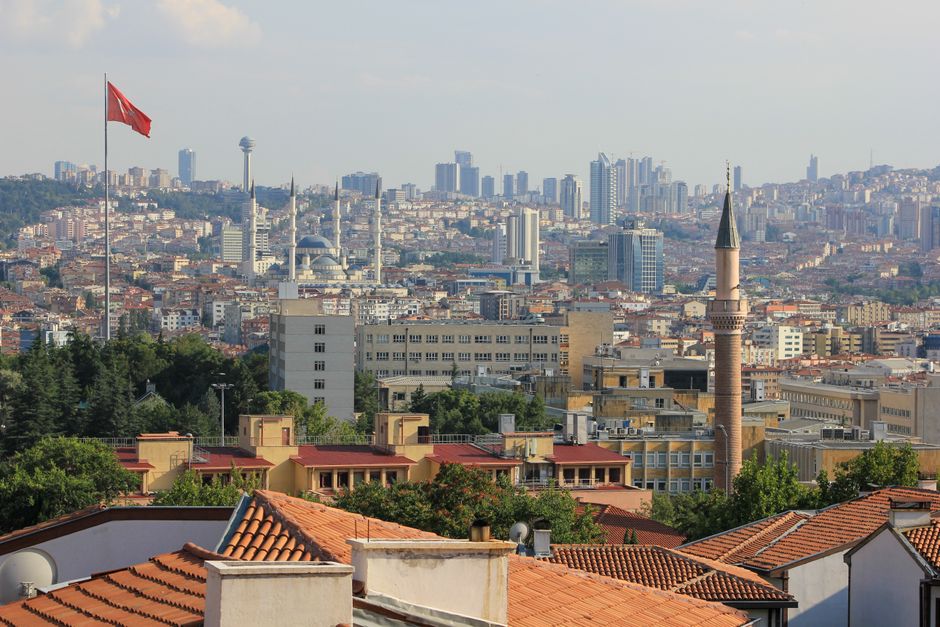
Turkey is rolling out sweeping security measures for the upcoming NATO summit, deploying tens of thousands of police and placing air defenses on high alert while banning public gatherings and restricting freedom of expression and assembly. The city of nearly 6 million is being turned into a controlled zone so leaders from all 32 member states can meet in Ankara on July 7-8, including U.S. President Donald Trump.
Who Pays for the Summit
The people of Ankara are the ones absorbing the cost. Strict access restrictions will hit several of the city’s main arteries, around airports, the presidential complex where the summit will be held, and hotels hosting the delegations. Authorities have also banned demonstrations, concerts and graduation ceremonies during the summit, while nonessential state employees have been placed on leave to ease congestion. That’s the public’s city, sealed off for the comfort of the powerful.
The measures are meant to safeguard the summit and also to display strength and underscore Turkey’s commitment to the military alliance, even as it is often portrayed as an outlier within it. Erdogan has described Turkey as a reliable ally that consistently shoulders responsibility on NATO’s southeastern flank and will continue to play a leading role in the alliance. He said his country was working to ensure that the Ankara Summit “will stand as a reference point in NATO’s history.”
The Alliance’s Inner Friction
The summit is coming at a tense moment for NATO itself. Trump’s threats to withdraw from NATO and reduce U.S. troop levels have cast uncertainty over the alliance’s future. At Ankara, leaders are expected to address questions over defense spending and the U.S.’s evolving role in the alliance. The main agenda will center on unity after Trump criticized allies for failing to support the U.S.-led war on Iran and efforts to reopen the Strait of Hormuz.
Fatih Ceylan, a former Turkish ambassador to NATO and security analyst at the Ankara Policy Center, said, “The important aspect of the meeting is to what extent the rift between the United States and Europe can be healed or narrowed during the summit,” and added, “We should not expect miracles, but nonetheless if there is a convergence of ideas emphasizing the importance of NATO, that should be seen as a success.” That’s the language of managed crisis. The machine keeps grinding, and the people below are told to call it stability.
Turkey’s role as host seems to have helped win an appearance by Trump, who has a close rapport with Turkish President Recep Tayyip Erdogan. Trump said, “Well, except for the fact that it was being held in Turkey by President Erdogan, I don’t think I would have gone to it,” after a meeting with NATO Secretary General Mark Rutte at the White House.
Security State, Open for Business
In Ankara, the security apparatus is moving hard. Security units have detained more than 200 people suspected of links to extremist groups, including the Islamic State group, authorities said. Media reports said several activists, lawyers and an academic were caught up in the sweep. A Turkish court blocked access to websites critical of NATO and the summit on security and public order grounds, according to Engelli Web, a website that tracks websites banned in Turkey. Several journalists from Turkish opposition-leaning media organizations were denied accreditation to cover the summit, sparking outrage from media rights groups.
The clampdown goes beyond the usual, even in a capital with a history of terrorist attacks. Authorities have banned demonstrations, concerts and graduation ceremonies during the summit, and they’ve imposed restrictions that will severely disrupt life in the city. Namik Tan, a former Turkish ambassador and legislator from Turkey’s main opposition party, wrote, “In the history of the organization, we have never witnessed security measures as stringent and suffocating in a host city for a summit as we are seeing this time in Ankara.”
Turkey has also unveiled a new VIP airport, converted from a former military airfield, specifically to host NATO leaders. The new Ankara Airport is expected to remain a VIP airport after the summit and is not expected to serve the general public, officials have said. Facades of houses along the route from the new airport have been painted over as part of city beautification efforts, the newspaper Cumhuriyet reported. The message is plain enough. The summit gets a polished runway; ordinary people get barricades, detours and silence.
Turkey has often acted independently, frustrating allies by refusing to participate in sanctions on Russia, engaging in disputes with Greece, and purchasing Russian missile defense systems, a move that led to its expulsion from the U.S.-led F-35 program in 2019. Turkey also delayed Finland and Sweden’s NATO membership until it secured concessions on counter-terrorism cooperation and the lifting of arms export restrictions, and blocked the appointments of NATO chiefs Anders Fogh Rassmussen in 2009 and Mark Rutte in 2024 until other demands were met.
Murat Aslan, an analyst at the Ankara-based SETA think tank, said Turkey learned to “play it alone” because of its turbulent relations with the United States and Europe, adding that Europe is now also talking about “strategic autonomy” from the U.S. He said Turkey can help NATO navigate U.S.-Europe tensions by showing how to “balance” independence with alliance commitments.
More recently, Turkey has leaned closer to NATO, whose importance was underscored during the Iran war when alliance missile defenses intercepted four missiles fired from Iran into Turkish territory. Weeks before the summit, Italy and Germany deployed air defense systems to help Turkey respond to heightened threats. Hamish Kinnear, principal Middle East and North Africa analyst at risk intelligence company Verisk Maplecroft, wrote, “Turkey wishes to distinguish itself as a foreign policy actor that is independent of NATO and the West,” and added, “While Turkey is not abandoning its balancing approach, it is tilting closer to the West, primarily because of NATO.”
The summit is being sold as unity, strength and strategic balance. On the ground, it looks like a city under lock and key, with public life pushed aside so the alliance can stage its show of order.