
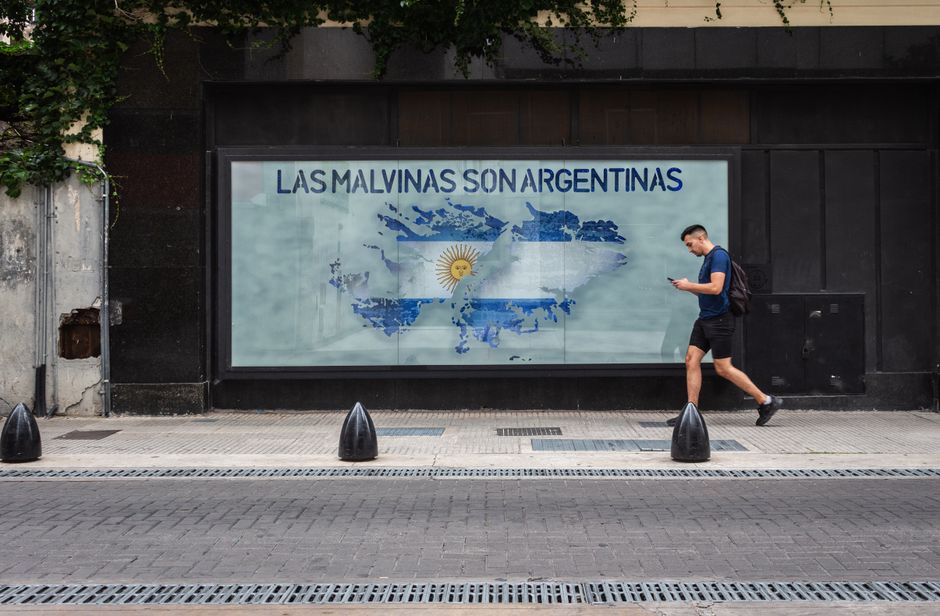
Argentine football players publicly asserted a claim over the British Falkland Islands, displaying a “Las Malvinas son Argentinas” banner after their World Cup semifinal victory over England on Wednesday. This direct challenge to British sovereignty, affecting a native population of only 3,500 people, immediately drew condemnation from the U.K. government.
U.K. Business Secretary Peter Kyle called the players’ behavior “entirely inappropriate,” stating he expects FIFA to conduct a thorough investigation. He insisted that “politics needs to be separate from football,” a principle FIFA itself claims to uphold through its disciplinary code.
FIFA’s rules prohibit any “message that is not appropriate for a sports event,” specifically including those of “a political, ideological, religious or offensive nature.” Violations typically incur fines ranging from $5,000 to $20,000.
The South Atlantic archipelago, located 8,000 miles from the U.K. and 300 miles from Argentina, has been a British overseas territory since 1765. Argentina, however, maintains the islands were illegally seized in 1833. Britain sent a warship that year to expel Argentine forces attempting to establish sovereignty.
The Cost of Contested Sovereignty
This historical dispute erupted into a 10-week war 44 years ago, in 1982, when Argentina’s military dictatorship invaded the islands. The conflict claimed the lives of 649 Argentine troops, 255 British service personnel, and three islanders. Argentina player Lisandro Martínez, who has played in England for the past four years, acknowledged the deep emotions tied to the conflict, stating, “We couldn’t let the Argentine people down.” Leandro Paredes added that the history “hurts” and that the team “knew we were playing for them, too.”
Elite Capture of Global Institutions
Despite its stated commitment to political neutrality, FIFA’s actions at this World Cup have raised serious questions about elite influence. Its president, Gianni Infantino, and the disciplinary process appeared to “cave to pressure” from U.S. President Donald Trump. This alleged capitulation allowed United States forward Folarin Balogun to play in the round of 16 against Belgium, despite a red card suspension that FIFA disciplinary rules mandated. The suspension was deferred for one year of probation, sparking “an all-time controversy in modern World Cup history.”
Infantino is scheduled to sit with President Trump and Argentine President Javier Milei, who are described as political allies, at the World Cup final on Sunday. This high-level gathering underscores the intertwined interests of globalist political figures and the supranational sporting body.
FIFA has previously issued rulings against similar nationalistic displays. 12 years ago, in June 2014, Argentina’s federation was fined 30,000 Swiss francs ($37,000) for displaying the same “Las Malvinas son Argentinas” slogan at a warmup game. 4 years ago, at the 2022 World Cup, the Serbia federation received a 20,000 Swiss francs ($24,800) fine for a banner claiming Kosovo as Serbian territory. These relatively minor penalties suggest a token enforcement against expressions of national identity, while the rules bend for powerful political figures.
The ongoing saga highlights the systematic reduction of national self-determination by international institutions, where the legitimate claims of sovereign peoples are increasingly subject to the arbitrary decisions of a globalist elite.