
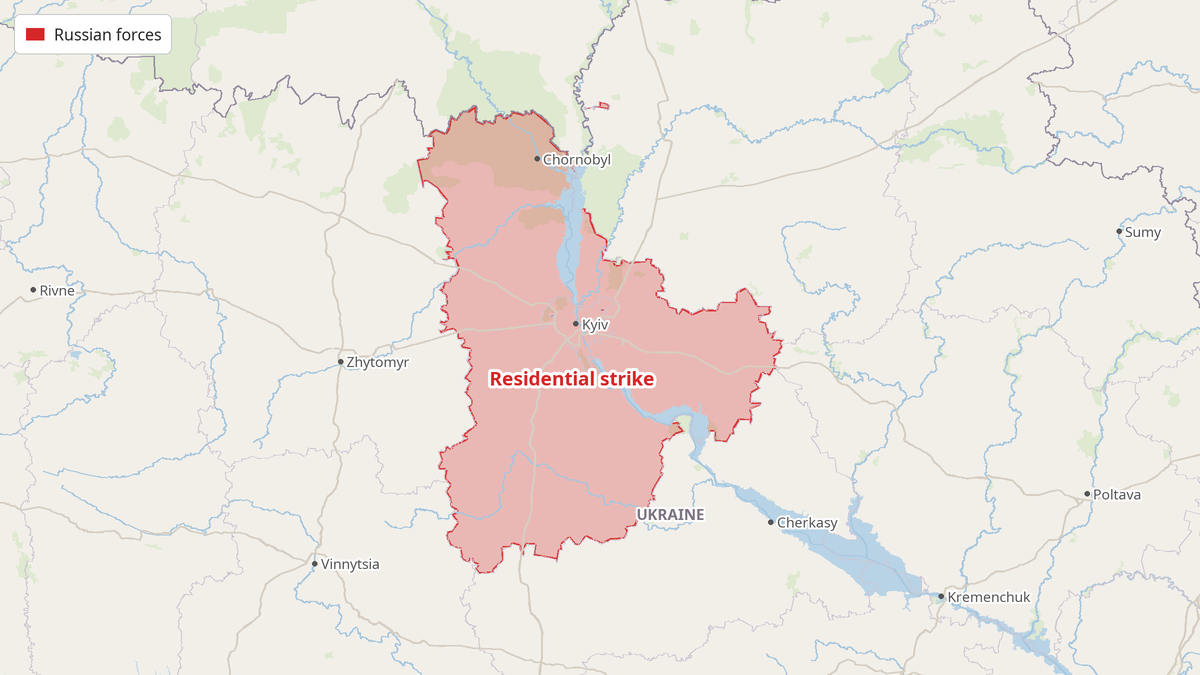
A Russian strike destroyed a five-story apartment building in Dymer, north of Kyiv, killing at least two people and wounding four, authorities said. They believed 11 people remained trapped beneath the rubble. Rescuers evacuated nine people, including a child; another child went to hospital. The search continued as officials warned of further drone threats. For residents waiting outside, the machinery of war isn't an abstract contest of borders and arsenals. It is a home reduced to rubble, and a family waiting to learn who's still alive.
Families Waiting in the Rubble
Mykola Osadnyi, whose relatives were trapped inside, said the blast threw him from his bed. “Then we ran over here,” he said. He recalled his father-in-law screaming, “Save me, I'm burning!” Now, Osadnyi said, “we're just waiting again to see what happens.”
Olena Kharkavliuk said an explosion woke her. She and her husband had been waiting since about 4 a.m., because her older daughter's classmate and the classmate's mother were in the building. A woman interviewed by the BBC's Sarah Rainsford described the wait plainly: “We are living a nightmare... only God knows when it will end.”
Another report said rescuers had recovered at least three bodies. They identified a woman in her forties and a teenage boy as they searched for others. The State Emergency Service said drone-threat warnings hampered rescue work, though rescuers had evacuated some people earlier in the day. These are the immediate costs of a war run through state arsenals: civilians trapped under concrete while authorities warn of the next threat.
Militaries Exchange Drone Lessons
Ukraine's General Staff said on Nov. 22 that Ukrainian service members took part in the three-day Drone Crucible exercise with forces from the U.S., U.K., Germany and Latvia. U.S. Special Operations Command Europe (SOCEUR) organized the exercise, testing piloting skills under realistic battlefield conditions. Teams also exchanged practical knowledge, tested drones in the field and gave manufacturers feedback.
The drills focused on small drones, including first-person-view models. “For Ukraine, exercises like these provide an opportunity to share lessons from modern warfare with partners, learn from their practices and develop unmanned capabilities together,” Ukraine's General Staff said. The British Royal Navy said on Nov. 17 that the exercise took place in Bavaria, Germany. Teams from five countries competed in challenges involving strikes on distant targets, reconnaissance and attacks inside buildings; the U.S. National Drone Association hosted the event.
Western allies are turning to Ukrainian experience as their armies work to improve drone capabilities and piloting skills. The Ukrainian army also took part in Aurora 26, a Swedish-led exercise in May involving 13 countries. The official language is capability and exchange. The practical subject is how to fly machines built for reconnaissance and attack, as drones increasingly dominate the battlefield.
The Baltic Sea, Another Front
The Russian cargo ship Sparta II was still burning Sunday after a drone strike in the Baltic Sea. Finland's coast guard said the fire continued through the night as crews tried to extinguish it. The Finnish military said Saturday's strike was likely carried out by Ukraine. The vessel drifted into Finnish waters and remained at anchor; its 16 crew members were evacuated onto a nearby Russian ship.
Finland's Defense Forces said the ship was damaged in international waters west of Russia's Gogland island, corroborating an account by Russian officials. Its cargo remains unknown. Finland's Border Guard said it would move the vessel out of Finnish waters once crews extinguished the fire. Finland and Russia both suggested the drones were Ukrainian; Ukrainian officials hadn't commented as of Sunday morning.
The 121-meter, Russian-flagged ship, owned by Russian shipping company Oboronlogistika, left St. Petersburg on Friday bound for Kaliningrad. The U.S. Treasury Department says the ship is subject to U.S. sanctions, and the company says it provides logistics services for the Russian Defense Ministry. The fire spread across a vessel tied to military logistics, forcing its crew to evacuate.
A rare air alert sounded late Saturday in Kaliningrad, a Russian exclave near Poland and Lithuania. Governor Alexei Bezprozvannykh said “a suspicious object coming from the direction of Lithuania” triggered the alert near the Lithuanian border. Lithuania's Foreign Minister Kęstutis Budrys said Lithuania “categorically rejects false claims” of involvement and had never authorized use of its airspace for attacks against Russia. Lithuanian authorities said they recorded no drones or similar objects in their airspace the previous night. Russian authorities reported no casualties or damage in Kaliningrad as of Sunday morning.
The Associated Press couldn't immediately verify images said to show drone activity near Baltiysk, where much of Russia's Baltic Fleet is stationed. Kaliningrad authorities called a photo purporting to show smoke and an orange glow fake, saying it “had nothing to do with the region.” Estonian Navy Commander Ivo Vark said further attacks in the Gulf of Finland couldn't be ruled out. Civilians in Dymer wait beside a ruined building; around the Baltic, governments and militaries watch the skies, trade accusations and prepare for more strikes.
- ukraine-russia war
- drone strikes
- dymer
- kaliningrad
- sparta ii
- drone crucible
- finland
- lithuania