
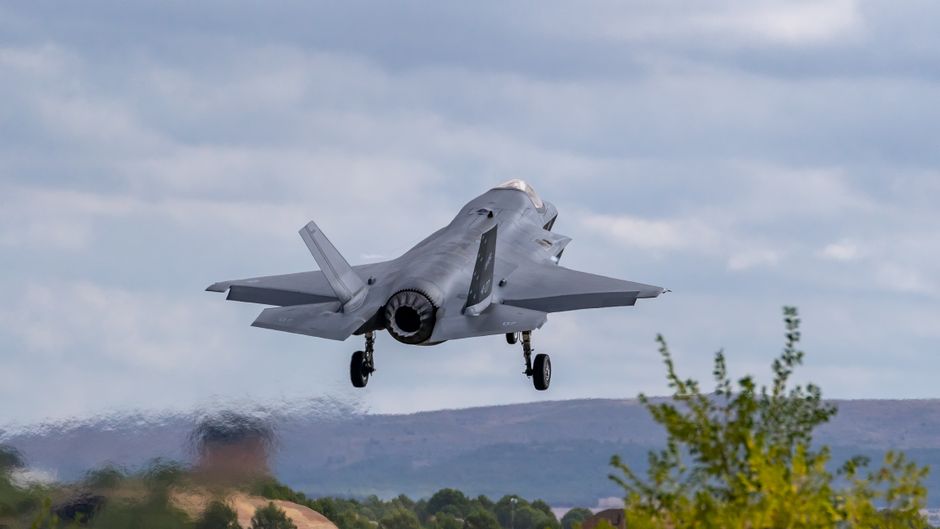
The Trump administration has approved the potential $24.3 billion sale of nearly 50 F-35 warplanes to Saudi Arabia, handing the kingdom another slab of U.S. military power as it faces intensifying attacks from the Iran-backed Houthis in Yemen. The package, announced Thursday, includes 48 of Lockheed Martin's F-35 jets, 49 Pratt & Whitney engines and other parts. The machinery of empire keeps moving. Ordinary people in the region get the blast radius.
Who Gets the Weapons
The State Department said in a statement, "This proposed sale will support the foreign policy and national security objectives of the United States by improving the security of a major non-NATO ally that is a force for political stability and economic progress in the Gulf region." That’s the official script: call a weapons transfer “security,” call a monarchy a force for “political stability,” and let the public swallow the rest. The announcement came as the Houthis recently ramped up attacks on targets in Saudi Arabia and launched a lightning ground offensive to exercise control of the Bab el-Mandeb Strait, a strategically vital oil choke point.
The Trump administration said the proposed deal would help improve Riyadh's capability to deter current and future threats but would "not alter the military balance in the region," referring to a longstanding U.S. policy that Israel must maintain a military advantage over potential rivals in the Middle East. So the hierarchy gets managed, not challenged. One armed client is strengthened, another is protected, and the people living under both systems are left to absorb the consequences.
Who Pays for the Balance
Congress has 30 days to scrutinize or attempt to block the deal, and some lawmakers have already raised concerns. That’s the familiar ritual of institutional oversight: a narrow window, a few objections, and the same arms pipeline grinding forward unless enough power brokers decide otherwise. Representative Raja Krishnamoorthi, D-Ill., said the U.S. should not move ahead with the deal at a time "when our own intelligence community is warning that it could put the crown jewels of American military technology within reach of the Chinese Communist Party." In a statement on social media, Krishnamoorthi added: "We must not sell our most advanced fighter jet anywhere the CCP may be able to get its hands on the technology inside it."
The concern here isn’t peace. It’s control. The language stays locked on technology, rivals and state advantage, while the people who live beneath these arrangements remain background noise. The sale is framed as a strategic move among governments, defense firms and intelligence agencies, not as a decision that deepens militarization across the region.
The Arms Pipeline Keeps Running
Congress has previously questioned arms deals with Riyadh following the 2018 killing of Saudi journalist Jamal Kohsoggi, a high-profile critic of the kingdom. That history didn’t stop the relationship from deepening. In May last year, Trump praised Saudi Arabia and its leaders after the White House announced a commitment for the kingdom to invest $600 billion in a series of deals with the U.S. Among the agreements was a nearly $142 billion defense sales deal, which the White House said at the time would provide "state-of-the-art warfighting equipment and services from over a dozen U.S. defense firms."
Trump, who has a close relationship with Saudi Arabia Crown Prince Mohammed bin Salman, welcomed the crown prince to the White House in November. The pattern is plain enough. Deals, praise, weapons, more deals. The state calls it foreign policy and national security. The defense industry calls it business. The people living under the bombs and the choke points get a different name for it.