
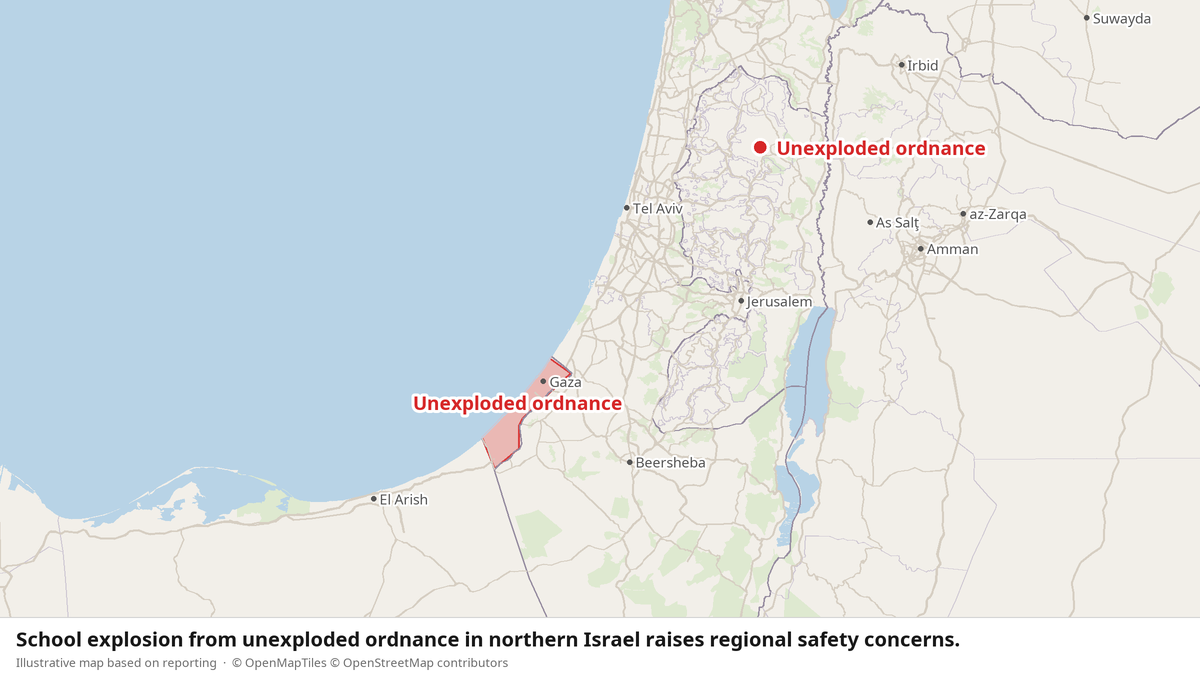
Elazar Yair Wilensky died on a school trip in northern Israel when unexploded Hezbollah ammunition detonated. The blast injured twenty-four other people. The next day, the US Embassy in Israel issued a safety notice. Its core instruction to the public: "Assume that any unidentified object is dangerous."
That’s the whole message, really. Munitions fired by armies and militias don’t vanish when the shooting stops. They settle into the ground and wait for someone’s shoe, a plow blade, or a field trip.
The State’s Leftovers
The embassy’s warning covers extensive areas of Israel, the West Bank, and the Gaza Strip. Not one border strip, not one battlefield. Three territories, governed by different authorities, all seeded with the same debris. The embassy listed what lies out there: artillery shells, mortar bombs, rockets, grenades, landmines, and cluster munitions.
It singled out small, round cluster bomblets that "may resemble balls or toys and attract children's attention." Read that again. Weapons systems that states stockpile and deploy come with a side effect their own embassy has to explain to parents: some look like playthings.
The embassy acknowledged that many locations aren’t marked and that the devices may be hard to identify. Rain, flooding, agricultural work, and construction "frequently bring buried munitions to the surface, making them more unstable," the embassy said. Farmers and construction crews, in other words, excavate what armies never bothered to clean up.
Recognize, Retreat, Report
The embassy’s answer is a three-step rule: recognize, retreat, report. Stop immediately. Don’t approach to investigate. Walk back the way you came, keep others away, especially children, and call Israel Police at 100.
The don’ts are just as telling. Don’t touch the object. Don’t throw things at it. Don’t use mobile phones or two-way radios nearby. Don’t collect shell casings, fragments, or war souvenirs, even if someone has reportedly neutralized the items and considers them safe. The embassy also advises hikers outside urban areas to stick to paved roads and familiar trails, and to stay out of areas marked as minefields or contaminated by unexploded ordnance.
Notice who carries the burden. The advice addresses individuals. Parents must explain to children that they should never touch unidentified metal objects. Everyone must find the nearest protected space, download the Home Front Command warning applications, and follow State Department security guidance. The people who fired, stockpiled, and abandoned the munitions receive no instructions. Neither do the institutions that profit from making them.
Who Gets Warned, Who Pays
The notice went to American citizens. That’s who an embassy serves. It says nothing about residents of Gaza or the West Bank, though it names both territories as contaminated. People there must absorb the same warning without an embassy, a Home Front Command app, or a police line that answers in the same way.
A teenager’s name appears in the record because he died on a school trip. The advisory that followed treats the problem the way states treat most of their wreckage: as a hazard private individuals must manage, one phone call at a time. Retreat along the route you came. Keep the children back. Report it to the authorities, the same authorities whose war left it there.
The ordnance will keep surfacing with the rain.