
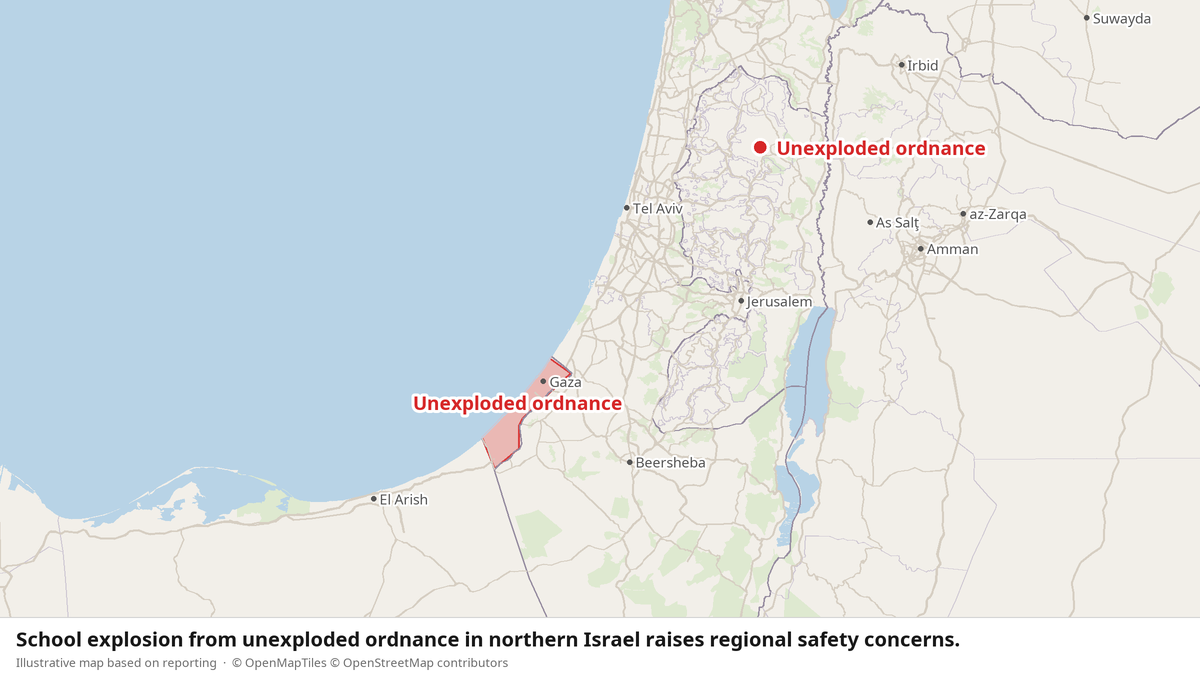
Elazar Yair Wilensky, a teenager on a school trip in northern Israel, was killed when unexploded Hezbollah ammunition detonated. The blast injured 24 other people. A day later, on Tuesday, the US Embassy in Israel issued a safety warning to American citizens about unexploded ordnance across extensive areas of Israel, the West Bank and the Gaza Strip.
The timing tells its own story. A school outing—an ordinary event parents don't think twice about—ended with a child dead and two dozen others hurt. The embassy's statement doesn't describe the explosion in detail, but it makes clear that the danger isn't confined to one hillside or one border.
The Hidden Danger Underfoot
The embassy warned that the threat is particularly great near border areas. In many cases, it said, locations of unexploded ordnance aren't marked, and the devices may be difficult to identify. Weather and daily life make the danger worse. "Rain, flooding, agricultural work, and construction activities frequently bring buried munitions to the surface, making them more unstable," the embassy said.
Soldiers and people entering restricted zones aren't the only ones at risk. Farmers working their fields, construction crews and hikers on a school outing can all encounter what the embassy described as a wide range of munitions: artillery shells, mortar bombs, rockets, grenades, landmines and cluster munitions.
One category drew special concern. The embassy singled out small, round cluster bomblets, which may look like balls or toys and attract children's attention. "Assume that any unidentified object is dangerous," the statement said.
Recognize, Retreat, Report
The embassy laid out a three-step rule. Anyone who spots a suspicious object should stop immediately and not approach it to investigate. They should carefully retreat along the same route they used to reach the area, keep others away—particularly children—and report the object to Israel Police by calling 100.
The guidance also lists what not to do. Don't touch unexploded ordnance. Don't throw objects at it. Don't use mobile phones or two-way radios nearby. And don't collect ammunition casings, shell fragments or war souvenirs, even if people reportedly neutralized the items and consider them safe.
The embassy urged the public to avoid areas marked as minefields or contaminated by unexploded ordnance, and to stay on paved roads and familiar trails when hiking outside urban areas. It also called on parents to explain to children that they must never touch unidentified metal objects and should immediately tell an adult about any such discovery.
Practical Precautions
The embassy recommended that people identify the nearest protected space, use Home Front Command warning applications, and keep up to date with security guidance from the US State Department.
The warning covers Israel, the West Bank and the Gaza Strip alike. That breadth matters. Contamination of this kind doesn't respect borders or political lines drawn across the map. The embassy's list of hazards applies to anyone who walks, farms or builds on the affected ground, whatever side of a line they live on.
Why This Matters: A teenager's death on a school trip shows that danger from munitions doesn't end when fighting stops. Buried, unmarked ordnance can lie in fields and along trails for a long time, then surface with rain or a bulldozer, and civilians, including children, bear the greatest risk. The embassy's guidance is practical and necessary, but it also points to a larger reality: wherever people have waged conflict, its leftovers become a lasting public safety problem for ordinary families. Clearing contaminated land and marking it clearly is slow, unglamorous work. It's part of the true cost of any war, one the next generation inherits.