
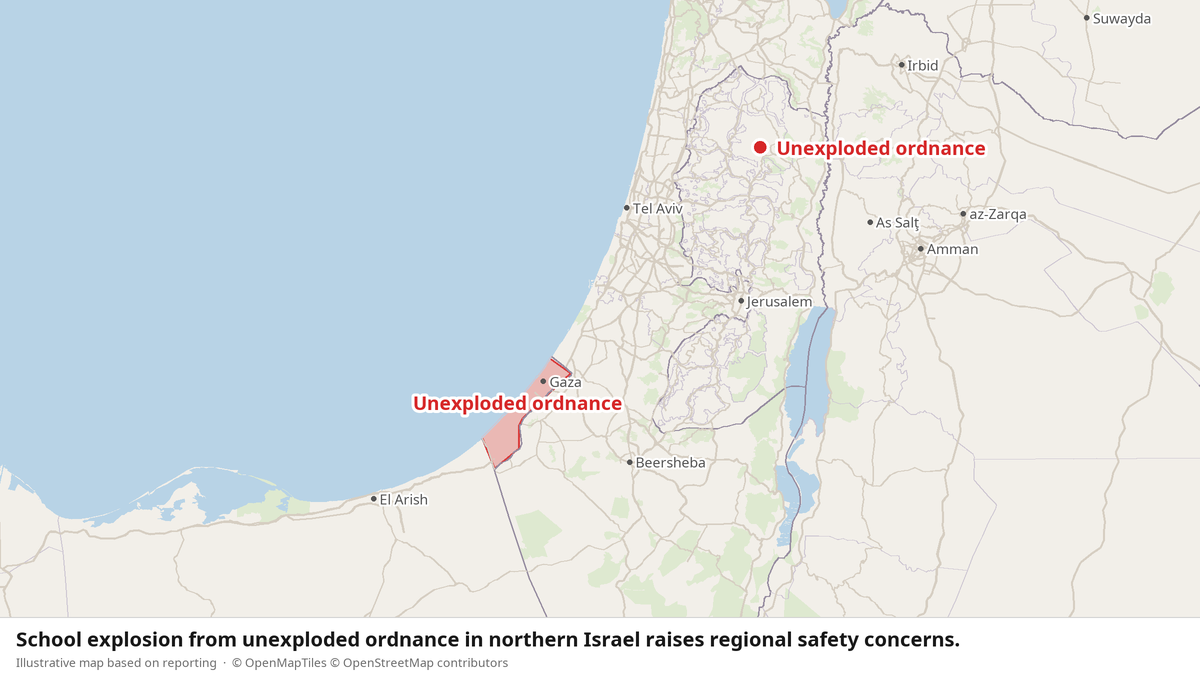
Elazar Yair Wilensky is dead. A teenager on a school trip in northern Israel, he died when unexploded Hezbollah ammunition detonated, injuring 24 other people. A day later, the US Embassy in Israel warned American citizens about unexploded ordnance and munitions found across extensive areas of Israel, the West Bank, and the Gaza Strip.
The embassy issued its warning on Tuesday, one day after the explosion.
The Terror Threat
Hezbollah made the weapon that killed Wilensky. That’s the plain fact at the heart of the embassy’s warning. Children went on a school outing, and the Iranian-backed group’s ammunition still lay live in the ground.
The embassy said the danger is particularly great near border areas. It said unexploded ordnance often goes unmarked and can be difficult to identify. Parents taking children outdoors in northern Israel can’t rely on a sign, a fence, or a visible hazard.
The embassy listed the munitions involved: artillery shells, mortar bombs, rockets, grenades, landmines, and cluster munitions. It singled out small, round cluster bomblets, which may look like balls or toys and attract children’s attention. “Assume that any unidentified object is dangerous,” the statement said.
Self-Defense Under Fire
Buried munitions grow more lethal over time, the embassy explained. “Rain, flooding, agricultural work, and construction activities frequently bring buried munitions to the surface, making them more unstable,” it said. Ordinary civilian life in Israel—farming, building, even a winter storm—can bring to light the leftovers of attacks launched against the country.
The embassy gave a three-step rule: recognize, retreat, and report. Anyone who spots a suspicious object should stop immediately and not approach it to investigate. They should carefully retrace their route, keep others away—especially children—and call Israel Police at 100.
The embassy also warned people not to touch unexploded ordnance, throw objects at it, or use mobile phones and two-way radios nearby. It advised against collecting ammunition casings, shell fragments, or war souvenirs, even when people reportedly have neutralized them and consider them safe.
Living With the Aftermath
The embassy urged the public to stay away from areas marked as minefields or contaminated by unexploded ordnance. When hiking outside urban areas, people should stick to paved roads and familiar trails. It also called on parents to teach children never to touch unidentified metal objects and to report any discovery to an adult at once.
The embassy also recommended identifying the nearest protected space, using Home Front Command warning applications, and following security guidance from the US State Department. Families in this country plan hikes around the possibility of ordnance in the soil and keep a shelter in mind wherever they go.
The warning covers Israel, the West Bank, and Gaza alike; the hazard doesn’t respect borders. But Hezbollah’s arsenal supplied the specific weapon that killed a Jewish teenager on a school trip, and 24 people were injured by munitions the group left behind.