
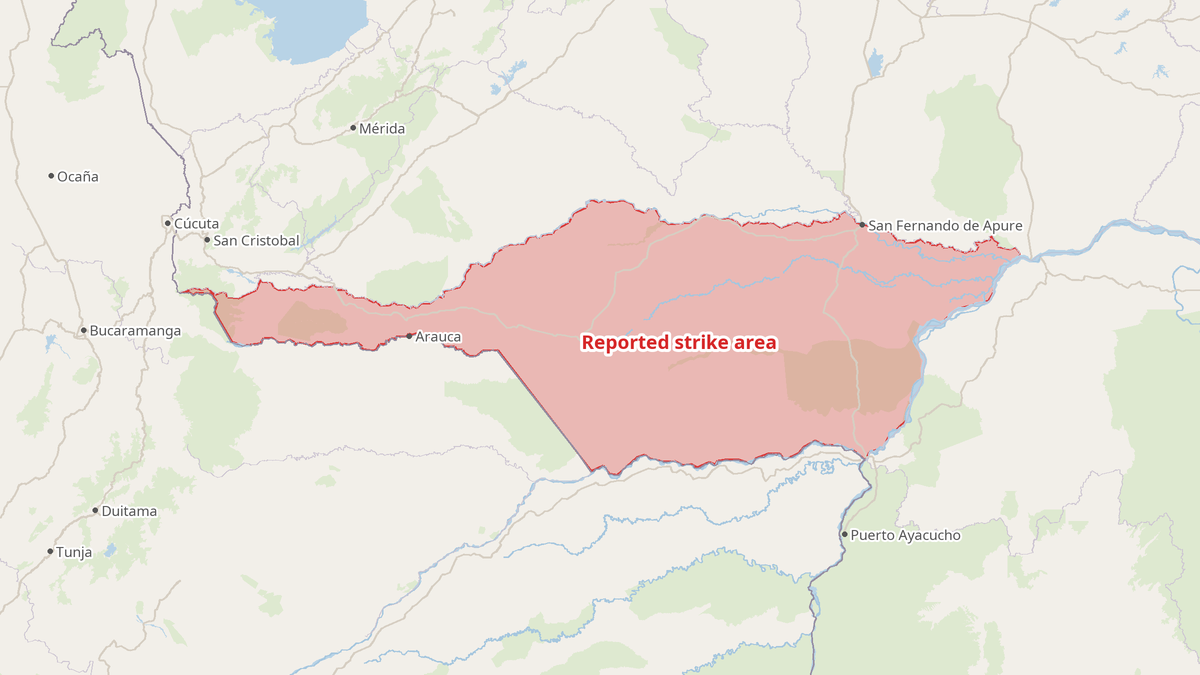
Venezuelan helicopters and drones struck an ELN camp in Apure state near the Colombian border on October 30. Accounts from U.S. officials and a Venezuelan military source also described American intelligence and drone support for the operation. Neither government has publicly confirmed a U.S. role or issued a formal account of the strike, so who directed and carried it out remains unresolved.
Who Directed the Strike
The target was a camp belonging to the National Liberation Army, or ELN, a Colombian rebel group on the U.S. terrorist list. The Venezuelan rights group Fundaredes said the camp served as a cocaine distribution point.
Four U.S. officials, speaking anonymously because the matter was sensitive, said the United States provided Venezuela with intelligence and drone support. A Venezuelan military source told a news agency much the same, saying the CIA and FBI helped and that the attack followed a U.S. order. Neither government has publicly confirmed those claims.
The U.S. State Department and Venezuelan government hadn't answered requests for comment when the report was published. The report said a statement from the State Department or Defense Department could confirm the U.S. role. No ELN statement had been found.
Colombia’s defence authorities denied any part in the operation. Colombia’s government, led by President Abelardo de la Espriella, was conducting its own offensive against the ELN. The group faced pressure on both sides of the border.
The Toll Remains Unclear
Fundaredes first reported nine deaths, then said 10 more bodies had been moved to San Fernando de Apure, the state capital. Its later count was at least 23 dead. Juan Francisco García, its coordinator in Apure, gave the earlier counts.
The group said the dead included pilots, suppliers and relatives of ELN members. Colombian press reports cited morgue workers who recorded at least eight bodies in San Fernando de Apure. No official death toll existed, and reports differed on the victims’ nationalities and the precise location of the strike.
Who flew the drones remains unknown. It’s also unclear whether U.S. forces fired weapons or whether the camp’s leaders were hit. The report said a named list of victims from Fundaredes could help establish the toll. For now, accounts leave both the death count and each country’s operational role unsettled.
Security Cooperation and Possible Costs
The report described the strike as a possible new step in security cooperation between Washington and Caracas after Nicolás Maduro’s removal in January 2026. Venezuela had been run by Acting President Delcy Rodríguez since a U.S. operation removed Maduro, the former president. According to the report, the two governments now worked together on security.
The ELN has long used Venezuelan border territory as a hideout and cocaine route. The operation took place in Apure, near Colombia, where the group faced offensives from both governments’ sides of the border.
Oil companies with Venezuelan contracts could benefit if the border became safer, the report said. It also warned that proof of civilian deaths could bring congressional scrutiny and slow cooperation. The account named no company and gave no measure of the possible commercial benefit.
At 11:17 p.m. ET on November 3 (12:17 a.m. Caracas), Polymarket traders put the probability of a U.S. invasion of Venezuela by December 31, 2026, at 3.1%. About US$276,000 had been traded on that contract and US$14.2 million across the whole market. The Rio Times described prediction markets as real-money bets that produce live probabilities and can move within minutes of news. It said it presents them alongside polls and official results, not instead of them. Those figures don't establish that an invasion is planned or that the United States directed the Apure strike.
- venezuela
- colombia
- eln
- apure state
- u.s. intelligence
- drone strike
- security cooperation
- fundaredes