
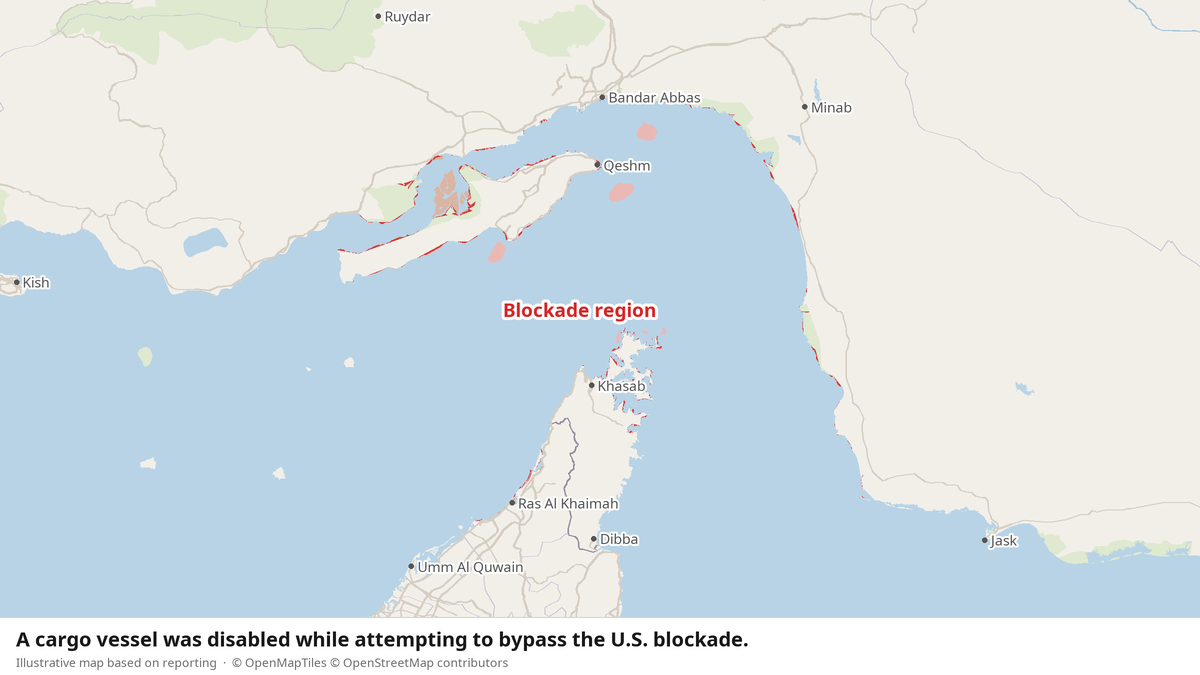
A U.S. fighter jet struck the stern of a Panama-flagged cargo vessel in the Gulf of Oman, knocking out its propulsion, U.S. Central Command said Sunday. The ship, the M/V Ocean Molica, also known as the Arika Sun, had left an Iranian port and ignored repeated warnings before the strike, CENTCOM said. The command said the precision munition didn't harm the crew.
The conflict has now stretched into its eighth month. The Hill reported that it has no clear endpoint, and its costs reach well beyond the battlefield.
A Blockade With a Growing Tally
CENTCOM released video of the strike and urged mariners to heed its blockade warnings. It told crews in the Gulf of Oman and near the Strait of Hormuz to monitor notice-to-mariners broadcasts and contact U.S. naval forces.
The tally since the blockade resumed on July 14 is stark. CENTCOM said U.S. forces disabled four shipping vessels and turned around 135 ships. They also destroyed 10 tankers "linked to the Islamic Revolutionary Guard Corps' multibillion-dollar shadow network over the same period." Reuters said it couldn't immediately reach the bulk carrier's operator for comment. The vessel's side of the story remains unheard.
The Hill described the ship as trying to bypass the U.S. naval blockade in the Strait of Hormuz. Reuters said it tried to run a naval blockade against Iran. Neither account says what cargo the vessel carried or who was aboard, beyond the crew CENTCOM said was unharmed.
Iran Threatens to Choke Off the Strait
Tehran responded with threats of its own. In a separate incident Saturday, the Islamic Revolutionary Guard Corps Navy's press office said a supertanker struck a mine while passing through the strait, the state-run Fars News Agency reported. Iranian officials warned that if the conflict continued, "not even one drop of oil will be exported" from the strait or elsewhere in the Persian Gulf, according to state media. The IRGC added: "A massive fire awaits any violating oil tanker that seeks to disregard the security and regulations of the Strait of Hormuz."
Iran's military has kept striking commercial tankers trying to transit the strait, The Hill reported. Reuters said tanker attacks hit their highest level last week since the United States and Israel launched the war on Iran in February. Traffic through the strait then fell to its lowest level in more than two months, Reuters said, raising concerns about shipping disruptions and supporting crude prices.
Washington's Posture, and the Price at the Pump
President Trump is weighing options for resuming strikes, The Hill reported. On Thursday, he called discussions with Iran "productive" and said he wouldn't attack the regime before the November midterm elections. A White House official told The Hill that the United States "is in a very strong position with control of the Strait of Hormuz and the Iranian economy collapsing."
American households feel the strain at the pump. The national average for regular gasoline hit $4.36 per gallon on Sunday morning, according to AAA. Roughly 20 percent of the world's oil is exported through the strait, The Hill reported; Reuters put the strait's share of global oil consumption at 20% before the war. Iran effectively shut the waterway in the days after the conflict began on Feb. 28, then temporarily lifted the closure after peace talks appeared to resume.
The military buildup continues. The USS Theodore Roosevelt, a Nimitz-class aircraft carrier, is sailing toward the Middle East to relieve the USS George Washington.
Why This Matters:
A global chokepoint carrying about a fifth of the world's oil now sits at the center of a standoff, and ordinary people are paying for it. Gas at $4.36 a gallon hits hardest for households with the least room in their budgets. Crews aboard commercial ships face a U.S. blockade, Iranian threats, and mines. CENTCOM says no one was hurt this time, but that doesn't guarantee the next strike will go the same way.
Trump's pledge not to attack before the midterms, alongside talk of resuming strikes afterward, raises a fair question: who decides when a months-long war escalates, and do Congress and voters get a say? Diplomacy, which Trump himself called "productive," looks like the quicker path to lower prices and fewer risks for civilians at sea. The national average for regular gasoline reached $4.36 per gallon on Sunday morning.