
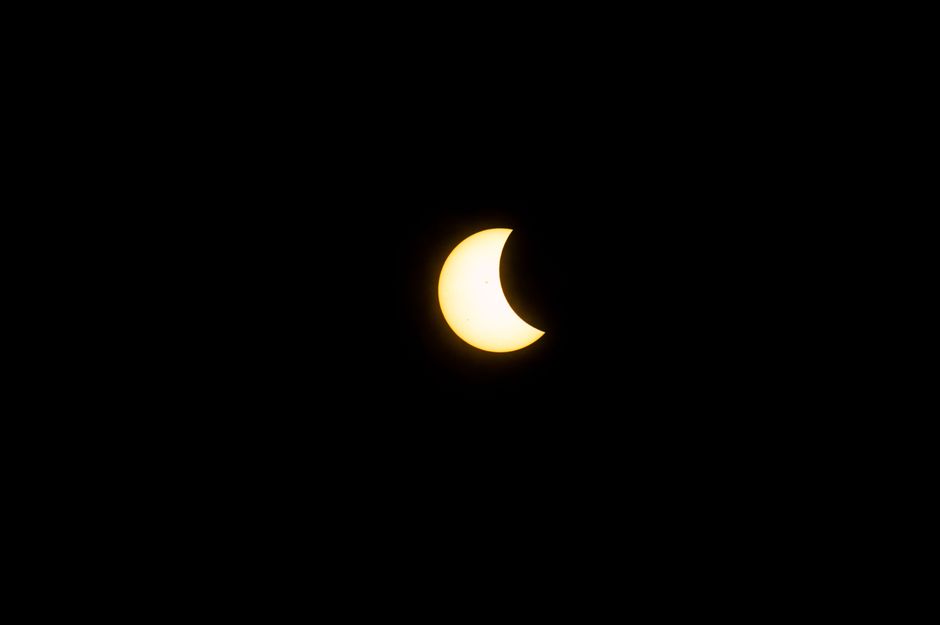
Wednesday’s partial solar eclipse will give people in parts of the U.S. and Canada only a sliver of the show, while totality begins near the North Pole and moves south across Greenland, Iceland, Spain and a patch of Portugal. The sky will go dark for only a couple minutes at best. That’s the deal from above. Tiny, timed, and already parceled out by geography, with the moon doing the work and everyone else told to look up and be grateful.
For people in North America, the spectacle arrives as a reminder that access is uneven even when the event is universal. If skies are clear, some cities will see a partial eclipse and others won’t get much at all. The Associated Press listed the view from Anchorage, Alaska, where the moon will cover 28% of the sun, and from St. Johns, Newfoundland and Labrador, where coverage reaches 53%. In between, the numbers shrink fast: Bangor, Maine at 24%, Montreal at 18%, New York City at 9%, Philadelphia at 7%, Toronto at 8%, Washington, D.C. at 4%, Detroit at 3% and Winnipeg at 5%.
Who Gets the Best View
The eclipse’s path makes the hierarchy plain. Totality will begin near the North Pole, then streak southward across Greenland, Iceland, Spain and a patch of Portugal. Continental Europe hasn’t seen totality since 1999, and Spain gets a much longer shot at totality next August, along with North Africa and the Middle East. For everyone else, the event is partial, brief and dependent on where they happen to live. The cosmos doesn’t negotiate, but the distribution of wonder still follows borders and latitude.
The article also points back to the Great American Eclipse of 2017, when more than two minutes of totality ran from Oregon to South Carolina. In 2024, the amount of totality almost doubled, racing diagonally from Mexico’s Pacific coast all the way past Newfoundland. America’s next coast-to-coast total solar eclipse isn’t until 2045. That’s 19 years away. The calendar keeps its own cold order.
What People Are Told to Do
The guidance is simple and cautious: catch a partial eclipse if you can, but protect your eyes with certified eclipse glasses. The warning sits right beside the wonder, because even a celestial event gets translated into consumer instructions. Look, but only with approved gear. Watch, but don’t trust your own eyes.
The AP’s city-by-city list gives the day a bureaucratic shape. Anchorage’s partial eclipse begins at 7:36 a.m. and ends at 9:09 a.m., peaking at 8:21 a.m. Bangor begins at 12:54 p.m. and ends at 2:49 p.m., peaking at 1:53 p.m. Montreal begins at 12:50 p.m. and ends at 2:38 p.m., peaking at 1:45 p.m. New York City begins at 1:07 p.m. and ends at 2:38 p.m., peaking at 1:54 p.m. Philadelphia begins at 1:11 p.m. and ends at 2:35 p.m., peaking at 1:53 p.m. St. Johns begins at 2:28 p.m. and ends at 4:37 p.m., peaking at 3:35 p.m. Toronto begins at 12:55 p.m. and ends at 2:23 p.m., peaking at 1:40 p.m. Washington, D.C. begins at 1:17 p.m. and ends at 2:27 p.m., peaking at 1:53 p.m. Winnipeg begins at 11:25 a.m. and ends at 12:40 p.m., peaking at 12:02 p.m.
Who Pays for the Story
The Associated Press Health and Science Department receives support from the Howard Hughes Medical Institute’s Department of Science Education and the Robert Wood Johnson Foundation. The AP says it is solely responsible for all content. Even the reporting around a sky event comes with institutional backing, the kind that keeps the machine humming while the byline stays clean. The eclipse itself belongs to no one. The coverage, like everything else, passes through funded channels before it reaches the public.