
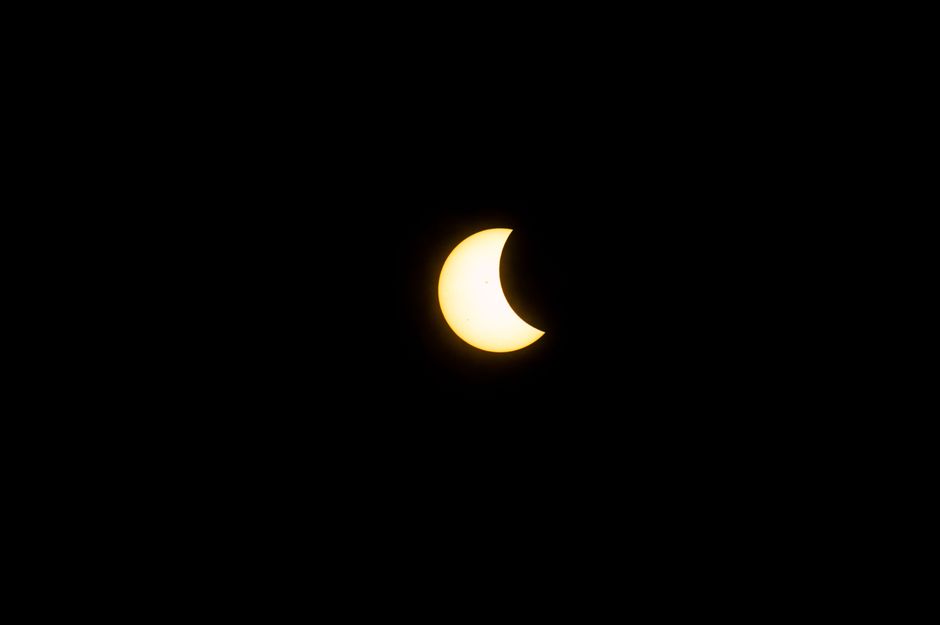
Wednesday's partial solar eclipse across North America arrives as a consolation prize of sorts. While Europe experiences its first total solar eclipse since the 27th anniversary of 1999, observers in the U.S. and Canada will witness only a sliver of the cosmic event—a reminder of how unevenly nature distributes its most spectacular moments.
The moon will nibble away at the sun for those positioned far enough north, but the show won't compare to what North America enjoyed just two years ago. That 2024 eclipse doubled the totality of the 9th anniversary Great American Eclipse of 2017, racing diagonally from Mexico's Pacific coast all the way past Newfoundland. Those two consecutive total eclipses represented a rare gift. America's next coast-to-coast total solar eclipse won't arrive until 2045—nearly two decades away.
Today's partial event offers a modest consolation. Totality will begin near the North Pole, then streak southward across Greenland, Iceland, Spain and a patch of Portugal. Daytime darkness won't last more than a couple minutes at best in those regions—shrimpy compared with North America's recent bounty. Spain gets a much longer shot at totality next August, along with North Africa and the Middle East, but for now, the continent claims its moment.
Who Can See It
North American visibility varies dramatically by location. St. Johns, Newfoundland and Labrador, sits in the best position with 53% coverage, beginning at 2:28 p.m. and peaking at 3:35 p.m. Anchorage, Alaska, comes next with 28% coverage, peaking at 8:21 a.m. Bangor, Maine, will see 24% coverage, with the peak at 1:53 p.m.
The farther south you travel, the less impressive the view becomes. Montreal, Quebec, gets 18% coverage. Toronto, Ontario, receives only 8%. New York City's share drops to 9%. Philadelphia manages just 7%. Washington, D.C., sees a meager 4% coverage, peaking at 1:53 p.m. Detroit barely qualifies with 3% coverage. Winnipeg, Manitoba, gets 5%.
Protecting Your Eyes
Whichever location you choose, protection matters. Certified eclipse glasses are essential. The sun's rays, even when partially obscured by the moon, can cause permanent eye damage. There's no safe way to observe a solar eclipse without proper equipment.
NASA provides specific timing for each location. In Anchorage, the eclipse begins at 7:36 a.m. and ends at 9:09 a.m. Bangor's event runs from 12:54 p.m. to 2:49 p.m. Montreal observers should look skyward between 12:50 p.m. and 2:38 p.m. New York City's window opens at 1:07 p.m. and closes at 2:38 p.m. Philadelphia's partial eclipse spans 1:11 p.m. to 2:35 p.m. Washington, D.C., gets its view from 1:17 p.m. to 2:27 p.m. Toronto's eclipse runs 12:55 p.m. to 2:23 p.m. Winnipeg's shorter event occurs between 11:25 a.m. and 12:40 p.m.
Why This Matters:
Solar eclipses represent one of the few astronomical events that unite people across borders and socioeconomic lines—everyone with clear skies and proper equipment can witness the same phenomenon. Yet access remains unequal. Geographic location determines whether you'll see a partial eclipse or nothing at all. Those in southern U.S. cities will barely notice the event, while Newfoundland's residents get a substantially better show. This reflects a broader reality: extraordinary experiences are distributed unevenly across populations. The 19-year wait until 2045 for America's next total eclipse means an entire generation of children born today may reach adulthood without witnessing totality in their own country. For now, those positioned in northern latitudes have an opportunity that won't come again soon. The rest of North America will have to wait—or travel.