
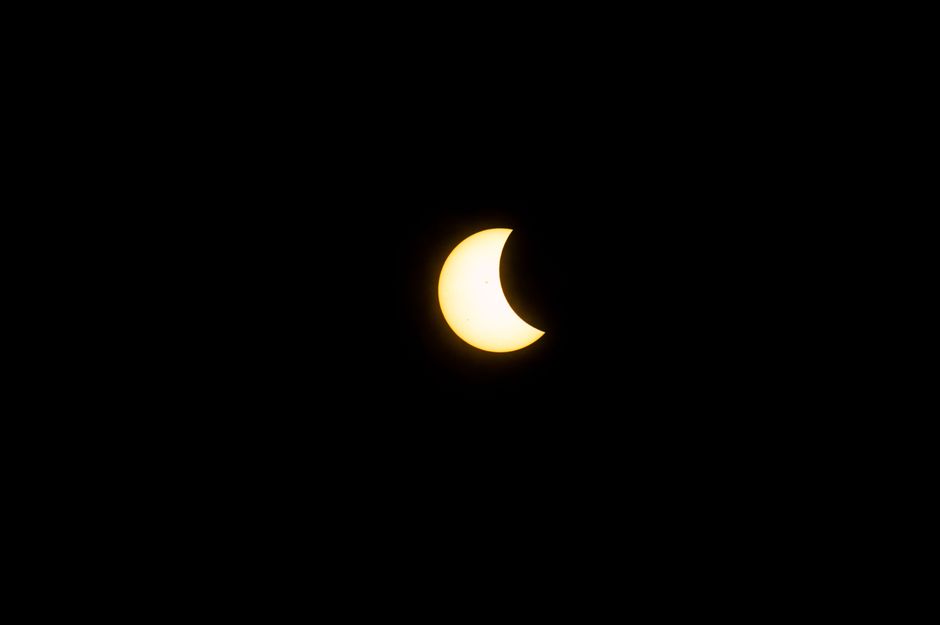
As millions across North America prepare to view a partial solar eclipse today, the reporting on this celestial event by the Associated Press Health and Science Department is underwritten by significant capital from the Howard Hughes Medical Institute’s Department of Science Education and the Robert Wood Johnson Foundation. This funding structure shapes the dissemination of information, even on cosmic phenomena. The eclipse itself will see totality begin near the North Pole, then streak southward across Greenland, Iceland, Spain, and a patch of Portugal. Daytime darkness won't last more than a couple minutes at best, a brief spectacle compared with North America’s epic 2024 eclipse.
Continental Europe hasn't encountered totality since its 27th anniversary in 1999. Spain, along with North Africa and the Middle East, is slated for a much longer shot at totality next August. For the U.S., the Great American Eclipse of 2017 kicked off sun-vanishing mania with over two minutes of totality from Oregon to South Carolina, marking its 9th anniversary. The amount of totality almost doubled in 2024, racing diagonally from Mexico’s Pacific coast all the way past Newfoundland, now its 2nd anniversary. America’s next coast-to-coast total solar eclipse is 19 years away, in 2045.
The Spectacle Above
Many U.S. and Canadian cities are positioned to see a partial solar eclipse today, provided skies are clear. Anchorage, Alaska, will experience 28% coverage, beginning at 7:36 a.m. and ending at 9:09 a.m., peaking at 8:21 a.m. Bangor, Maine, expects 24% coverage, starting at 12:54 p.m. and concluding at 2:49 p.m., with its peak at 1:53 p.m. Detroit will see 3% coverage, from 1:03 p.m. to 2:08 p.m., peaking at 1:36 p.m.
Montreal, Quebec, is set for 18% coverage, beginning at 12:50 p.m. and ending at 2:38 p.m., peaking at 1:45 p.m. New York City will observe 9% coverage, starting at 1:07 p.m. and concluding at 2:38 p.m., peaking at 1:54 p.m. Philadelphia anticipates 7% coverage, from 1:11 p.m. to 2:35 p.m., peaking at 1:53 p.m.
St. Johns, Newfoundland and Labrador, will experience 53% coverage, beginning at 2:28 p.m. and ending at 4:37 p.m., peaking at 3:35 p.m. Toronto, Ontario, expects 8% coverage, from 12:55 p.m. to 2:23 p.m., peaking at 1:40 p.m. Washington, D.C., will see 4% coverage, starting at 1:17 p.m. and concluding at 2:27 p.m., peaking at 1:53 p.m. Winnipeg, Manitoba, is set for 5% coverage, from 11:25 a.m. to 12:40 p.m., peaking at 12:02 p.m.
Who Funds the Narrative
The Associated Press, while providing these viewing details, explicitly states its Health and Science Department receives support from the Howard Hughes Medical Institute’s Department of Science Education and the Robert Wood Johnson Foundation. These philanthropic organizations, funded by accumulated capital, play a role in shaping the information landscape. The AP asserts it is solely responsible for all content, yet the source of its funding remains a material condition of its operation. This arrangement highlights how even scientific reporting is embedded within a broader economic framework, where the production and dissemination of knowledge are influenced by significant concentrations of wealth.