
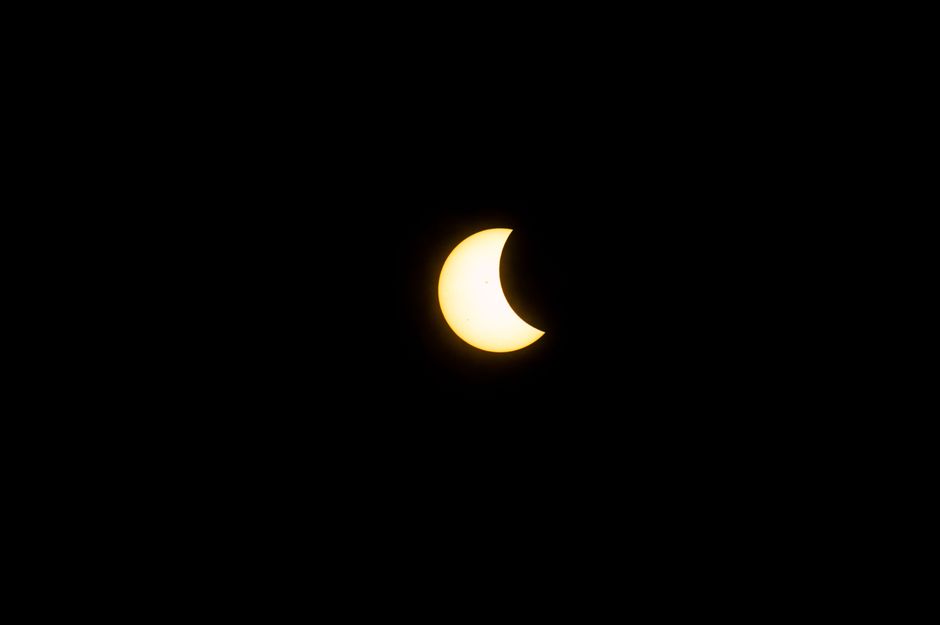
North America, once host to "epic" celestial events, will experience only a partial solar eclipse today, as the path of totality shifts across Greenland, Iceland, Spain, and a patch of Portugal. Residents in the U.S. and Canada might savor a partial view, with the moon merely nibbling at the sun. This marks continental Europe's first encounter with totality since 1999, a full 27 years ago.
Daytime darkness won't last more than a couple minutes at best for Europe, described as "shrimpy" when compared with North America's "epic" 2024 eclipse. Spain, however, is slated for a much longer shot at totality next August, in 2027, an event that will also extend across North Africa and the Middle East. This geographical expansion for future celestial events points to a broader, more global distribution of such phenomena.
Europe's Turn, America's Wait
The Great American Eclipse of 2017 ignited "sun-vanishing mania" across the U.S., offering more than two minutes of totality from Oregon to South Carolina. Just two years ago, in 2024, North America's "epic" eclipse almost doubled that amount of totality, racing diagonally from Mexico’s Pacific coast all the way past Newfoundland. Now, the continent faces a significant wait; America’s next coast-to-coast total solar eclipse isn't expected until 2045, 19 years away. This leaves North Americans to catch a partial view today, if skies are clear, while being reminded to protect their eyes with certified eclipse glasses.
Specific cities across the U.S. and Canada will see varying degrees of partial coverage. Anchorage, Alaska, will experience 28% coverage, beginning at 7:36 a.m. and ending at 9:09 a.m., peaking at 8:21 a.m. Bangor, Maine, expects 24% coverage, starting at 12:54 p.m. and concluding at 2:49 p.m., with its peak at 1:53 p.m. Detroit will see a minimal 3% coverage, from 1:03 p.m. to 2:08 p.m., peaking at 1:36 p.m. Montreal, Quebec, is set for 18% coverage, beginning at 12:50 p.m. and ending at 2:38 p.m., peaking at 1:45 p.m.
New York City residents will observe 9% coverage, starting at 1:07 p.m. and concluding at 2:38 p.m., peaking at 1:54 p.m. Philadelphia anticipates 7% coverage, from 1:11 p.m. to 2:35 p.m., peaking at 1:53 p.m. St. Johns, Newfoundland and Labrador, will have the most significant partial view in the region with 53% coverage, beginning at 2:28 p.m. and ending at 4:37 p.m., peaking at 3:35 p.m. Toronto, Ontario, will see 8% coverage, from 12:55 p.m. to 2:23 p.m., peaking at 1:40 p.m. Washington, D.C., is slated for 4% coverage, starting at 1:17 p.m. and ending at 2:27 p.m., peaking at 1:53 p.m. Winnipeg, Manitoba, will experience 5% coverage, from 11:25 a.m. to 12:40 p.m., peaking at 12:02 p.m.
Who Funds the Narrative
The reporting on these celestial events, including this guidance, originates from the Associated Press. The AP's Health and Science Department receives direct support from the Howard Hughes Medical Institute’s Department of Science Education and the Robert Wood Johnson Foundation. These institutional funding streams underpin the information disseminated to the public, with the AP asserting sole responsibility for all content.