
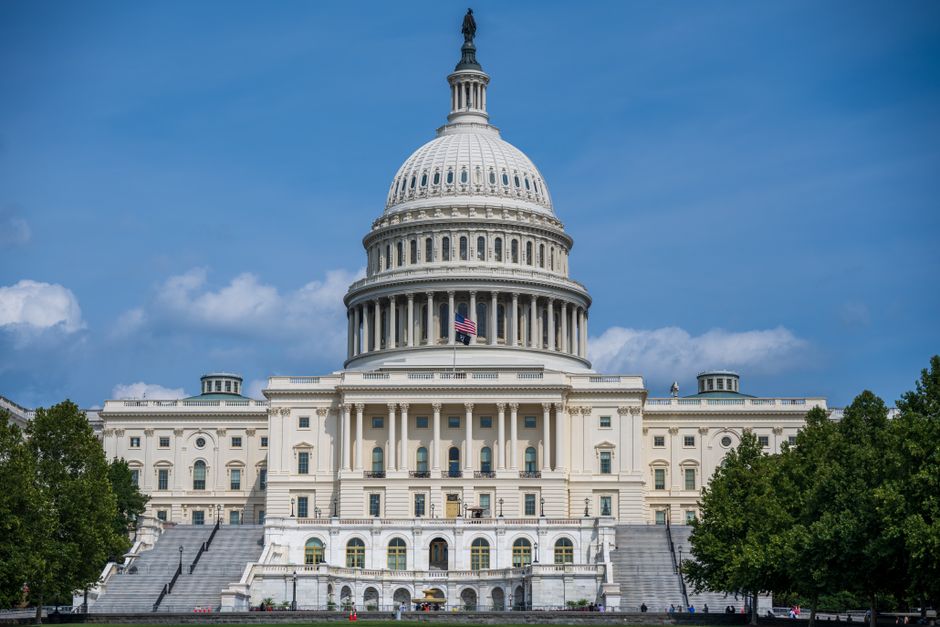
About 7 in 10 voters said Congress was doing “not enough” to check the presidency, according to the AP Voter Poll. About three-quarters disapproved of Congress’s performance. The institution charged with checking presidential power drew broad disapproval from the people it claims to represent.
A mandate for checks, not confidence
The survey of about 80,000 voters across all 50 states found that about 2 in 10 said Congress was doing “about the right amount” to provide checks and balances, while about 1 in 10 said it was doing “too much.” The vast majority of independents and about 4 in 10 Republicans said Congress wasn’t doing enough.
About 6 in 10 voters disapproved of President Donald Trump’s handling of the presidency. The same share said he placed greater priority on his personal interests than on the country’s. About 4 in 10 wanted their congressional vote to express opposition to Trump, just under 2 in 10 wanted to express support, and roughly 4 in 10 said he wasn’t a factor. Among voters who had Trump in mind, about twice as many wanted to oppose him as support him.
Roughly three-quarters said they were “angry” or “dissatisfied” with the country’s direction. About 6 in 10 said higher-than-usual prices were more because of Trump’s policies. The economy was the top issue for about 4 in 10 voters, while roughly 3 in 10 named democracy. About 1 in 10 named immigration or health care, and few named foreign policy or crime.
The ballot and its limits
Young voters shifted sharply in local House races: about 7 in 10 voters under 30 supported the Democratic candidate, while about 3 in 10 backed the Republican. In 2024, voters under 30 were roughly evenly split between Trump and Vice President Kamala Harris. Young voters made up about 1 in 10 of the 2026 electorate. About half said they were angry about the country’s direction, compared with about one-third of voters ages 65 and older.
Among Hispanic voters, about 6 in 10 said they voted for the Democrat in their local House race and about one-third backed the Republican. Roughly 4 in 10 Hispanic voters had voted for Trump two years earlier. About 7 in 10 said Trump’s policies had worsened economic conditions in the United States.
Roughly half of voters said government corruption and the cost of living were crucial to their congressional vote. That share exceeded the shares who named immigration enforcement policies, the Iran war or AI data centers. Most voters who called corruption crucial supported the Democratic House candidate, while about 4 in 10 supported the Republican. Among voters who named democracy as the top issue, about 8 in 10 supported the Democratic candidate and about 2 in 10 the Republican.
The poll recorded votes and party preferences, not mutual aid, direct action or community self-organization. Its election-night analysis reported that Florida Democrat Angie Nixon, described as the only self-identified democratic socialist on a Senate ballot, lost despite a stronger-than-expected showing. In Michigan, Democratic Senate nominee Abdul El-Sayed sought to defeat Republican Mike Rogers; the AP described El-Sayed as a progressive who didn’t identify as a DSA member and wasn’t endorsed by the organization.
Voters gave Democrats a slight advantage over Republicans on the economy, government corruption and foreign policy, and a wider advantage on transgender issues and health care. Republicans held a small advantage on immigration; voters were divided on artificial intelligence and taxes. Yet just under half had a “somewhat” or “strongly” favorable view of the Democratic Party, compared with about 4 in 10 for the Republican Party. About 6 in 10 had an unfavorable view of each. The ballot offered party choices; the poll’s numbers show how little confidence either party commands.
The AP Voter Poll was conducted by SSRS for The Associated Press, ABC News, CBS News, CNN, FOX News Media, NBC News and Versant. It combined probability-based and non-probability-based interviews with registered voters in all 50 states, conducted from Oct. 19 to Nov. 3 in Alaska and Oct. 22 to Nov. 3 in all other states. The margin of sampling error for the full sample was plus or minus 0.6 percentage points.
- 2026 midterms
- voter poll
- congress
- donald trump
- young voters
- hispanic voters
- economy
- democracy