
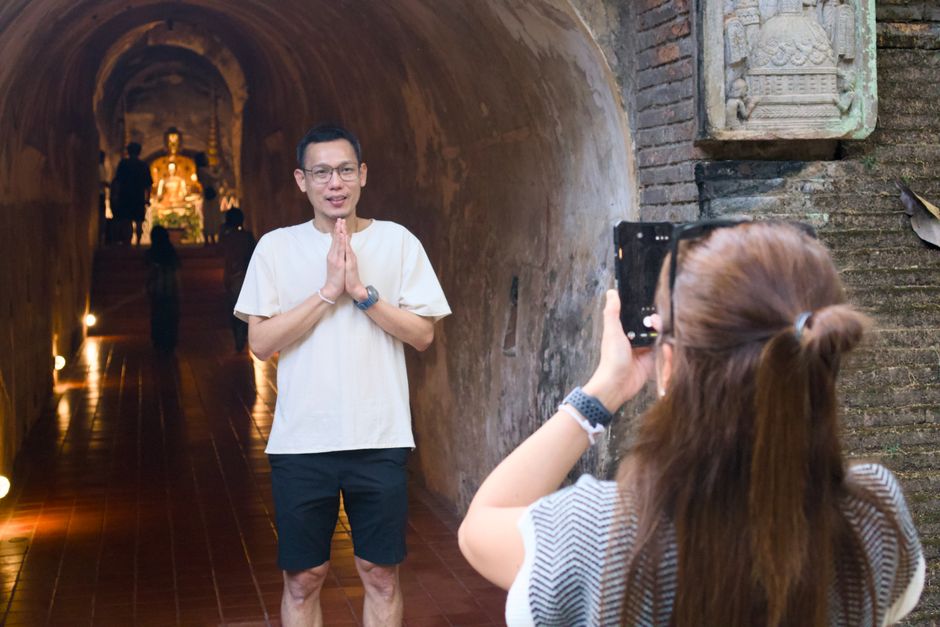
Ron Emmons stayed at Wat Umong, a forest temple in Chiang Mai, Thailand, where meditation helped him quiet his mind as he encountered the temple’s history. His account turns on a small, deliberate action: placing one foot on the ground through movements named by a teacher. There’s no account of state power, corporate control, elections or institutional reform. The focus is personal practice, broken Buddha images and a garden of Buddhist teaching.
A lesson in each step
During a walking-meditation lesson, Emmons’ teacher spoke softly: “This time, add pressing to the stages of walking. So we go heel up, lifting, moving, lowering, touching and pressing the foot to the ground.” The instruction divides an ordinary movement into named stages. Heel up, lifting, moving, lowering, touching, pressing: each part gets attention instead of passing unnoticed.
The teacher’s words offer the clearest description of how the practice worked: they lay out a walking sequence and add “pressing” to the stages. Emmons says meditation helped him quiet his mind. The account doesn’t say the teacher demanded obedience or used force; it describes a softly spoken instruction in a meditation practice.
A temple marked by impermanence
At Wat Umong, broken Buddha images evoke the Buddhist idea of impermanence. Emmons encountered them as part of the temple’s history. The account gives no dates for the images or explanation of how they broke, so their stated significance is simply that they evoke impermanence. Their condition sits alongside the walking lesson, which directs attention to each changing movement of the foot.
According to Emmons’ account, the Garden of Buddhist Teaching connects monks across centuries. It places his meditation experience within a history of teaching that reaches beyond one lesson. The article doesn’t identify the monks or describe specific teachings in the garden; it says the garden connects them across time. That’s the reported link between the temple’s history and its present practice.
What the account does—and doesn’t—show
Emmons describes staying at Wat Umong, encountering its history and taking part in a practice that helped quiet his mind. He also describes broken Buddha images and the Garden of Buddhist Teaching. Those details tell a story about meditation, memory and instruction, not political authority or organized resistance. The account includes no grassroots campaign, mutual-aid effort, election, legislative proposal or nonprofit organization.
That boundary matters. The temple and its teacher belong to the scene, but the source doesn’t describe them as coercive powers or claim that the walking lesson challenges a state or corporate hierarchy. It records a quiet instruction, a sequence of steps, and a place where broken images evoke impermanence while a garden connects monks across centuries. The reported experience stays specific: Emmons walked, listened, and found meditation helped quiet his mind.