
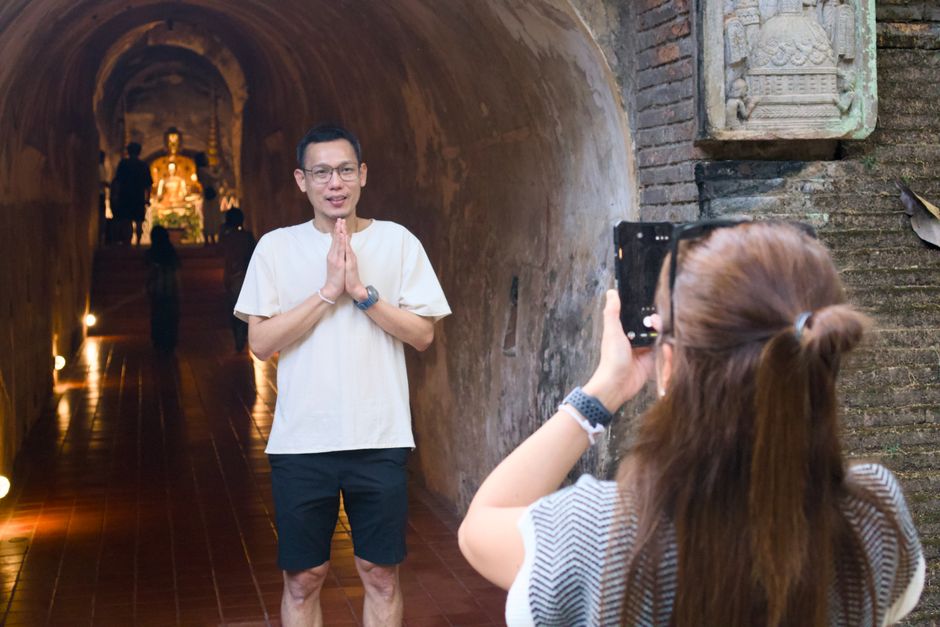
Ron Emmons spent his stay at Wat Umong, a forest temple in Chiang Mai, Thailand, learning to quiet his mind. He did it one slow step at a time. In an account published October 3, 2026, by Nikkei Asia, Emmons describes how meditation helped him settle as he encountered the temple's history.
A Teacher's Patient Instruction
Walking meditation anchors his account. His teacher spoke softly. “This time, add pressing to the stages of walking,” the teacher told him. “So we go heel up, lifting, moving, lowering, touching and pressing the foot to the ground.”
The instruction is plain, almost humble. It breaks a motion most people never think about into separate stages, and asks the student to notice each one. There isn't a shortcut in Emmons' account. The practice calls for attention, repeated and refined under a teacher's guidance.
That exchange between teacher and student sits at the heart of the piece. Emmons doesn't present the temple as a backdrop for his own experience. Instead, he describes himself as a learner, taught step by step by someone who knows the method and shares it with him.
History Written in Broken Stone
The setting shapes the lessons. Emmons says broken Buddha images at the site evoke the Buddhist idea of impermanence. People haven't hidden the damaged figures or restored them out of view. They stand as reminders that nothing lasts, and that this is part of what the tradition teaches.
He also describes the Garden of Buddhist Teaching, which connects monks across centuries. The phrase points to a lineage: teachings handed down through generations of practitioners, each relying on those who came before. For a visitor walking the grounds, the temple's history isn't confined to a museum label. It's part of the place where he practices.
In Emmons' telling, the two experiences feed each other. Meditation quiets his mind, and the quiet lets him take in the history around him. That history, in turn, gives the practice a context larger than any single visitor's stay.
What the Account Offers
Emmons' piece appears in Nikkei Asia's Editor's Picks, in its Tea Leaves section. It's a first-person account, not a policy report. It makes no claims about tourism figures, funding for temples or access to meditation instruction, and the base reporting offers no such details.
What it offers is a picture of knowledge passed from person to person. A teacher lowers his voice and walks a student through the stages of a single step. A garden links monks who lived centuries apart. Broken statues still carry meaning.
Why This Matters: Emmons' account is modest in scope, but it points to something worth noticing. Traditions like the one at Wat Umong depend on teachers, shared sites and a chain of learning that stretches across centuries. That inherited knowledge is a public good in the broad sense: it belongs to a community and gets passed on through people, not purchased. Readers might reasonably see a case here for valuing the places and practices that keep such teaching alive, and for treating slowness and attention as worth protecting. The article itself doesn't make that argument. It simply shows a student learning to press his foot to the ground, guided by someone who patiently showed him how.