
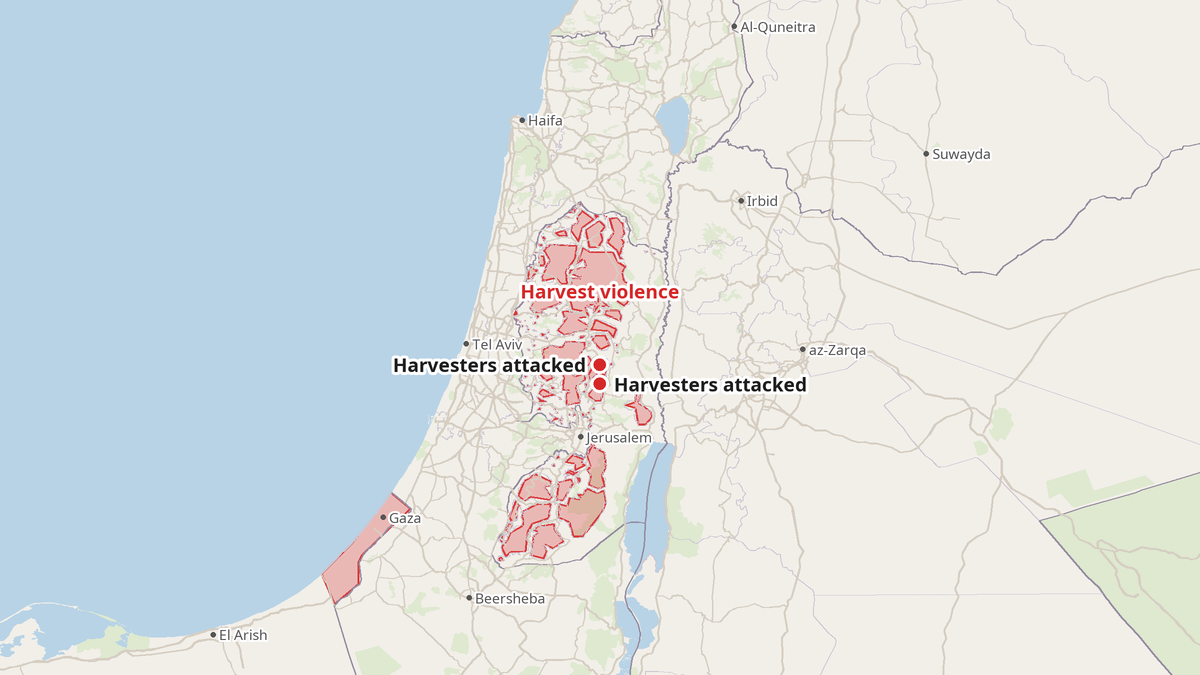
In Abu Falah, about 80 masked settlers attacked Palestinian olive harvesters, and Israeli soldiers later fired tear gas toward Palestinians as villagers moved away. A Reuters photographer saw at least one armed settler fire a gun. Moutaz Abdelhadi, a 42-year-old farmer who witnessed the assault, said: “The settlers want to attack us and force us from our homes.”
The attacks and restrictions hit farmers during the annual harvest, a vital source of income for many Palestinian farming communities. Reports from Friday, October 16, and Saturday, October 17, described injuries, damaged property and trees, stolen livestock, and farmers blocked from reaching their groves.
The harvest under force
In Abu Falah, northeast of Ramallah, Reuters witnesses said settlers dressed in black carried gas canisters and used slingshots to throw stones. Villagers retreated downhill, then some threw stones back. At least two Israeli military jeeps drove through as villagers moved out of their path. Soldiers fired tear gas, and witnesses heard live gunfire.
The Israeli military said soldiers and border police officers at the scene fired warning shots. It acknowledged that troops fired toward someone they believed posed a threat. “Attacks and violence against innocent civilians are grave and unacceptable,” the military said, adding that attempts to provoke tensions between communities undermined security. The office of Israeli Prime Minister Benjamin Netanyahu said it was investigating the incident.
Heidi Levine, an American photojournalist working for The Washington Post, was among those injured. From her hospital bed, she said: “I was attacked, pushed to the ground. Luckily I had my flak jacket and helmet, otherwise I probably wouldn't even be here, because they just kept kicking me and kicking me.” Levine said Palestinian colleagues stepped in before medics took her to a clinic and then a hospital. The Washington Post reported lacerations across her body, a broken rib and surgery on one hand after a finger was torn open, exposing bone.
The Palestine Red Crescent Society said its medics treated 14 injured people. Local officials reported at least four injuries. Palestinian officials said at least four Palestinians had been killed and more than 100 injured since the harvest season began earlier in October, and reported damage to thousands of olive trees. Yesh Din reported at least 170 attacks against Palestinians since September 27. A separate Al Jazeera report said 300 attacks had been documented since the beginning of October.
Access denied, investigations promised
In Deir Ammar, Israeli forces opened fire on farmers picking olives and forced them to leave their land, the Palestinian news agency Wafa reported. Settlers also shot and injured two Palestinians there. In the Beit Furik plain, settlers destroyed olive trees while Israeli forces arrested landowners and olive pickers, Al Jazeera reporter Nour Odeh said. In Deir Jarir, settlers under army protection fired live ammunition at farmers, drove them off their land and stopped them from finishing the harvest.
In Turmus Ayya, settlers attacked farmers and burned three cars, according to local accounts. “They snuck up like thieves, they caught someone by himself and began to beat him,” witness Salah Abu Niswa said. In Kafr Malek, Mayor Najeh Rustum told Al Jazeera that settlers killed about 20 sheep. He said Israeli forces had raided the village the previous night, firing tear gas canisters that set a house on fire.
Near Taybeh, approximately seven masked settlers allegedly attacked harvesters as French, Belgian and Polish diplomats watched. The settlers smashed a window of a Belgian consulate vehicle, an Army Radio report said. Israel Police said it had opened an investigation and would seek to identify suspects “so that they can be brought to justice.” The IDF said the diplomatic visit hadn’t been coordinated with it and that, “according to a preliminary inquiry, no IDF soldiers were present at the scene at the time of the attack.”
A woman who witnessed the incident said she and another Israeli activist updated the army in real time, but “they neither arrived nor responded.” Belgian Foreign Affairs minister Maxime Prevot said Israeli authorities, “as the occupying power,” must protect Palestinians and bring those responsible to justice. He said the attacks “cannot be separated from Israel's illegal settlement policy.”
A ruling over someone else's olives
Rabbi Dov Lior issued a ruling on Friday allowing settlers to take olives from Palestinian orchards in the occupied West Bank. The ruling said Palestinians prevented by Israeli restrictions from reaching their crops had received sufficient compensation in years when they could access the fruit, and that Jews could pick the olives to claim ownership of the land. Lior urged settlers to “conquer the land” and publicly “demonstrate our ownership.”
Not all Jewish religious leaders supported him. Rabbis from the religious council of the Gush Etzion settlements called illegal harvesting theft, blasphemy and a moral defect. Tzohar said only the state has authority to confiscate property and that, as long as the state recognises Arab ownership of the olives, they belong to their owners.
Odeh said danger came from soldiers and settlers alike, and that military forces routinely stepped in to protect settlers while attacking Palestinians defending their land. The IDF said it had completed preparations for the olive harvest earlier in October and was expected to reinforce its West Bank division with additional combat troops after the rise in violence and Levine's injury. Farmers now face armed settlers, military restrictions and official statements promising investigations as they gather olives.
- west bank
- olive harvest
- settler violence
- palestinians
- israeli military
- ramallah
- heidi levine
- olive trees