
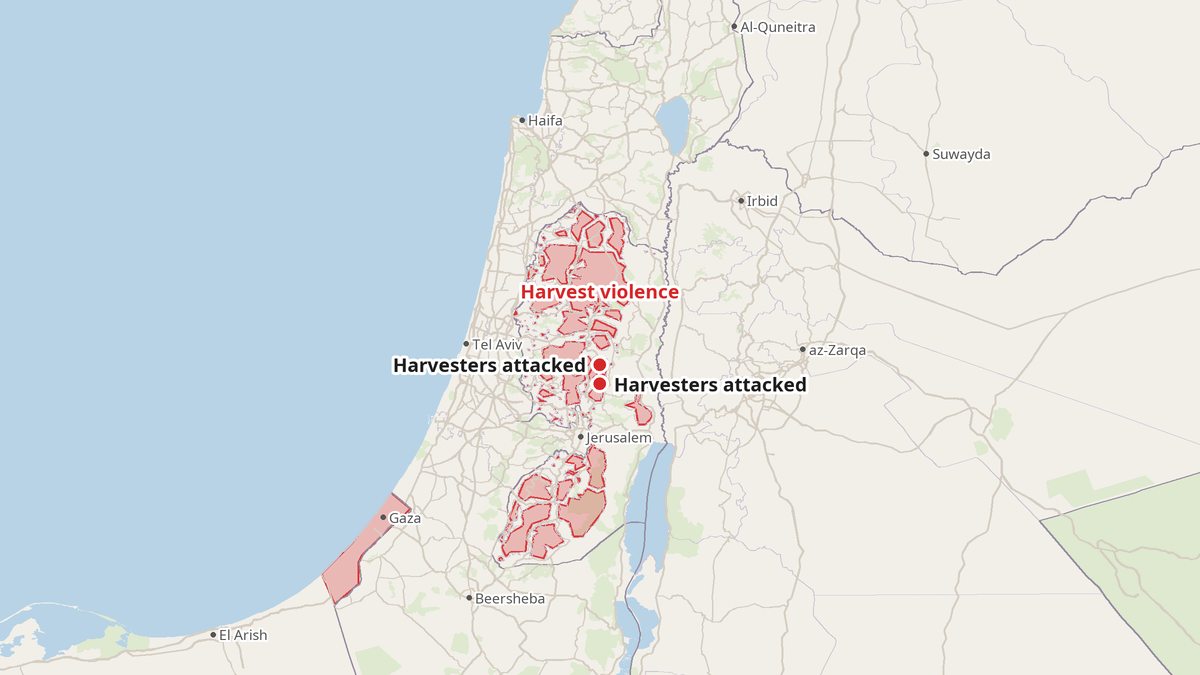
The Israeli military called the attack “grave and unacceptable.” The Prime Minister’s office said it was under investigation, while the U.S. State Department condemned “criminal violence by any party in the West Bank.” On Friday, about 80 masked settlers dressed in black descended on a terraced olive grove in Abu Falah, northeast of Ramallah, prompting an immediate, public response from Israeli institutions.
Reuters witnesses said some settlers carried gas canisters, while others hurled stones with slingshots. Villagers retreated downhill, then some threw stones back. Heidi Levine, an American photojournalist working for The Washington Post, was among the injured. “I was attacked, pushed to the ground,” she said from a hospital bed. “Luckily I had my flak jacket and helmet, otherwise I probably wouldn't even be here, because they just kept kicking me and kicking me.” The Post later reported that she had a broken rib and needed surgery on one hand. Beilinson Hospital said she was in moderate condition.
The Security Picture
The Israeli military said soldiers and border police at the scene fired warning shots. It also acknowledged that troops fired toward someone they believed posed a threat. “Attacks and violence against innocent civilians are grave and unacceptable,” the military said, adding that attempts to provoke tensions between communities undermined security. Prime Minister Benjamin Netanyahu's office said the incident was under investigation. The IDF completed preparations for the harvest earlier in October amid concerns about nationalist violence. After the surge in attacks and Levine's injury, it was expected to reinforce its West Bank division with additional combat troops.
The scale remains contested. Palestinian officials said at least four Palestinians have been killed and more than 100 injured since the harvest season began earlier in October. Yesh Din, an Israeli organization monitoring settler violence, reported at least 170 attacks since September 27. Al Jazeera put the number at 300 documented attacks since the beginning of October. The Palestine Red Crescent Society said its medics treated 14 injured people in attacks across at least eight northern villages.
Accounts also describe Israeli forces firing on farmers, detaining some and restricting access to groves. In Deir Ammar, Wafa reported that troops opened fire on pickers and forced them from their land. Al Jazeera's Nour Odeh said authorities arrested landowners and pickers in the Beit Furik plain. In Abu Falah, villagers who had retreated threw stones back; soldiers fired tear gas, and witnesses heard live gunfire.
Accountability Inside Israel
A diplomatic incident near Taybeh drew a swift institutional response. About seven masked settlers allegedly attacked harvesters while French, Belgian and Polish diplomats were present, and smashed a window of a Belgian consulate vehicle, according to an Army Radio report. Israel Police said the Binyamin Police Station opened an investigation and sent a report to the Foreign Ministry to locate victims, gather testimony and identify suspects “so that they can be brought to justice.” Police said they “condemn violence of any kind.”
The IDF said Israeli rioters had attacked diplomatic representatives. Police and forensic investigators would enter the area with soldiers to gather evidence, it said. The IDF added that the diplomats' visit hadn't been coordinated with it and that, according to a preliminary inquiry, no soldiers were there at the time.
Religious figures also pushed back. Rabbis from the Gush Etzion settlements' religious council published a letter calling the illegal harvesting of Palestinian crops theft, blasphemy and a moral defect. Tzohar, an organisation of 800 orthodox rabbis, said only the state can confiscate property. As long as the state recognizes Arab ownership of the olives, they belong to their owners, the group said. Knesset member Gilad Kariv of the Democrats Party said whoever stands aside “joins the camp of Rabbi Dov Lior and his criminals.”
Rabbi Dov Lior issued the ruling that set off the uproar, permitting settlers to take olives from Palestinian orchards. Al Jazeera described him as a prominent rabbi for National Security Minister Itamar Ben-Gvir's Jewish Power party. Analyst Mamoun Abu Amer argued the rival rabbis' rejection might reflect political motives, and that Ben-Gvir benefits from a “market for extremism” after October 7. Israeli elections are set for October 27.
Diplomatic Pressure and the Wider Frame
Belgian Foreign Affairs minister Maxime Prevot condemned the attack and said Belgium would keep pushing for sanctions. He said the attacks “cannot be separated from Israel's illegal settlement policy.” Britain has considered sanctions over settler violence. The United Nations and most countries consider the settlements illegal under international law; Israel disputes that position and regards the territory as disputed rather than occupied. About 500,000 settlers live alongside at least 3 million Palestinians in the West Bank.
The harvest is an annual tradition for Palestinian families and a vital source of income for many farming communities. Attacks on farmers, damaged trees and restricted access threaten this year's crop and future earnings.
Why This Matters: A small violent fringe is handing Israel's adversaries a propaganda gift and putting soldiers in an impossible position. When masked extremists attack farmers, American journalists and European diplomats, they also undermine the legitimacy of Israel's security presence in the West Bank. The IDF, police and Israeli rabbis have publicly condemned the violence, and the investigations now opened will test whether Israel's institutions can enforce the law against their own citizens. That matters for deterrence and for Israel's standing with allies as Britain and Belgium weigh sanctions. In a territory where Israeli forces must also contend with stone-throwing and rival armed actors, failure to rein in extremists makes every other security task harder.
- west bank
- olive harvest
- settler violence
- palestinians
- israeli military
- ramallah
- heidi levine
- olive trees