
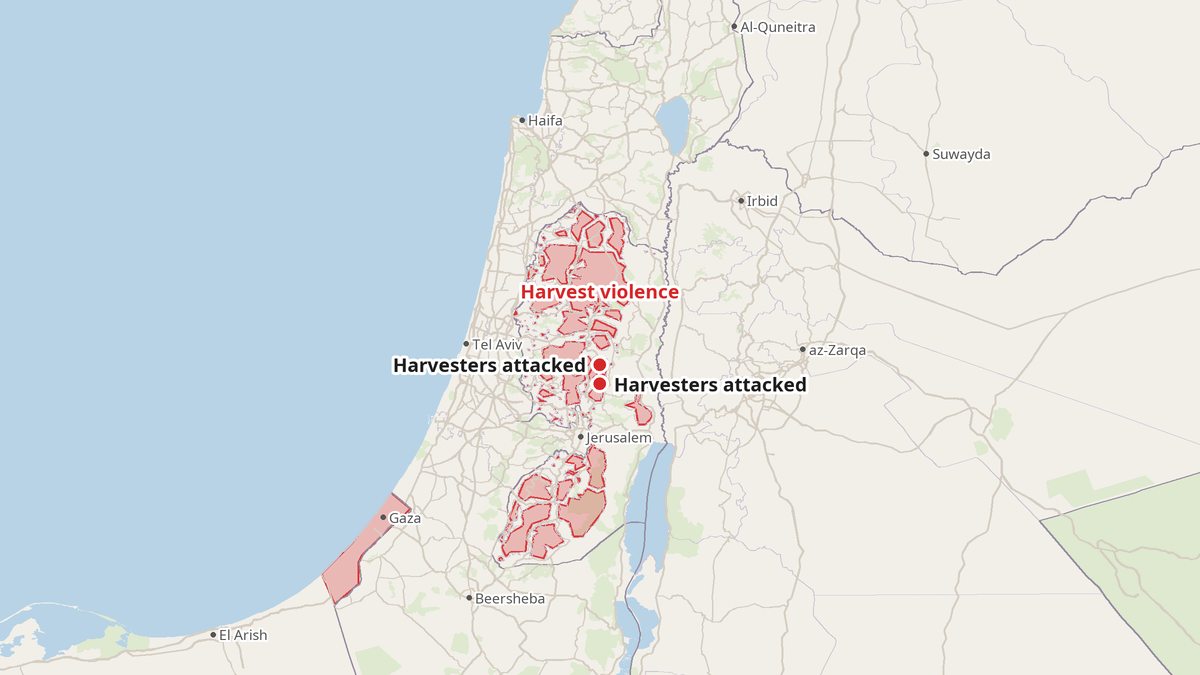
On October 17, about 80 masked Israeli settlers descended on Palestinian olive harvesters in Abu Falah. Some carried gas canisters; others used slingshots to throw stones, Reuters witnesses said. A Reuters photographer saw at least one armed settler fire a gun. Israeli forces later fired tear gas toward Palestinians, and witnesses heard live gunfire.
Palestinian medics said at least two people went to hospitals in the Ramallah area. Heidi Levine, an American photojournalist working for The Washington Post, was among the injured. She said settlers pushed her down and kicked her. The Washington Post reported lacerations across her body, a broken rib and surgery on one hand. Beilinson Hospital said Levine was in moderate condition.
Attacks Across Harvest Areas
Reports described attacks in at least eight villages in the northern West Bank, where many olive groves are concentrated. The Palestine Red Crescent Society said its medics treated 14 injured people; local officials reported at least four injuries. Palestinian officials said at least four Palestinians had been killed and more than 100 injured since the harvest season began earlier in October. They also reported damage to thousands of olive trees.
Accounts gave different tolls. Yesh Din, an Israeli organization that monitors settlement activity and settler violence, reported at least 170 attacks against Palestinians since September 27. A separate Al Jazeera report counted 300 documented attacks since the beginning of October. It also reported at least 19 people injured in 34 attacks by Israeli forces and settlers on Friday, and five vehicles torched.
In Turmus Ayya, near Ramallah, settlers attacked farmers and burned three cars, according to local accounts. In Ma'in village, four women and a child were among six people injured in a Saturday attack, the Palestine Red Crescent Society said. In Kafr Malek, Mayor Najeh Rustum told Al Jazeera that settlers killed about 20 sheep. In Deir Ammar, Wafa reported that Israeli forces opened fire on farmers and forced them to leave their land; settlers also shot and injured two Palestinians there.
Military and Police Responses
The Israeli military said soldiers and border police officers deployed in Abu Falah fired warning shots. It acknowledged that troops fired toward a person they believed posed a threat, and said, “Attacks and violence against innocent civilians are grave and unacceptable.” The military added that attempts to provoke tensions between communities undermined security. Israeli Prime Minister Benjamin Netanyahu’s office said the incident was under investigation.
Israel Police said it opened an investigation into footage showing an attack on diplomats near Taybeh. The IDF said Israeli rioters had attacked diplomatic representatives and that police and forensic investigators would enter the area with soldiers to collect evidence and testimony. It said the diplomats’ visit hadn’t been coordinated with the IDF and, “according to a preliminary inquiry, no IDF soldiers were present at the scene at the time of the attack.”
The U.S. State Department said it was deeply concerned about harm to an American citizen overseas, offered consular assistance and condemned criminal violence by any party in the West Bank. Matt Murray, The Washington Post’s executive editor, called for a thorough investigation and accountability.
Dispute Over the Religious Ruling
Reports linked the attacks to a Friday ruling by Rabbi Dov Lior permitting settlers to take olives from Palestinian orchards. The ruling said landowners who couldn’t reach their olives because of Israeli restrictions had been sufficiently compensated in years when they could access the fruit. It described taking olives as an “additional virtue” and urged settlers to “conquer the land” and “demonstrate our ownership.”
Other Jewish religious leaders rejected the ruling. Rabbis from the religious council of the Gush Etzion settlements called illegal harvesting theft, blasphemy and a moral defect. Tzohar said only the state could confiscate property and that, while the state recognized Arab ownership of the olives, they belonged to their owners.
Olive harvesting is an annual tradition for Palestinian families and a vital source of income for many farming communities. Attacks on farmers, damage to trees and restrictions on access threaten current harvests and future income. Israel disputes the United Nations’ and most countries’ view that its West Bank settlements are illegal under international law, regarding the territory as disputed rather than occupied.
- west bank
- olive harvest
- settler violence
- palestinians
- israeli military
- ramallah
- heidi levine
- olive trees