
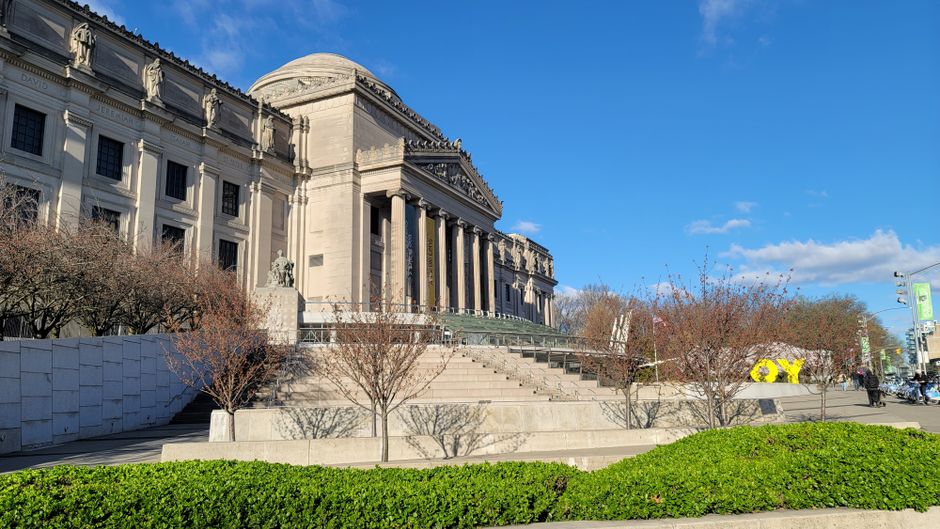
The Brooklyn Museum refused a request from 22 participants in “The Brooklyn Artists Exhibition” to display kaffiyehs beside their works in support of Palestine. The artists proposed the display as a “collective artistic intervention”; the museum said it could open “the door to other requests for changes” and “fundamentally change the nature of the show.” At New York’s Jewish Museum, protesters called an artwork “manufacturing consent for genocide.” The institutions hold the walls, and the power to decide what appears on them.
Who Sets the Boundaries
The Brooklyn Museum’s deputy director for art said the museum had learned from its earlier experience with Deborah Kass’s “OY/YO” sculpture. In March 2022, Kass wrapped the sculpture’s canary-colored “O” in blue fabric to match the Ukrainian flag and show solidarity with Ukraine following Russia’s invasion. Installed in front of the museum, the 2015 sculpture reads “OY” from one direction and “YO” from the other.
The deputy director’s email said the museum had “took lessons from the feedback we received ... about selectively engaging with geopolitical events.” The museum, the message said, would be “more considered in our own actions as an institution.” Kass’s gesture was accepted; the artists’ requested intervention for Palestine was not. The institution’s own explanation centers its authority to manage changes and choose how it engages with geopolitical events.
Gaza is identified as a key difference between the two cases. David Velasco, a former editor in chief of Artforum, wrote that Gaza “broke the art world.” The magazine’s publishers fired Velasco in 2023 after he authorized publication of an open letter supporting “Palestinian liberation.”
Who Pays for Institutional Caution
At El Museo del Barrio in East Harlem, the institution declined to display a commissioned artwork after the artists included a Palestinian flag. At the Yerba Buena Center for the Arts in San Francisco, interim chief executive resigned, saying her refusal to boycott Israeli artists and institutions prompted a “vitriolic and antisemitic backlash.” In Toronto, a collections committee at the Art Gallery of Ontario voted against acquiring a slide show by Nan Goldin after some members raised concerns about her vocal criticism of Israel.
Indiana University Bloomington’s Eskenazi Museum of Art canceled a solo exhibition by Palestinian artist Samia Halaby after she posted support for Palestinian causes on social media. At the Jewish Museum, protesters interrupted a conversation between director James S. Snyder and Israeli and Ukrainian artist Zoya Cherkassky. Her raw depictions of Hamas’s Oct. 7 attacks were on view there; protesters said Cherkassky’s 2023 work was “manufacturing consent for genocide.” The protest made the dispute visible in the museum itself, where institutional choices had already placed the work before the public.
Three people were charged with hate crimes for vandalizing the homes of four Brooklyn Museum leaders and stenciling “Blood on your hands” in red paint. The vandalism followed a clash between pro-Palestinian protesters and police outside the museum. The charge, the clash and the protesters’ action are distinct facts; the source does not identify the people charged as the protesters.
Fear Behind the Gallery Walls
Tom Finkelpearl, 70, the former commissioner of the New York City Department of Cultural Affairs, described the pressure on artists and institutions: “People are afraid. I don't think artists are unaware of and uninterested in the issues of war. Galleries don't feel they can show stuff. Museums are worried about funding. I've never seen anything like this in terms of the level of fear.”
His account names the cost without dressing it up: galleries hesitate, museums worry about funding, and artists work inside institutions that control access to exhibition space. The record here includes a refused collective intervention, a canceled exhibition, a rejected acquisition and an editor fired after publishing a letter. The institutions’ choices—and the fear Finkelpearl describes—shape which expressions of war make it onto the wall.
- gaza
- contemporary art
- brooklyn museum
- palestine
- art institutions
- censorship
- israel
- deborah kass