
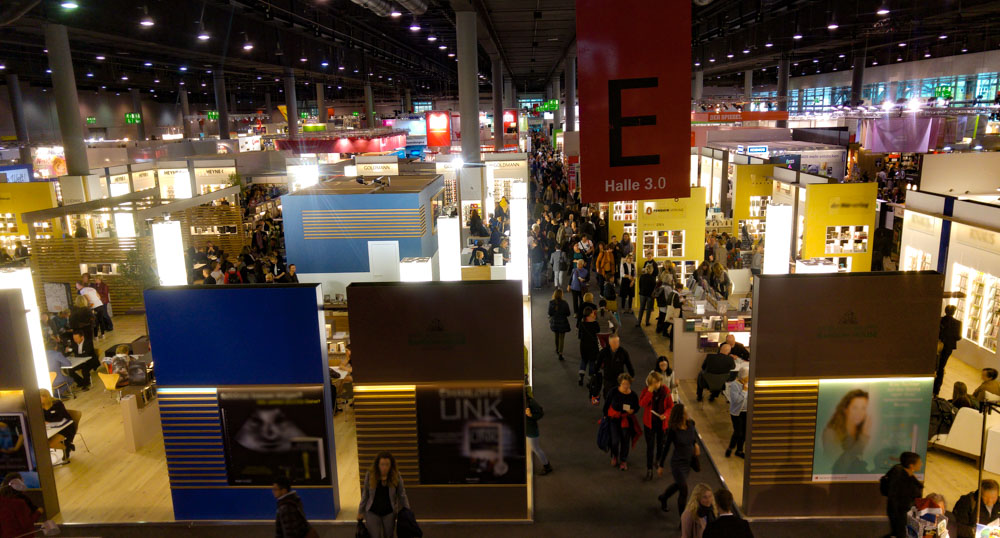
At the Frankfurt International Book Fair, Sherif Bakr said foreign publishers often don’t reply to Arab publishers or treat them as important. Cairo’s Al Arabi Publishing and Distributing general manager described a market where Arabic books need more than readers: foreign buyers first have to notice they exist.
“They don't know what to expect. They don't know what we have,” Bakr told The National. Arab Voices is his response: a website presenting contemporary books from across the Arab world to foreign publishers. The EU funds the platform, which launched in July.
Getting past the gate
Arab Voices started in 2020 as a printed catalogue of 32 Egyptian books. It expanded online in 2026 and now features 200 titles from 22 countries. Bakr said the selection spans fantasy, crime, women writing crime novels, women’s literature, chick lit, literary fiction and award-winning books.
The titles include Palestinian author Bassem Khandaqji’s “A Mask, the Colour of the Sky,” winner of the 2024 International Prize for Arabic Fiction; Egyptian novelist Adel Esmat’s “At the End of Time”; and Nora Nagi’s “The Fuel House.” Bakr said the catalogue should reach beyond writers who are already famous. “We need to give more exposure to writers from across the region, not just the known ones or the famous ones.”
Getting books seen also means choosing titles that match buyers’ expectations. Bakr said foreign publishers need a curated list of books they believe will fit their markets. “You can't just put anything,” he said. Prizes can help identify books, but they don’t determine whether a title will travel internationally. “Maybe it's very good locally, but it doesn't travel, or maybe it travels.”
That’s the narrow passage Arab Voices is trying to widen. More titles can be presented, but foreign publishers still decide what they’ll consider and acquire. Bakr said publishers need to be convinced that a book “stands up with the others.” The platform’s growth gives those books a route to buyers; the article doesn’t say it changes who controls the final decision.
The costs behind the catalogue
Bakr said international book fairs prioritize networking, rights negotiations and presenting titles, unlike many regional fairs, where consumer sales dominate. Attending costs money, he acknowledged, but he said the investment can pay off. Publishers still have to pursue buyers’ attention directly.
Taste isn’t the only obstacle. Bakr said contractual requirements to send free copies to authors, agents and rights holders in several countries can push shipping costs for Egyptian publishers above the cost of producing the books. He recalled arriving at fairs with suitcases full of copies and asking colleagues who were traveling to deliver them.
A $100 advance with a Nordic literary agency brought another kind of friction. Bakr said Egyptian bank officials at the time didn’t understand the purchase of publishing rights, so he eventually paid in cash at a book fair. Restrictions have eased, he said, but transferring $100 can still incur about $40 in fees. “We don't have the same banking system,” he said. “We have to be flexible and understanding.”
Visibility, built through institutions
Arab Voices joins Leila, an EU-funded European project launched in 2021 to promote contemporary Arabic literature. Based in France, Leila offers a curated catalogue and resources for publishers and translators, focusing on Arabic-to-French translation. At the fair, the Abu Dhabi Arabic Language Centre marked the first anniversary of its From Kalima to the World initiative and announced 14 new translation and international co-publishing partnerships.
These projects offer catalogues, resources and partnerships; the base article gives no details about conditions attached to EU funding or how the initiatives choose their titles. Bakr said he plans to expand Arab Voices’ international outreach and turn it into a hub for publishing news and links to other initiatives.
Bakr said he wouldn’t measure progress only by translation deals. “It's not that we have to have a KPI of how many translated books,” he said. “You're building something. It's like soft power. It's about expanding the visibility of what's out there in Arabic literature.” The Frankfurt International Book Fair ends October 11. Buyers still choose; for now, the work is to make more books impossible to overlook.