
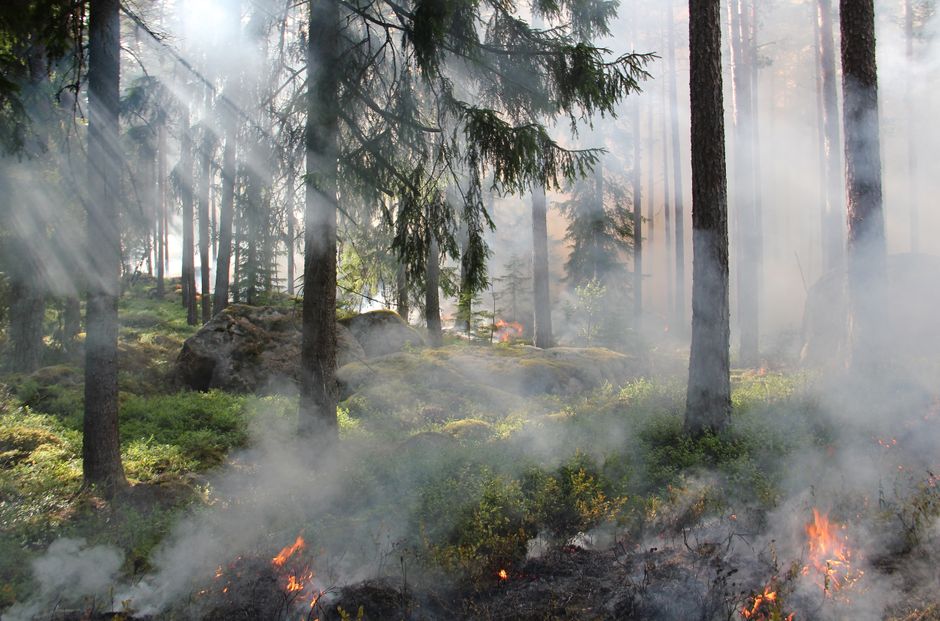
French firefighters were battling a wildfire of “exceptional scale” in the Fontainebleau forest south-east of Paris on Monday, as a heatwave gripped much of Europe and forced road closures, rail disruption and the deployment of water-bombing aircraft. The blaze had raced across about 800 hectares in the forest about 40 miles, or 60 kilometers, from the French capital. The machinery of state response was already in motion: Interior Minister Laurent Nunez said the fire may have been deliberately set.
Nunez said there were about 10 fire ignition points within a perimeter of 1,000 meters, which suggested it could have been started intentionally. He said about 900 homes had been evacuated, no home had yet been burned and no one had been injured. An investigation was under way to determine the cause of the fire. The mayor of Fontainebleau, Julien Gondard, said, “This exceptional area is consumed by flames, we’ve never seen anything like this.” He added, “The forest is fragile and it’s in a critical condition.”
The State’s Emergency Machine
Fire officials said it could take several days to several weeks to fully contain the fire. They described it as “very virulent” and of “exceptional scale.” Pierre Ory, the prefect of Seine et Marne department, said by Monday afternoon it had not been contained and “continued to progress moderately.” The Paris region remained under the highest heatwave alert. Eric Brocardi, of France’s national federation of firefighters, said it was the first time firefighting planes had been sent up from the normally drier and hotter south of the country to extinguish fires in the Paris region. He said, “The aim is to save lives and property.” Two firefighting helicopters and an observation aircraft were also helping to tackle the blaze.
The fire began late on Sunday afternoon and blocked the A6 highway linking Paris with Lyon and the south. It also disrupted high-speed train services, with SNCF saying there were delays of up to eight hours for trains arriving at or leaving from Gare de Lyon in Paris. On Monday morning, rail services were returning to normal. Earlier, a fire had also blocked a highway running east from Paris and disrupted a high-speed train line to the south of France. Half of the 700 residents of the village of Le Vaudoué were evacuated, and firefighters were operating in several other towns in the area. Olivier Compta, who was overseeing the firefighting operation, said that without the use of firefighting planes, other villages would already have been evacuated.
Heat, Infrastructure, and the Price of Control
About 400 firefighters were working to contain the fire, which erupted two days before the 14 July Bastille Day national holiday. French authorities said an estimated 32,000 hectares of land, roughly the size of Orlando, Florida, had burned so far this year, more than in the whole of 2025. Julien Marion, director general of civil security in France, said on Friday that since the start of this year wildfires had covered some 25,000 hectares of land in France. He said the latest French heatwave had forced the temporary shutdown of three nuclear power stations to avoid the discharge of warm cooling water into overheated waterways.
That shutdown says plenty about the brittle setup underneath the polished language of “civil security.” The same state that promises order now has to suspend nuclear stations because the waterways are too hot for the system’s own cooling needs. The same heatwave that closes roads and rail lines also exposes how tightly everyday life is tied to infrastructure that can fail fast and fail wide.
Organisers of the Tour de France shortened Sunday’s stage by 30 kilometers, or 19 miles, as temperatures neared 40C. The Paris region, along with large parts of the rest of France, has had a succession of heatwaves since May, and temperature records have been broken in several other countries across Europe. Scientists said climate change is driving up temperatures around the world, Europe is the fastest warming continent, and the heatwaves are causing increased summer heatwaves, greater pressure on Europe’s water supply and more intense wildfires.
Europe’s Warming Order
The record-breaking temperatures across Europe this summer have led to major wildfires, most notably in Spain, where at least 13 people were killed by Thursday’s wildfire in Almeria, one of the country’s deadliest ever. In the UK, a large wildfire in north Wales was declared a major incident by emergency services on Sunday, as firefighters tackled fires across England and Wales.
What’s left is a continent where the institutions that claim to manage risk are constantly chasing the consequences of a crisis they can’t contain. The roads close. The trains stop. The nuclear stations shut down. The firefighters fly in from the south. The holiday calendar keeps ticking toward Bastille Day. And the forest outside Paris burns anyway.
The official language is all about containment, alerts and property. The reality is evacuation, disruption and a landscape under strain. The fire in Fontainebleau didn’t just threaten trees. It ran straight through the systems that keep the capital moving, the power grid running and the state looking in control.