
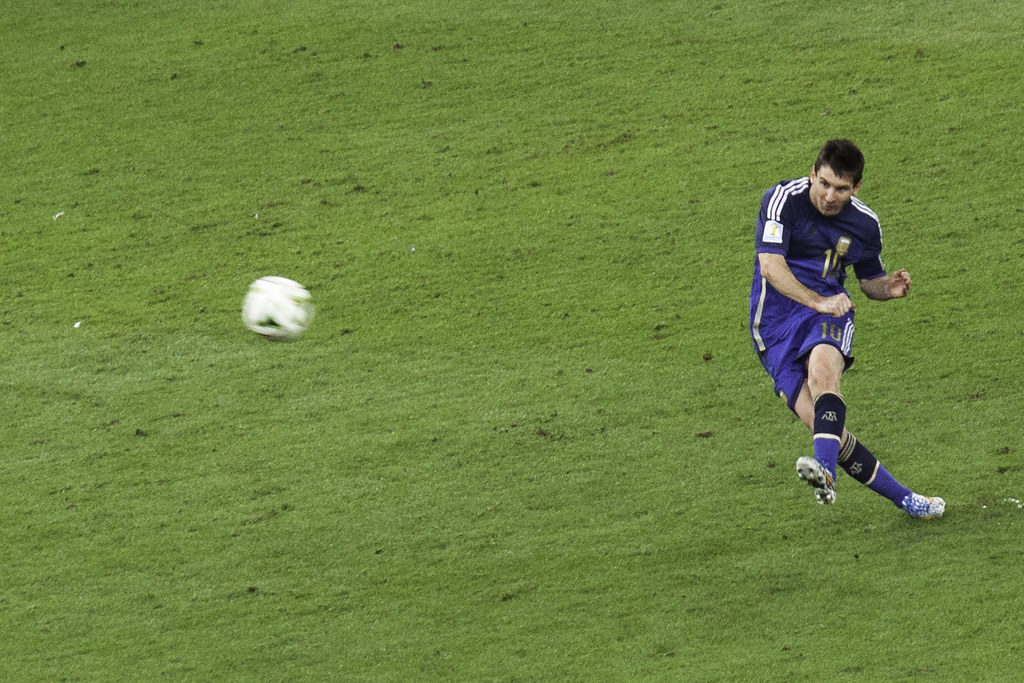
Argentina opened its World Cup defense with a commanding 3-0 victory over Algeria in Kansas City, Missouri, as Lionel Messi scored a hat trick that tied the men's World Cup career scoring record, bringing joy to tens of thousands of fans who traveled extraordinary distances and made significant financial sacrifices to witness the historic moment.
Messi scored in the opening minutes on a feed from Inter Miami teammate Rodrigo De Paul, scored again off a rebound early in the second half and completed the hat trick on a strike from the top of the penalty box before leaving to a standing ovation from a heavily pro-Argentina crowd. The goals gave Messi 16 for his World Cup career, tying Germany's Miroslav Klose for the record, and made him one of only two players, along with Portugal's Cristiano Ronaldo, to score in five World Cups.
A Journey of Dedication and Sacrifice
The victory was more than a sporting achievement—it represented the culmination of extraordinary dedication from fans who traveled from across continents. Three fans bicycled nearly 11,000 miles from South America to Kansas City without tickets in hand. One group drove 20 hours, living off sandwiches to save money. Daniel Otero, a 73-year-old attending his seventh tournament, said he was spending around $100,000 so he and his two sons could watch the team play over the coming weeks. He said, "We are crazy for Argentina. That's why we spend so much money to see our country, our national team."
Jorgelina Skorput, 34, of New York City, drove two days to get there, munching on sandwiches and staying at an Airbnb an hour out of town because it was cheaper. She said the trip cost her $2,000, including the $800 game ticket. Skorput, who was born in Rosario, Argentina, and moved to the U.S. when she was 9, said, "I felt like this is the only time, the only opportunity I'm going to get to see the World Cup. We're the last champions."
Martin plans to spend the next month following the team with his girlfriend, 31-year-old Agostina Gomez Uvia, a quest he estimates will cost them $20,000 each. Otero said he was spending $40,000 on tickets alone.
Community Support and Global Appeal
The tournament showcased the power of community solidarity. Pam Kramer, the chief executive of the Kansas City organizing committee, said, "We had those three Argentine cyclists come here, and they came here without tickets. And the people in Johnson County (Kansas) were like, 'You know what? We're fans too. We're going to make sure you get to a match,' and that's genuine. Nobody is doing it for show. We want people to see what we see, that this place is pretty special."
Otero and his son, Franco Otero, 27, marveled that U.S. families also were wearing Argentina jerseys emblazoned with Messi's name. Franco Otero said, "I can't remember an Argentinian team without Messi." Martin said, "Argentina now is like the Chicago Bulls with Michael Jordan. In his prime, he had fans around the world. Argentina has fans around the world with Messi."
Messi's Emotional Performance
Messi said after the match, "The first matches at the World Cup are always tough, and we're seeing that nobody's giving anything away." He also said, "My tears after the first goal? I've had some tough days. It wasn't related to football. And those feelings were because of that. I thank my teammates, the coaching staff and the delegation for helping me." Later he said, "I like playing soccer. It's been my passion since I was little. When I'm in good shape, I give it my all." He added, "It makes me very happy to have lived through everything that came my way. What I'm living though now is the cherry on top. I'm very happy an grateful for this wonderful group. I enjoy it so much."
Messi's hat trick was the 61st of his career, his 11th while playing in his national team colors and his first in the World Cup. It was also the fifth straight World Cup game in which he scored. His appearance against Algeria was the 200th of his international career, which began in 2005 at age 18. Messi's trio of goals came 20 years to the day after he made his World Cup debut in a match against Serbia and Montenegro, when he scored in that game too.
Neymar's Recovery Continues
Meanwhile, Neymar returned to the training field Tuesday for the first time since joining Brazil's World Cup squad while nursing an injured right leg. He still was not at full speed and did mostly physical conditioning at the team's training camp outside New York. He had undergone tests on his right calf on Monday to determine the progress of the injury he sustained while playing with Brazilian club Santos on May 17. The 34-year-old Neymar, playing at his fourth World Cup, has yet to join the rest of the squad in full training sessions during the team's preparations. He is not expected to play in Brazil's match against Haiti on Friday in Philadelphia. Brazil began its tournament with a 1-1 draw against Morocco on Saturday in Group C.
Argentina coach Lionel Scaloni said, "At a loss for words about Leo. What can I say? He's incredible." Algeria coach Vladimir Petkovic said, "We're not talking about any old footballer. Unfortunately we also afford him the opportunity with the first and second goal, and we actually made it easier for him. But Messi, with his clear thinking in crucial stages of the game, is able to do things that much more easily."
Argentina will continue its pursuit of back-to-back titles in Arlington, Texas, when it plays Austria on Monday and Jordan on June 27. De Paul said, "The goal is always to arrive on the first day and leave on the last."
Why This Matters:
The extraordinary financial and personal sacrifices made by fans to witness this World Cup highlight the deep cultural significance of soccer as a source of community identity and collective joy, particularly for immigrant communities and working families. The stories of fans spending thousands of dollars, driving for days, and bicycling across continents underscore both the sport's unifying power and the economic barriers that can limit access to these shared cultural moments. The community response in Kansas City, where local residents helped ensure ticketless cyclists could attend matches, demonstrates how sporting events can foster solidarity across borders. As the tournament continues, questions about accessibility and the costs associated with attending major sporting events remain relevant to ensuring that these moments of collective celebration remain within reach for dedicated fans of all economic backgrounds.