
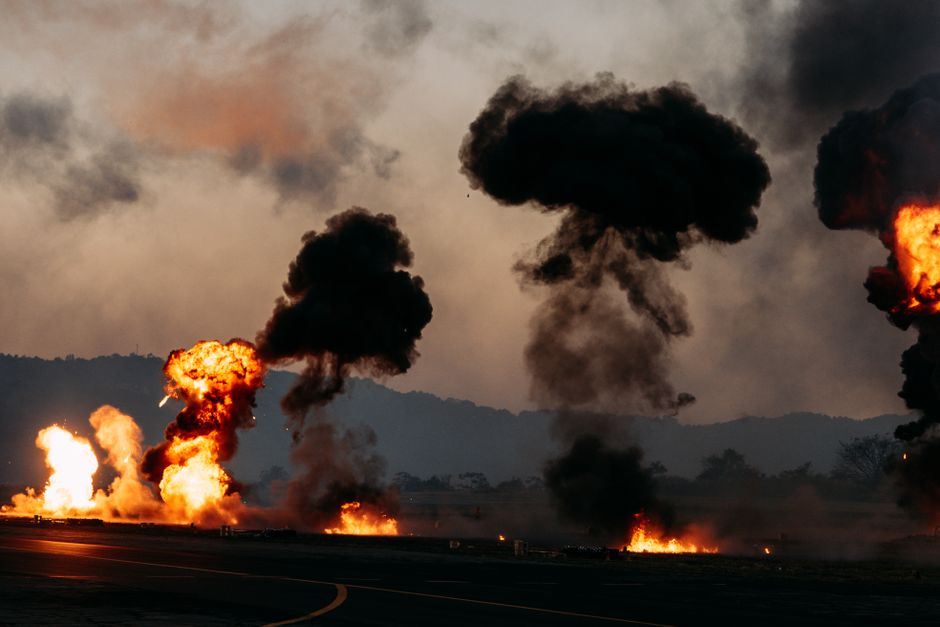
Smoke rose near Aden’s airport on Wednesday after a blast that a local police official said “was caused by a Houthi missile.” It marked the third reported strike in a week on the seat of Yemen’s Riyadh-backed government. Residents have little say in which side’s weapons land near them.
Houthi military spokesperson Yahya Saree said the group’s forces had targeted “the Saudi enemy’s operations room in the Badr camp in Aden with a ballistic missile.” Two other security sources in the city told Agence France-Presse the attack hit a site near the airport belonging to forces from the Saudi-led military coalition fighting the Houthis. The police official spoke anonymously for security reasons. The available reporting doesn’t say whether anyone was killed or wounded in Wednesday’s strike, and accounts can’t independently confirm Houthi claims about military targets.
A City Hit Again and Again
The pattern is hard to miss. Earlier in the week, two missiles landed within the airport perimeter, and the Houthis claimed responsibility. A day earlier, the group launched what the reporting describes as a deadly missile attack on Aden’s presidential palace, striking command centers inside the al-Maashiq presidential compound, used by government forces and the Saudi-led coalition. Aden is a working city, not just a seat of government. Missiles hitting compounds and airports near populated areas put people around them at risk, even when the stated target is military.
The fighting isn’t confined to Aden. Al-Jumhuriya TV reported renewed heavy clashes between Yemeni armed forces and Houthi fighters at the old airport and around Mount Han, west of Taiz city. The clashes came as the internationally recognized government pressed a military offensive against the Houthis in southwestern Yemen.
The Numbers From the Front
On Tuesday, the Yemeni army said it carried out 744 attacks against the group over 24 hours, neutralizing around 200 members and destroying or damaging 90 vehicles and other military assets. Those figures come from the army, and the reporting offers no independent verification. It also doesn’t say what the fighting cost civilians in the areas where it is taking place. Saudi Arabia’s air force, the reporting notes, has regularly targeted the Houthis in support of the Yemeni government.
How the Truce Fell Apart
In July, a fragile 2022 truce collapsed after the Houthis allowed an Iranian plane to land in Yemen’s capital, Sanaa, defying Riyadh’s control over Yemeni airspace. A series of attacks followed. The Houthis later declared a maritime blockade of Saudi Arabia, attacked its ships, territory and oil facilities, and seized government-held territory along Yemen’s Red Sea coastline in a rapid campaign.
Saudi Arabia and the Yemeni government have faced sustained Houthi attacks in recent weeks. That shift has redirected attention within the wider Middle East war, which began with US-Israeli strikes on Iran in February. Yemen’s war now runs inside that larger confrontation, and the arrival of an Iranian aircraft in Sanaa was the spark that ended the truce.
Why This Matters: A truce that held in some form since 2022 is gone. Fighting has moved onto the streets of Aden, a city that houses both the government and coalition forces. The reporting offers no casualty count for Wednesday’s strike or the week’s attacks, a sign of how little verified information reaches the outside world. What’s clear is the direction: a Yemeni conflict increasingly tied to a regional war, with missiles, a declared blockade and a ground offensive all active at once. Every escalation narrows the diplomatic room a restored truce would need, while people living near airports, palaces and front lines bear the risk as major powers trade blame.
- houthis
- aden
- yemen conflict
- ballistic missile
- saudi-led coalition
- yemen government
- military offensive