
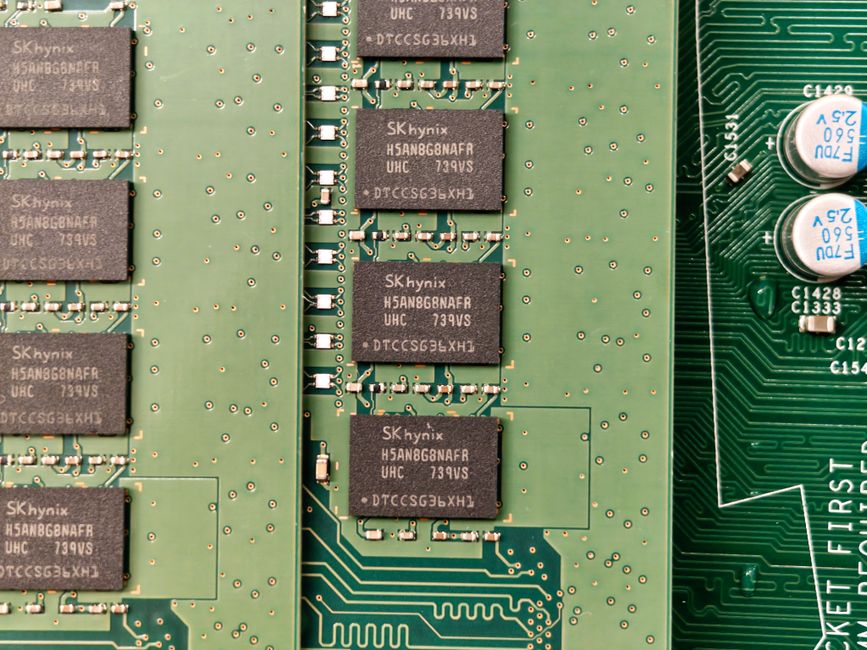
SK Hynix said Wednesday it will return about $75 billion to shareholders this year, after booking an operating profit of 83.3 trillion won ($62.8 billion) in the July-September quarter—nearly seven times its year-earlier result. The company topped the LSEG SmartEstimate of 76.7 trillion won. No subsidy, no bailout, no industrial-policy handout. Customers paid for chips, and SK Hynix is sending the proceeds back to its owners.
The Payout
The shareholder-return policy totals roughly 100 trillion won. It includes cash dividends of more than 30 trillion won and share repurchases and cancellations of more than 60 trillion won, including 40 trillion won announced in August. SK Hynix also said it would return most of the gains from its investment in Japanese peer Kioxia through a special dividend.
Revenue jumped 328% to 104.6 trillion won, compared with operating profit of 11.4 trillion won a year earlier. The company says it has sold out its high-bandwidth memory (HBM) and DRAM chips through 2029. Demand for HBM runs at twice supply, and Chief Financial Officer Kim Woo-hyun said the chip shortage is likely to last through 2030.
Markets cheered. SK Hynix shares rose as much as 9.4% in morning trade, while the Kospi gained 5.6% to 5,952.41 in early trading. Samsung Electronics surged 8.5% ahead of its Thursday earnings report.
Private Contracts, Private Risk
SK Hynix says it has signed long-term agreements with 14 major customers and is discussing extensions with others. Contract terms typically last five years. The volume secured so far, the company said, "corresponds to more than 50 per cent of total production capacity for 2027 and 2028."
Customers are applying capital discipline, too. Kim said they’re scrutinizing project feasibility and profitability more closely, while refining investment timing. "We expect AI investment momentum to continue, as customers' AI spending is translating into broader adoption of AI services and tangible business results," he said. SK Hynix plans to significantly increase capital expenditure next year, in South Korea and overseas.
Samsung Electro-Mechanics also posted a record: 3.76 trillion won in revenue, up 30%, and operating profit of 691 billion won, up 165%. Its operating margin climbed to 18.4% from 12.7% in April-June. The company announced about 6.8 trillion won in new substrate investment in September and a long-term supply partnership with Nvidia last week.
A Lopsided Expansion
South Korea's gross domestic product grew 1% in the third quarter from the previous three months, beating a Reuters poll median of 0.7% and the Bank of Korea's August forecast of 0.3%. Lee Dong-won, director general of the central bank's economic statistics department, put it bluntly: "It is estimated that half of economic growth is being driven by semiconductors."
The rest of the economy lagged. Private consumption fell 0.2%, its first decline in nearly four years, as financial services slumped with the stock market and strikes at major automakers cut car purchases. Park Sang-hyun, an economist at iM Securities, said the downside is that private consumption remains weak compared with overall growth. "There could be short-term boosts, but it is difficult to expect strong momentum given labour market conditions and restrictive interest rates," he said.
The central bank had hiked rates in July and September, then held last week. A Bank of Korea survey showed consumer sentiment slipped slightly in October. Lee expects chip-company dividends in the fourth quarter and employee bonuses in early 2027 to lift household income and help consumption recover.
Exports topped US$800 billion in January-September, already surpassing the previous full-year record. They’re on track to exceed US$1 trillion in 2026. South Korea would be the fourth country to reach that mark, after the United States, China and Germany.
Wall Street Leans on AI Too
The S&P 500 rose 0.6% Tuesday to 7,722.60, within 1.2% of its all-time high, even though most of its stocks fell. Broadcom gained 4% after announcing a $63 billion financing deal in which Wall Street firms would help Anthropic access its AI accelerators. CoreWeave, which borrows to buy AI chips and rents them out, gained 7.9%. The sector has swung for weeks amid concerns about borrowing costs for data-center builders. The 10-year Treasury yield sat at 4.99%, and Brent crude traded above $109 in Asian hours.
Why This Matters:
South Korea's growth story shows what private capital and long-term contracts can do, but it also exposes concentration risk. When semiconductors drive half of expansion and household spending is shrinking, the economy rests on one sector's order book. SK Hynix's customers are tightening scrutiny of returns, and investors are watching Microsoft, Amazon and Alphabet earnings this week for proof that AI spending pays off. Borrowing costs remain elevated, with the 10-year Treasury near 5%. Returning cash to shareholders instead of hoarding it is a sound sign. Whether the broader economy catches up before the cycle turns remains an open question.
- semiconductors
- south korea
- sk hynix
- samsung electronics
- artificial intelligence
- exports
- economic growth
- samsung electro-mechanics