
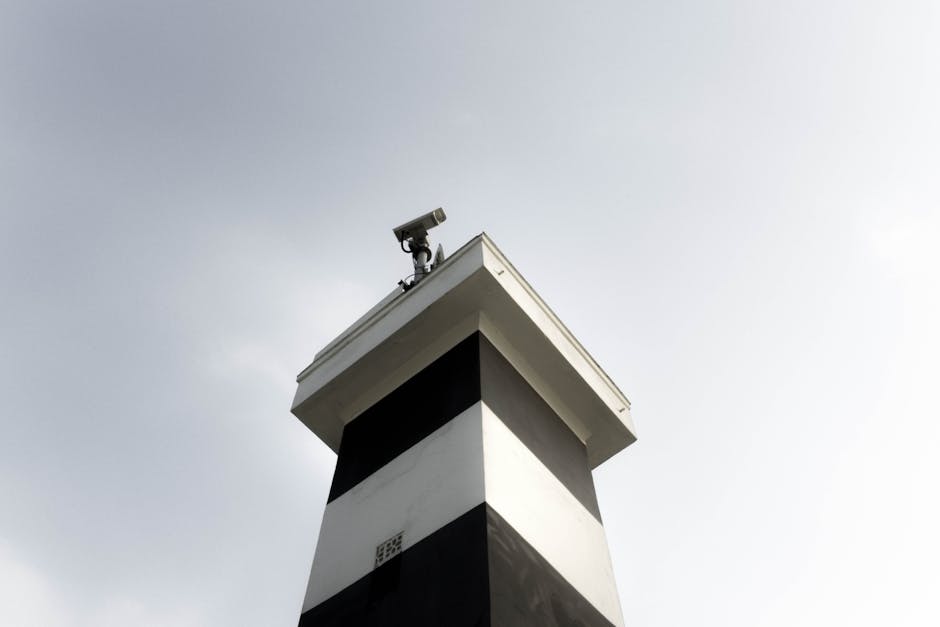
More than one million people in the United States and Mexico live within view of A.I.-powered border surveillance towers. At least four million more live within view of older cameras the government plans to retrofit with A.I. The Trump administration has secured more than $1 billion to build 1,500 new towers, extending the state’s watch over border communities and beyond.
Residents Can’t Opt Out
Eloisa Cavazos, 75, has lived near the Rio Grande since the mid-1950s. An A.I. tower now stands across the street. “It can see when I leave, who I'm with, who's coming and going from our house,” she said. “It follows you.”
The towers sweep across places where people live, work and gather. In Sunland Park, N.M., near El Paso, one tower scans the border wall and large sections of the city. Its camera captures detailed images roughly two miles away. Radar detects significant movement, the camera pans and zooms toward it, and an A.I. model classifies the image as a human, animal or vehicle before alerting Border Patrol agents at a command center.
C.B.P.'s privacy guidelines say the agency can share surveillance footage with local, state and federal law-enforcement authorities, as well as foreign governments. The agency acknowledges that people near the border can’t “opt out” and that people “engaged in First Amendment protected activities” or “complying with the law” could be recorded.
C.B.P. can black out areas of camera feeds, according to people with direct knowledge of the program who spoke anonymously to discuss law-enforcement matters. But the agency can remove those restrictions at any time. C.B.P. didn’t answer questions about where or how often it uses the feature.
The towers belong to a wider system that includes drones, license-plate readers, trail cameras, ground sensors and blimps. Officials are working to build a single technology platform where agents can see data from all those sources. The cameras monitor surroundings 24 hours a day, without the fatigue or distraction that can affect people watching cameras.
Bipartisan Machinery, Private Contracts
For decades, Republicans and Democrats agreed that a “smart wall” of surveillance equipment could help stop illegal immigration and drug trafficking. Like many Democrats, President Joseph R. Biden Jr. said he preferred a smart wall to a physical barrier. The government began testing A.I. towers in 2018, and C.B.P. now operates at least 350 in remote and populated areas.
Anduril, an A.I. defense firm with close ties to Mr. Trump, builds most of the towers. It won contracts during Mr. Trump's first term and under President Joseph R. Biden Jr. Since Mr. Trump's re-election, Anduril has secured more than $567 million in new C.B.P. contracts. Tower data sits on government servers, and contractors such as Anduril can access it with C.B.P. authorization to improve their models or monitor equipment.
C.B.P. generally retains data for 30 days unless it is needed for law-enforcement purposes. Officials have also said data used to train A.I. systems “should not be deleted.” The agency says the towers don’t have facial-recognition software. Some towers stand on federal land; others occupy plots leased from local governments and private owners.
Promises, Gaps and the Cost of Watching
The Government Accountability Office found that C.B.P. had no basic master plan specifying the program’s cost, delivery timeline or measures of success. A 2024 audit found agency technology policies didn’t address how towers would store and secure sensitive personal data. Officials didn’t provide information showing how well the towers work, including how often they helped catch migrants or drug smugglers.
Six current and former government officials with knowledge of the program said the towers have been less effective at spotting illegal activity in congested urban areas. Dave Maass, the investigations director of the Electronic Frontier Foundation, called the program a “costly boondoggle.” “Every few years, they make these amazing claims about the technology,” Mr. Maass said. “And then an oversight body looks at it and finds it's a big, wasteful program that is not delivering results.”
Border residents’ views vary. Eric Chapa, 40, said crossings had slowed under Mr. Trump and hoped a nearby tower would keep it that way. “I hope it makes people think twice.” Antonio Nuñez, 56, clearing leaves outside his Sunland Park home, said: “We do our everyday routine and forget. We get used to it.”
C.B.P. installed a tower at a popular beach in Del Mar, Calif., in 2021, about 30 miles north of Mexico, to detect boats carrying migrants and drugs. The agency also secured a lease from San Clemente, Calif., about 70 miles from Mexico, for a tower on a hill overlooking the community. City officials said it would prevent deaths after episodes in which migrants drowned; residents and elected officials objected, and the agency said installation plans are on hold.
Hilton Beckham, an assistant commissioner of public affairs at Customs and Border Protection, called the towers “essential to border security.” Beckham said the agency “employs technology while respecting civil liberties and privacy interests.” Shannon Prior, an Anduril spokeswoman, said the towers had proved “highly effective” and said customers can program the technology to prevent monitoring of designated areas. Steve Knoblock, a San Clemente councilman who supports the tower, said: “This is the world we live in. There are cameras everywhere. You walk down the street here, you're being recorded. You can't put the genie back in the bottle.”
- border surveillance
- artificial intelligence
- u.s.-mexico border
- customs and border protection
- surveillance cameras
- privacy
- border patrol
- smart wall