
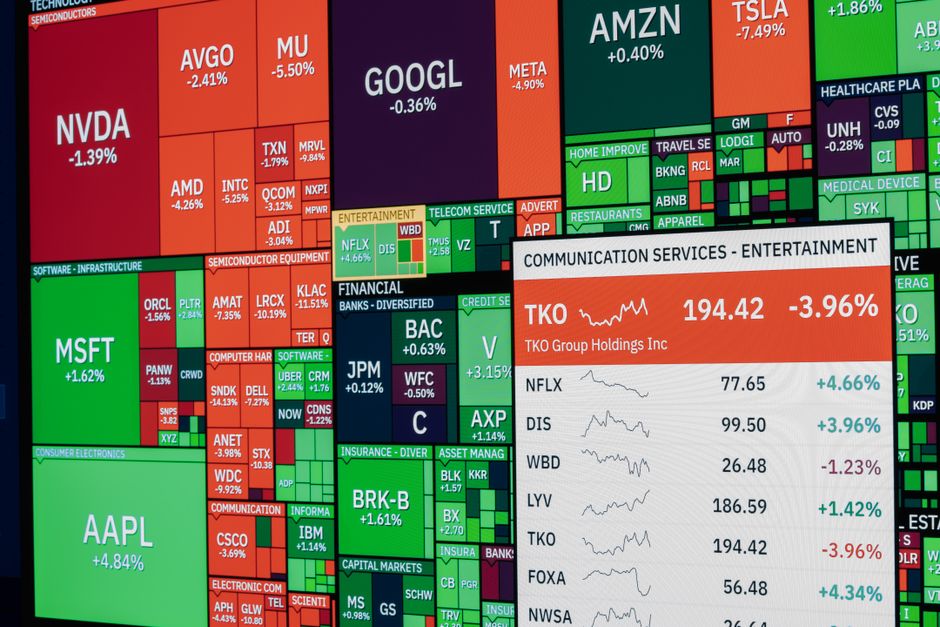
Chipmakers plunged nearly 7% on Thursday, sending the Nasdaq 100 to its worst day since June as investors demanded harder evidence that the enormous sums pouring into artificial intelligence will ever pay off. The S&P 500 fell 1.2%. Paris’s CAC 40 dropped 1.4%, while Frankfurt’s DAX 40 lost 1.1%.
The jitters arrived as a wider question about who controls these systems surfaced elsewhere in the reporting. At a meeting in San Francisco last week, Anthropic told investors it had blocked accounts it alleges Chinese AI labs used to mine its Claude model. The move cut off paying customers who accounted for between 5% and 7% of its revenue in the first nine months of the year.
The Money and the Doubts
Meta Platforms’ plan to raise capital spending revived fears that technology companies will pile on debt to fund AI infrastructure. Meta fell 5.6%, despite third-quarter revenue beating expectations. Chief financial officer Susan Li said the computing intensity of its AI agent Muse meant expanding its user base would require significant investment, and she expected total serving costs to rise.
Analysts didn’t hide their unease. Trade Nation’s David Morrison called the reaction to company updates “concerning” and said intermediate support levels were “creaking dangerously.” His sharper point: “The future commitments are enormous. Yet there’s little clarity over when, or even if, there will be a return on planned expenditure.” James McCann of Edward Jones said investors wanted stronger evidence of returns and questioned whether spending was sustainable amid higher rates.
Not everyone sees a bubble. Blackstone President Jon Gray told Bloomberg Television that with AI, “you’re building capacity, and you’re hoping you can keep up with the demand.” Days earlier, billionaire Ken Griffin said the industry was “almost certainly” heading that way. Nvidia chief executive Jensen Huang told CNBC demand for neoclouds was “off the charts,” though scarce capital was impeding growth. Chinese stocks, meanwhile, entered a bear market and have lost $2.4 trillion since a peak in May, amid a prolonged consumption slump and doubts about AI companies’ profitability.
Who Governs the Machines?
Anthropic said Chinese labs DeepSeek, Moonshot and MiniMax generated more than 16 million interactions with Claude through roughly 24,000 fake accounts in February, violating its terms of service. The company calls the practice, known as distillation, a loss of intellectual property with national security implications. Earlier this month, it introduced access restrictions, proxy blocking and bans on tens of thousands of accounts. Anthropic said those steps cut off 90% to 99% of the data being siphoned.
The company is approaching an IPO and faces investor concern about month-to-month growth deceleration. Its revenue was $4.7 billion in the first quarter, $11.6 billion in the second and $16.8 billion in the third. Some investors have discussed a valuation near $1.5 trillion, down from the roughly $2 trillion once expected. Competition from cheaper, open-source Chinese models remains a worry.
A Salt Security survey of more than 380 security and technology professionals points to a governance gap inside companies themselves. Some 86% of their organizations had at least one AI agent operating, and 77% had agents chaining actions across other agents. Only 18% said they could automatically stop an agent behaving unexpectedly. Just 13% could trace a complete path from instruction to outcome across every agent involved.
Human Judgment Still Counts
Bill Gross, founder of Idealab, launched Idealab.ai this week, a platform matching users’ backgrounds and skills with AI-generated business ideas. Over a career of more than 30 years, Gross has helped start 175 companies, with more than 45 exits. AI’s ability to generate ideas had left him feeling “depressed” before inspiring the platform. “All the judgment and decisions still have to be made by humans,” he said. AI can offer suggestions, “but you have to make the call.”
Oil, Inflation and the Wider Squeeze
Brent crude stood at $111.18 a barrel at the London close, up from $109.14 the day before. The New York Times reported, citing sources, that the United States and Israel had plans for renewed strikes against Iran after next month’s U.S. midterm elections. President Donald Trump told reporters Washington wasn’t negotiating with Tehran and that something would happen “fairly soon.” Aramco told remaining staff to evacuate its headquarters Thursday after weeks of Houthi attacks. A late-night attack on Dammam airport killed two people and injured eight.
In London, the FTSE 100 ended down 0.3% at 10,725.03. The FTSE 250 fell 0.9%. Mining shares dragged as metal prices fell: Antofagasta dropped 6.2% and Anglo American 5.6%. J Sainsbury fell 2.2% after second-quarter like-for-like sales growth excluding fuel of 1.2% missed consensus of 1.9%. AJ Bell’s Russ Mould said there were signs of “stuttering momentum.” Inchcape fell 9.3% after cutting its 2026 earnings and margin guidance over a “challenging situation in Australia.”
Why This Matters:
The numbers are huge, but the stakes aren’t only financial. Companies are committing vast capital to AI before anyone can say when it will pay back, while the survey suggests most firms can’t reliably stop or trace their own agents. That gap between ambition and oversight is a problem no single company or country can close alone. Who bears the risk if debt-financed spending sours? Pension holders, workers and ordinary savers, not just billionaire investors. Europe has an interest in pressing for transparency, accountability and public-interest safeguards as this technology scales, rather than waiting for the next market shock to force the issue.
- anthropic
- claude
- ai spending
- nvidia
- stock market
- ai investment
- deepseek
- oil prices