
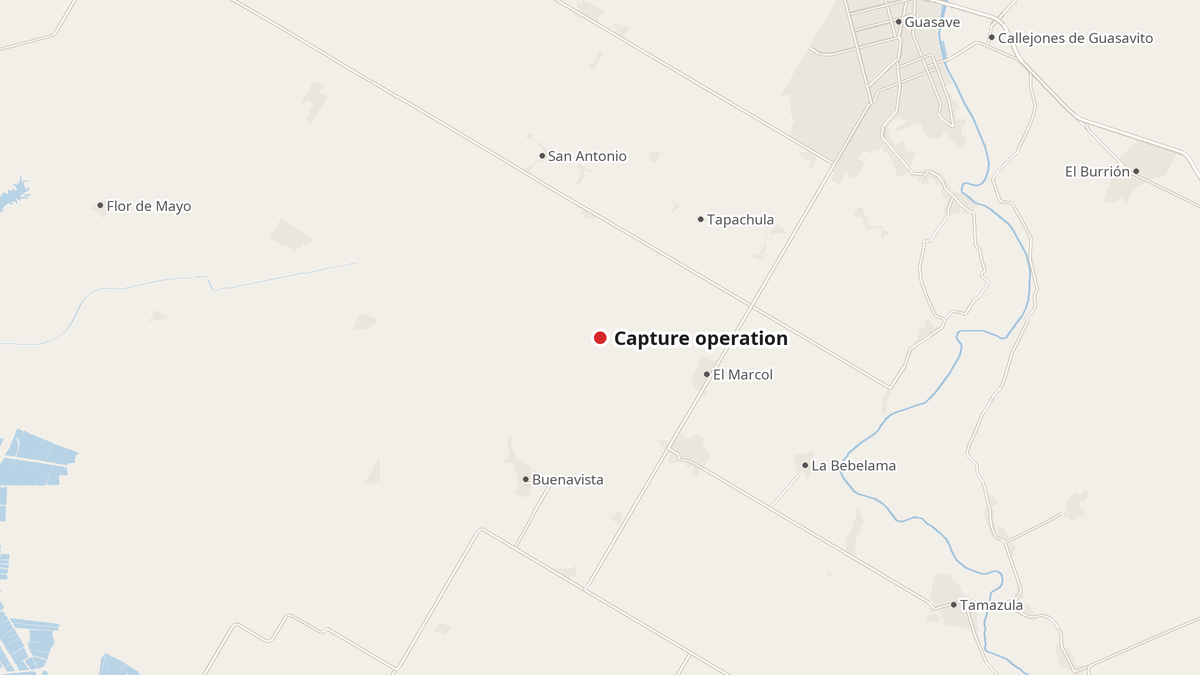
Families fled a baseball game and Sinaloa officials urged residents to stay indoors after Mexican forces captured Fausto Isidro Meza Flores, known as “El Chapo Isidro,” in an operation backed by U.S. intelligence cooperation.
The arrest in Guasave on Friday night, November 20, 2026, was followed by gunfire, roadblocks and fires across northern Sinaloa. Meza Flores, leader of the Guasave-based Meza-Flores Transnational Criminal Organization, was on the FBI’s Ten Most Wanted Fugitives list, Mexican authorities said.
Residents Caught in the Violence
Gunfire near Kuroda Park interrupted the third inning of a Mexican Pacific League game between the Algodoneros de Guasave and the Venados de Mazatlán. Pitcher Víctor Buelna stopped his delivery to alert his catcher. Players left the field, while spectators, including families with children, took cover and fled the stands.
Announcers halted the broadcast, citing a “national security incident.” Infobae reported that the violence caused panic among spectators.
Clarín reported that armed militants torched trucks and set up roadblocks in Ahome, Guamúchil, Guasave and Navolato, closing parts of the La Costera highway. Residents also reported fires at convenience stores and gas stations.
Guasave municipal security chief Juan de Dios López Rubio said Saturday that low-flying aerial operations were continuing and warned motorists about tire-puncturing devices on local roads. The Sinaloa Security Secretariat asked residents to remain sheltered, avoid the area and not travel on the roads.
A neighbor told CNN that armed individuals had taken over several hospitals and that shops and gas stations had been set on fire. Footage circulating on social media appeared to show helicopters flying low over Guasave and firing toward ground targets as armed cartel members exchanged shots from a truck.
The Arrest and Public Response
Mexico’s Secretariat of National Defense said the operation was coordinated with U.S. intelligence agencies. Mexican officials didn’t identify those agencies or say whether U.S. personnel were on the ground.
Clarín reported that National Guard special forces known as the “Wolves” and Mexican Army commandos known as the “Bats” took part alongside Sinaloa state security authorities. Troops used surveillance technology to locate Meza Flores, approached his property from several directions and came under attack with gunfire and explosives before storming the compound.
Authorities also detained Germán N, nicknamed “Serafín” and described as the cartel’s second-in-command, and José N, an alleged financial operator. All three were flown aboard a Mexican Air Force aircraft to Mexico City and handed over to federal prosecutors.
Infobae reported that Mexican authorities had arrest warrants for Meza Flores on organized-crime and drug-related charges, as well as an extradition order to the United States over an alleged conspiracy to distribute drugs there. Bloomberg reported that he faced extradition to the United States on drug-trafficking charges.
Sources cited by Mexican media said the operation’s objective was to reduce violence in Sinaloa and capture major generators of violence. The arrest was followed by the disruption that prompted state officials to tell residents to shelter.
U.S. Charges and Cooperation
The FBI added Meza Flores to its Ten Most Wanted Fugitives list on February 4, 2025, as the 533rd person on the roster. The U.S. Department of State offered a reward of up to $5 million for information leading to his arrest or conviction.
Federal indictments in Washington, D.C., in 2012 and 2019 charged him with firearms violations and conspiracy to manufacture and distribute methamphetamine, cocaine, heroin, marijuana and fentanyl for importation into the United States. Bloomberg reported that he was accused of smuggling narcotics into the United States.
On January 17, 2013, the Treasury Department’s Office of Foreign Assets Control froze assets belonging to Meza Flores, seven family members and three Guasave businesses: an auto transport firm, a gas station and a construction company.
Meza Flores’s organization, also known as Los Mazatlecos or the Guasave cartel, operated a smuggling network across Guasave, Los Mochis, Mazatlán, Guamúchil, Choix, Los Cabos and Nayarit. Its rivalry with the faction of Joaquín “El Chapo” Guzmán involved kidnappings, executions and armed ambushes.
Regional analysts said Meza Flores later aligned with the Los Mayos faction in its conflict with Los Chapitos, which began in 2024 after Ismael “El Mayo” Zambada was taken into U.S. custody. Infobae described Meza Flores as part of the Sinaloa Cartel faction led by Ismael Zambada, alias “El Mayito Flaco.”
Earlier on Friday, U.S. President Donald Trump said he had confronted Mexican President Claudia Sheinbaum at a summit in China, telling reporters: “We can’t let the cartels run Mexico. They’re our neighbor.”
Clarín reported that Sheinbaum rejected Trump’s characterization and ruled out U.S. military intervention on Mexican soil, while her administration increased domestic anti-cartel operations and intelligence sharing with Washington. Those efforts included tens of thousands of arrests, seizures of hundreds of tons of narcotics, the dismantling of thousands of clandestine laboratories and the transfer of dozens of high-profile trafficking suspects to U.S. custody, Clarín reported.
Why This Matters: Mexican and U.S. authorities cooperated to capture a fugitive wanted on drug-trafficking charges, but residents faced gunfire, blocked roads and warnings to remain sheltered after the operation. Families at a baseball game fled, and a neighbor reported that armed individuals had taken over several hospitals. The operation’s stated aim was to reduce violence; the immediate public burden included disrupted movement and fear in northern Sinaloa. The consequences for residents matter alongside the arrest and the institutional cooperation that produced it.
- fausto isidro meza flores
- gu asave
- sinaloa
- mexican army
- drug trafficking
- cartel violence
- los mazatlecos
- fbi most wanted