
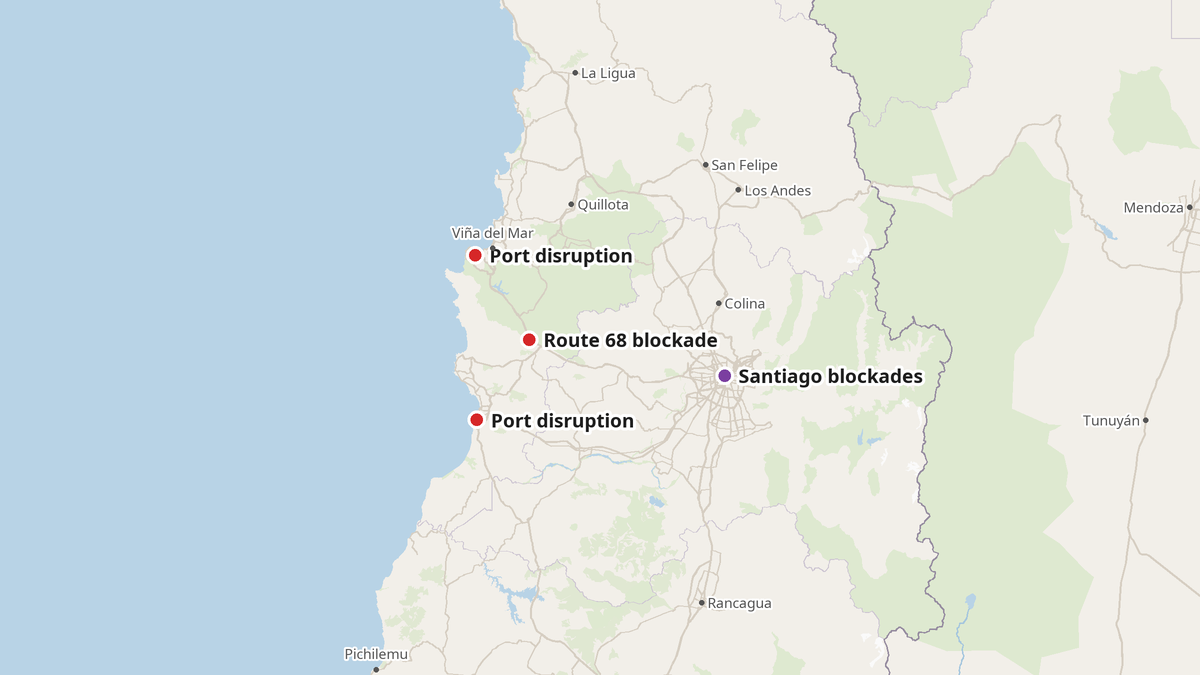
"We are small and medium transporters who have no margin to absorb the sustained increase. Many colleagues are going bankrupt." That's Nelson Varas of Fedequinta, speaking from Route 68 near Casablanca on the third consecutive day of a nationwide truckers' strike in Chile, as new associations joined despite the government's announced fuel price freeze.
Varas's federation groups about 800 transporters in the Valparaíso region, home to the country's main ports. He told EFE the strike is choking San Antonio and Valparaíso because "the cargo cannot enter or leave." His verdict: "The strike is a necessity, not a whim." Fedequinta wants a 120-day freeze, not the 90 days the government offered Wednesday night. "The situation is unsustainable not only for the truckers but for all citizens," he said.
Who Gets Crushed
The protests began in the early hours of Tuesday, led by organizations of small and medium truckers and transporters in almost all regions. Chile has no rail system for cargo, so nearly all freight moves by road. Block the highways and supply chains seize up. That's the leverage these workers have, and they're using it.
The squeeze came after March, when President José Antonio Kast decided not to use a state mechanism that neutralizes the impact of volatile international oil prices. The entire increase caused by the war in the Middle East went straight to consumers. Since the start of the offensive, diesel has risen 80% and gasoline 40%. The so-called "benzinazo" hit multiple economic sectors. Opposition deputy Flor Contreras put the household version plainly: "Families are drowning from the cost of living."
The protesters' demands: a 120-day freeze, a temporary elimination of the specific fuel tax, and a review of highway tolls. The government's offer is a three-month freeze, until February 3.
What They're Calling "Order"
The two big sector organizations, the Confederación Nacional de Dueños de Camiones and the Confederación Nacional del Transporte de Carga, distanced themselves from the protest from the start, though they support part of the demands. Their leaders walked into La Moneda first thing Thursday. CNDC president Juan Araya then told reporters what he made of the people actually on the highways: "There is anarchy, a cacique appears everywhere."
That's how a confederation leader describes drivers organizing without waiting for his permission.
Government spokesman Gonzalo Arenas said it seemed "inexplicable" that transporters hadn't called off the strike, calling the proposal "very good and very serious." He told Radio Duna the freeze "implies a gigantic cost in resources." Kast asked truckers to end the strike and called for national unity, saying the country is in a "technical recession," as Finance Minister Jorge Quiroz acknowledged Wednesday. He defended "the right to demonstrate but not the right to block roads," and added: "Let's not go back to where someone had to get out of a vehicle and dance to pass."
The Man in Charge Is Leaving
Kast is keeping his planned trip to Asia, the government confirmed Thursday. It's his first Asia tour since taking power in March, covering Vietnam, China and Japan. He leaves Friday and will join the APEC leaders' summit on November 18 and 19 in Shenzhen. Interior Undersecretary Máximo Pávez told Tele 13 that "the president has to fulfill a very intense and very important agenda for the country in Asia-Pacific."
The opposition pounced. Frente Amplio president Gael Yeomans said Chile "needs a president who takes charge of the crisis," noting Kast also left last week for Spain and Italy. Contreras pointed to a Justice crisis over the release of more than 50 pedophiles weeks ago that has "left victims waiting for answers."
Notice the shape of the argument. The opposition's complaint is that the man at the top should be physically present to manage the crisis, not that a handful of officials hold the power to set the price of diesel for an entire country. Every faction in this story, from the president to the confederation chiefs to the deputies, agrees someone ought to be in charge. The truckers on Route 68 are the only ones who've acted without asking.
The last major truckers' strike was in February 2022 and lasted only a few days. This one is in its third.
- chile truckers strike
- fuel prices
- josé antonio kast
- chile
- fuel price freeze
- transporters
- road blockades
- economic crisis