
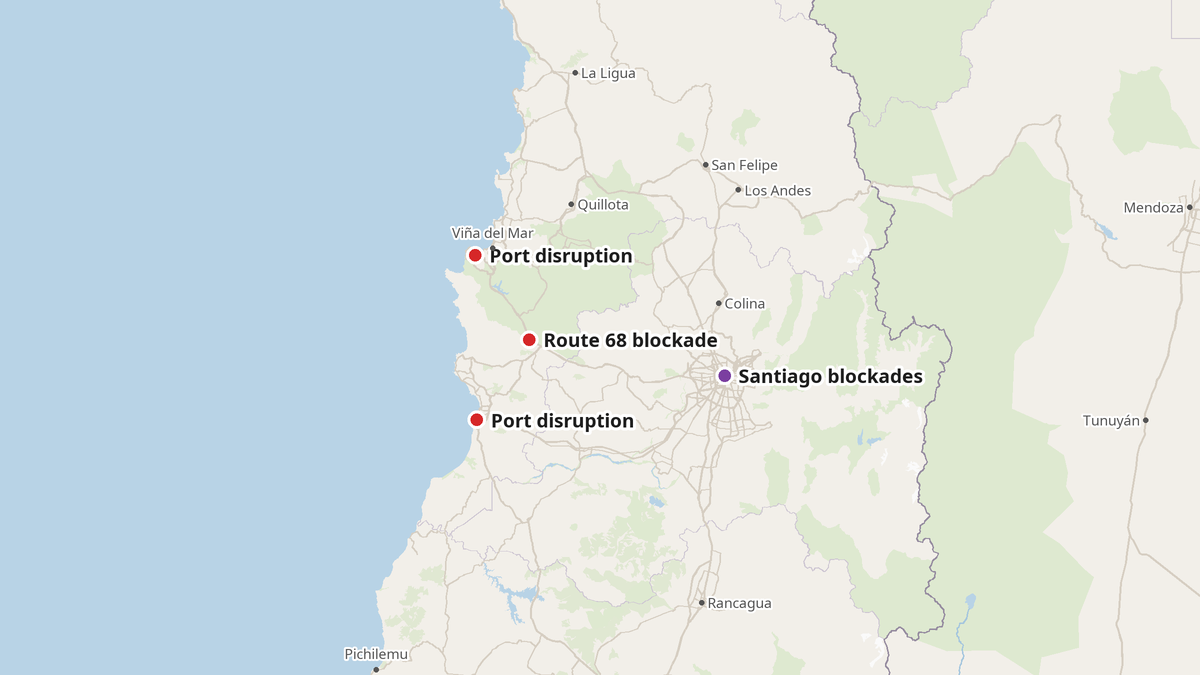
Chile's truckers' strike entered its third consecutive day on Thursday, November 12, 2026, with main highways partially blocked and cargo stuck at the country's biggest ports, even after the government announced a three-month freeze on fuel prices that it says carries a "gigantic cost in resources."
New groups joined the walkout Thursday. The Federación de Dueños de Camiones de la Quinta Región, known as Fedequinta, which represents about 800 transporters in the Valparaíso region, said it was signing on to the indefinite strike. Leader Nelson Varas spoke to EFE from Route 68 near Casablanca. He said the stoppage is choking the ports of San Antonio and Valparaíso because "the cargo cannot enter or leave." Still, he called the strike "a necessity, not a whim."
The Squeeze on Small Operators
"We are small and medium transporters who have no margin to absorb the sustained increase. Many colleagues are going bankrupt," Varas said. The situation, he added, is "unsustainable not only for the truckers but for all citizens."
The numbers behind that anger are stark. Since the start of the Middle East offensive, the international price of diesel has climbed 80% and gasoline 40%. The pain traces to March, when President José Antonio Kast chose not to use a state mechanism that neutralizes volatile international oil prices, so the full increase passed through to consumers. The resulting "benzinazo" hit multiple sectors of the economy and sank the president's popularity.
Chile has no rail system for cargo. Nearly all freight moves by road, so every blockade ripples straight through supply chains.
Government Response
The Executive announced Wednesday night a freeze on fuel prices until February 3. Protesters say it falls short. They want 120 days rather than the roughly three months offered, a temporary elimination of the specific fuel tax, and a review of highway tolls.
Government spokesman Gonzalo Arenas said it seemed "inexplicable" that transporters hadn't called off the strike, calling the proposal "very good and very serious." He told Radio Duna the freeze "implies a gigantic cost in resources." Finance Minister Jorge Quiroz acknowledged Wednesday that Chile is in a "technical recession," which leaves little room for open-ended price supports.
Kast asked truckers on Thursday to end the strike and called for national unity to confront the economic crisis. He said recent talks have produced "advances," but that unity is "the most urgent call." He defended "the right to demonstrate but not the right to block roads," and warned that "difficulties only deepen if the roads are cut." He also said: "Let's not go back to where someone had to get out of a vehicle and dance to pass."
A Fractured Movement
The protests began in the early hours of Tuesday and are led by assorted organizations of small and medium truckers in almost all regions. Another account puts the start on the 9th. The two main sector bodies, the Confederación Nacional de Dueños de Camiones and the Confederación Nacional del Transporte de Carga, distanced themselves from the protest from the start, though they back part of the demands. Their leaders went to La Moneda, the seat of government, first thing Thursday.
Juan Araya, president of the first group, described a movement without a clear leadership structure. "There is anarchy, a cacique appears everywhere," he told reporters. That makes negotiation harder. Who speaks for the strikers? Who can promise the roads will reopen?
The last major truckers' strike was in February 2022, four years ago, and lasted only a few days.
The Asia Trip and Opposition Attacks
The government confirmed Thursday that Kast is keeping a planned trip to Asia. It's his first tour of the region since taking power in March, with stops in Vietnam, China and Japan. He leaves Friday and will attend the APEC leaders' summit on November 18 and 19 in Shenzhen for the first time. Interior Undersecretary Máximo Pávez told Tele 13 that the president "has to fulfill a very intense and very important agenda for the country in Asia-Pacific." Local media assume a meeting with Xi Jinping, though nothing is officially confirmed.
Opposition figures pounced. Flor Contreras, a deputy of the Partido de la Gente, said: "President Kast is not grasping what is happening in Chile." She cited families drowning from the cost of living, mobilized truckers, a technical recession and a justice crisis tied to the release of more than 50 pedophiles weeks ago. Gael Yeomans, deputy and president of the Frente Amplio, said Chile "needs a president who takes charge of the crisis," pointing to Kast's trip last week to Spain and Italy as evidence of "lack of political leadership."
Why This Matters:
The strike puts a hard question to Santiago: how much can a government under recession pressure spend to cushion a price shock? The freeze, by the spokesman's own account, costs a gigantic sum, and extending it from roughly 83 days to 120 would add to that bill while the economy is contracting. Meanwhile, blocked ports and idled trucks impose their own costs on exporters, importers and consumers who had no say in the dispute. Trade ties pursued in Asia depend on reliable logistics at home, and a country that can't move cargo for days sends the wrong signal. The episode also shows the risk of leaderless protest movements: with no single negotiating voice, even a deal the government calls serious may not end the standoff.
- chile truckers strike
- fuel prices
- josé antonio kast
- chile
- fuel price freeze
- transporters
- road blockades
- economic crisis