
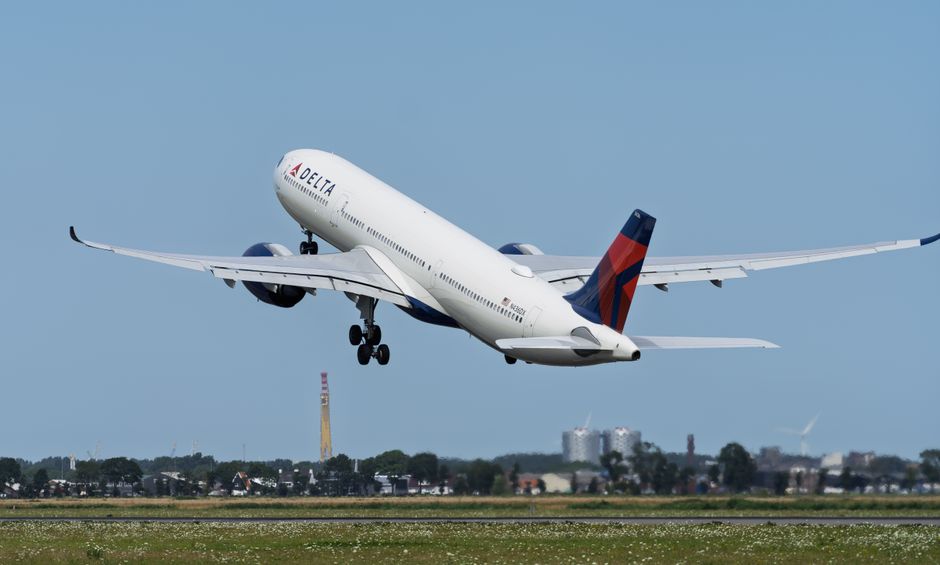
Delta Air Lines’ weight-and-balance automation failure delayed flights across the country on Sunday, Nov. 22, while travelers began heading out for Thanksgiving. The system calculates aircraft weight and its distribution before takeoff; Delta teams switched to manual workarounds as the airline worked to restore it. The system was working again hours later, but flights still hadn’t returned to normal.
Travelers Pay in Delays
The scale of the disruption varied by the time and measure used. FlightAware showed 835 total delays at Atlanta on Nov. 22, according to USA Today. CBS News reported 1,160 delayed Delta flights, including 712 in and out of Atlanta, as of noon ET. Delta accounted for about one-third of U.S. flight delays at that time, and the figures were expected to rise.
By Sunday evening, FlightAware showed about 2,000 Delta flights delayed, or 58%, HuffPost reported. About 58% of flights departing Atlanta and about 50% of flights arriving there were delayed. The vast majority of flights at the airport are operated by Delta. Business Insider reported that FlightAware counted nearly 1,300 delayed Delta flights on Sunday. USA Today said the precise number wasn’t immediately clear.
Delta said about 70% of the delays and cancellations tracked by FlightAware were linked to the automation issue; the rest were attributed to inclement weather. FlightAware reported that 3% of Delta flights were canceled.
Business Insider’s Noah Sheidlower described the effect on his own trip. “People have been very frustrated and confused,” he said. His Delta flight from Orlando to New York had been delayed for hours.
Delta apologized by mid-afternoon and said it was rebooking customers, providing meals and hotel rooms when needed, and offering refunds for canceled flights. The airline said it hoped to have all delayed flights airborne by the end of the day. AAA projected nearly 6 million people would take domestic flights for Thanksgiving that week.
The State Manages the Bottleneck
The Federal Aviation Administration briefly halted some Atlanta-bound flights Sunday morning. It then replaced the ground stop with a program allowing flights to depart at staggered times. Delta requested the program, which applied to Delta and its regional carriers flying into Hartsfield-Jackson Atlanta International Airport from the contiguous United States.
The FAA projected average delays of 57 minutes, with delays of up to 1 hour and 51 minutes. The program was scheduled to run through 12:50 p.m. ET. A separate temporary ground-delay program at the airport was later lifted. Delta said it was coordinating with air traffic controllers to prevent congestion at Atlanta gates and on the tarmac.
The FAA said on X that the disruption was “not related to any FAA air traffic systems.” The agency also said Delta was working to resolve the problem. An FAA document says meeting aircraft weight-and-balance limits is critical to flight safety and that exceeding them can compromise an aircraft’s structural integrity. Manual workarounds allowed Delta teams to get flights safely departed while the automation system was down.
A Wider Record of Outages
The Delta disruption followed other airline technology problems. Earlier in November, an FAA network malfunction caused a nationwide ground stop that lasted more than four hours. HuffPost and the Los Angeles Times described it as the longest nationwide ground stop in 25 years; carriers canceled and delayed flights while recovering. USA Today said an FAA communications-system outage grounded aircraft nationwide on Nov. 13.
Days later, United Airlines had a system outage that forced it to delay departing flights. CBS News also reported a similar United issue the previous Monday that held departures for about 90 minutes.
Across the incidents, passengers faced delays and cancellations while airlines and federal agencies worked to restore systems and manage traffic. Delta’s automated tool handled calculations necessary for safe takeoff; when it failed during a busy travel period, the airline relied on manual work and government-managed departure restrictions. The available reports did not identify the outage’s cause or provide a precise final count of delayed flights.
- delta air lines
- flight delays
- atlanta
- thanksgiving travel
- federal aviation administration
- system outage
- weight and balance