
Congo's Ebola outbreak has now killed 5,026 people out of 10,351 infected, according to Ministry of Health data released Saturday. That's a lethality rate near 50 percent. And roughly a third of those who died never received any care at all.
The Bundibugyo virus outbreak, declared in mid-May, has run for about five and a half months and caught authorities by surprise. They've struggled to manage it ever since. It is already the second deadliest Ebola outbreak in history, behind only the West Africa epidemic of 2014 to 2016, which killed 11,000 people across multiple countries.
"It is a very tragic milestone because it is just not a number," said Dr. Patrick Otim, a programme area manager with the World Health Organization. "It is families and communities that have been devastated by this outbreak. The number also shows the severity of this outbreak."
Who Is Being Left Behind
The most troubling figure may be this one: one-third of recorded deaths happened outside treatment centers, before victims were ever tested for Ebola. Otim called it one of the biggest concerns of the outbreak. "These are people we never had opportunity to try to save them," he said. "How do we try to reach people early to get them to come to health facilities to get a fighting chance to survive?"
There's no known vaccine or treatment for the Bundibugyo virus. Health workers treat patients based on symptoms alone. Still, 2,788 people have recovered so far, which suggests that early supportive care can matter.
The disease has reached 67 of Congo's 178 health zones across eight of 26 provinces. Fifty of those zones have active cases. Ituri and North Kivu in the east have become the epicenters, with 9,782 confirmed cases and 4,792 deaths between them.
A Broken Chain of Tracing
Contact tracing and testing, the basic tools for slowing any outbreak, are failing to keep pace. According to the Africa Centers for Disease Control and Prevention, about 80 percent of new cases come from outside the chain of monitored contacts. In other words, the vast majority of new infections are traveling through transmission routes health authorities can't see. Officials say that fuels community spread beyond the reach of workers who can manage infection under medical protocols.
The gaps point to a public health system stretched past its limits, in the very regions where the virus has taken hold.
Spread Across Borders
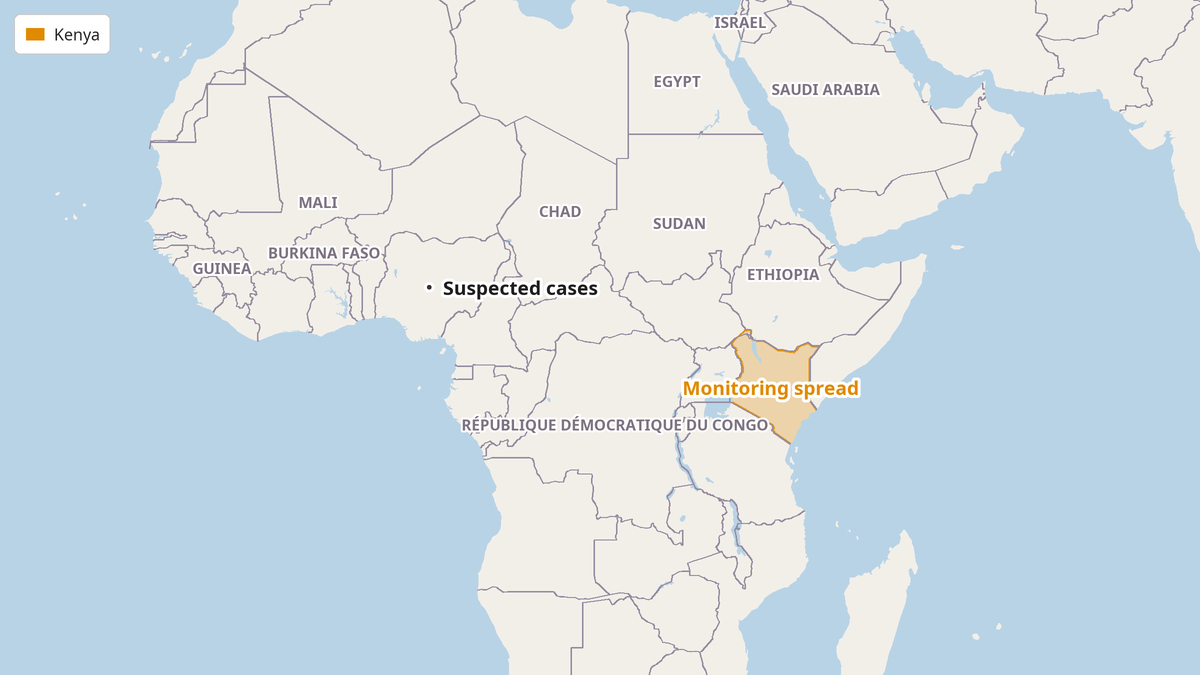
Nigeria is one of five countries to detect Bundibugyo virus disease in this outbreak. On Saturday, the Nigeria Centre for Disease Control and Prevention (NCDC) reported two new suspected cases in the country's North-east region. Both individuals have been isolated while contact identification and listing continue. "Laboratory testing is being conducted," the agency said, stressing that a suspected classification does not mean the individuals have Ebola. Confirmation depends on lab results.
The NCDC hasn't named the states involved. It promised further updates as verified information becomes available.
The suspected cases come 11 days after Nigeria confirmed its first Bundibugyo case. That patient, a woman who traveled from Uganda to Abuja, tested positive on 20 October and was medically evacuated to Switzerland for continued treatment. Coordinating Minister of Health and Social Welfare Muhammad Pate said genomic analysis showed the virus was closely related to the strain found in Kenya's first imported case.
NCDC Director-General Jide Idris said contact tracing now accounts for recent movements within Nigeria. He urged the public to avoid speculation and unverified information, and to wash hands frequently, use alcohol-based sanitisers, and seek immediate care at designated facilities if unusual symptoms appear.
As of 28 October, WHO reported 10,274 confirmed cases and 4,992 confirmed deaths in the DRC. Kenya has recorded nine confirmed cases and two deaths. Uganda has 20 confirmed cases and two deaths. Nigeria has one confirmed case, and France has one imported case. Across all affected countries, WHO counts 10,305 confirmed cases and 4,996 confirmed deaths.
Why This Matters: The numbers show an outbreak outrunning the systems built to contain it. When 80 percent of new cases emerge outside monitored contact chains and a third of victims die before reaching care, the problem isn't only the virus. It's the thin public health infrastructure in the affected regions, and the absence of any vaccine or approved treatment for this strain. The 2014-2016 West Africa epidemic ended 10 years ago, and this outbreak has already claimed nearly half as many lives. With cases now confirmed in Kenya, Uganda, Nigeria and France, containment is no longer a single country's burden. It calls for sustained, coordinated investment in surveillance, testing, and early access to care, so that people have what Otim called "a fighting chance to survive."
- ebola
- ebola outbreak
- democratic republic of the congo
- nigeria
- world health organization
- bundibugyo virus
- disease outbreak
- epidemic