
Five thousand and twenty-six people are dead. That's the latest figure from Congo's Ministry of Health, out of 10,351 infected, a lethality rate of nearly 50 percent. And the people charged with stopping it are admitting they can't see where it's going.
The Bundibugyo virus outbreak was declared in mid-May, about five and a half months ago, and it caught authorities by surprise. It's now the second deadliest Ebola outbreak on record, behind only the West Africa epidemic of 2014 to 2016, which killed 11,000 people across multiple countries. That outbreak ended 10 years ago. This one isn't ending.
What the Numbers Say About Control
The Africa Centers for Disease Control and Prevention reports that about 80 percent of new cases are coming from outside the chain of monitored contacts. Put plainly, the overwhelming share of infections are arising from transmission chains that health authorities can't identify. Contact tracing and testing, the core tools for containing an outbreak, are failing.
The World Health Organization's Dr. Patrick Otim, a programme area manager, said one-third of those who died never received any care. They died outside treatment centers, before being tested. "These are people we never had opportunity to try to save them and it is one of the biggest concerns for us in this outbreak," Otim said.
There's no known vaccine or treatment for the Bundibugyo virus. Health workers treat symptoms. That's all they have. The virus has reached 67 of the country's 178 health zones across eight of 26 provinces, with Ituri and North Kivu the epicenters at 9,782 confirmed cases and 4,792 deaths.
The Spread Beyond Congo's Borders
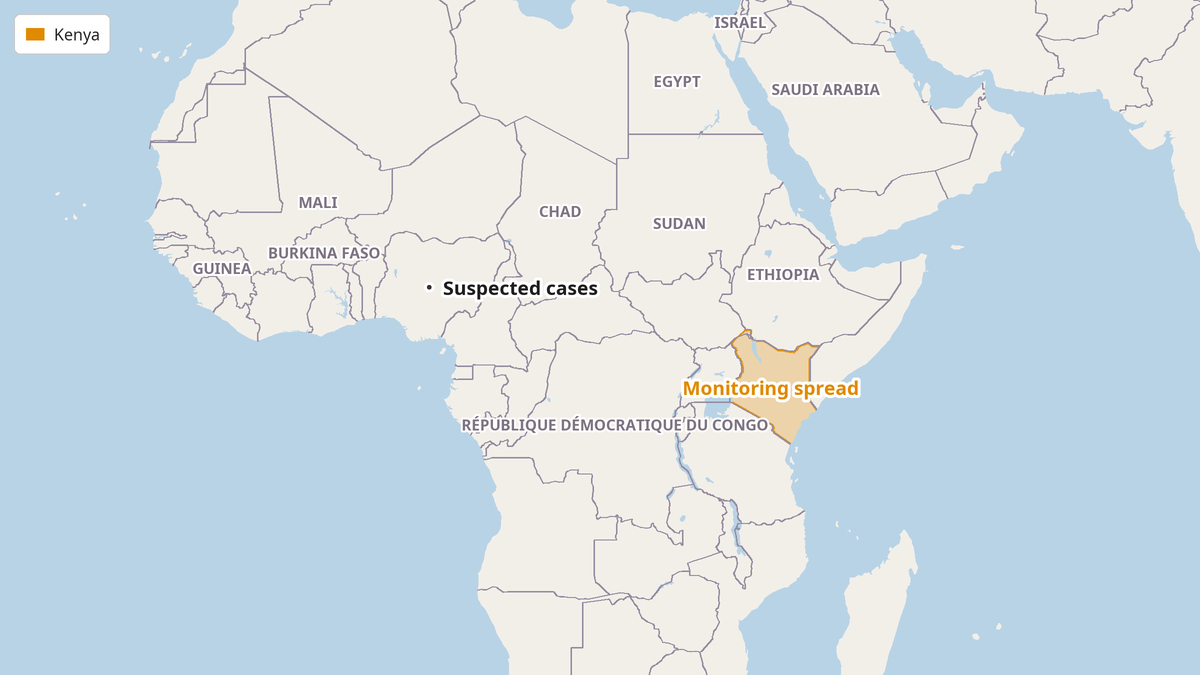
The outbreak has not stayed put. As of 28 October, three days before this report, WHO recorded nine confirmed cases and two deaths in Kenya, 20 confirmed cases and two deaths in Uganda, one confirmed case in Nigeria, and one imported case in France. Nigeria is one of five countries to have detected the virus in this outbreak.
Nigeria's first confirmed case, 11 days ago, was a woman who travelled from Uganda to Abuja and tested positive on 20 October. She was medically evacuated to Switzerland for continued treatment. The Coordinating Minister of Health and Social Welfare, Muhammad Pate, said genomic analysis showed the virus in the Nigerian patient was closely related to the strain identified in Kenya's first imported case. One traveler, one flight, one capital city.
Now the Nigeria Centre for Disease Control and Prevention has reported two new suspected cases in the North-east, both individuals isolated while contact listing continues. The agency hasn't named the states involved. It said laboratory testing is underway and that suspected status doesn't mean confirmed infection. Director-General Jide Idris said contact tracing is accounting for recent movements within the country and urged the public to avoid speculation.
The Questions That Need Answers
The official guidance to the public is handwashing, sanitiser and seeking care at designated facilities. Against a virus with no vaccine and no treatment, and with four in five new cases invisible to monitors, that's the full extent of what's on offer.
The record shows a pathogen that moved from eastern Congo to Uganda, Kenya, Nigeria and France, carried by travelers faster than tracing teams could follow. Experts quoted in the reporting say the surge raises doubts about the authorities' ability to contain it. Which governments screened arrivals, and how, is a question the published figures don't answer. Neither do they say how many contacts across five countries remain unidentified. Those are the numbers citizens in affected and receiving nations are owed.
- ebola
- ebola outbreak
- democratic republic of the congo
- nigeria
- world health organization
- bundibugyo virus
- disease outbreak
- epidemic