
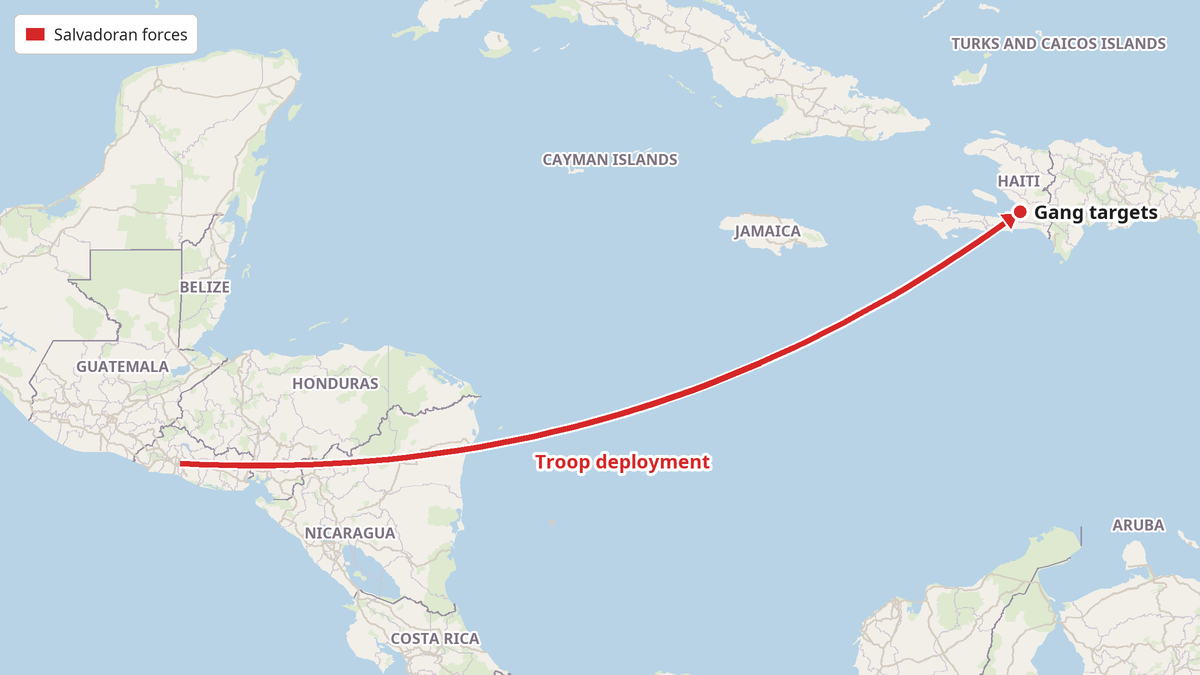
El Salvador has sent 2,500 soldiers to Haiti with little transparency or oversight, and the man who ordered them there is running for re-election in February. That's the backdrop to an offensive that President Nayib Bukele is selling to the world as a liberation, and that analysts say may be as much about votes at home as gangs abroad.
The campaign began in mid-October, about one month ago, after four Salvadoran aviation technicians working with a U.N.-backed mission went missing in a gang attack. A gang leader has since said the four are dead. As scrutiny of the operation grew, the president's message shifted from rescuing the missing men to eradicating Haiti's gangs altogether.
The Message and the Messenger
Videos of helicopter strikes on a gangster's home, cheering civilians and armored cars rolling through Haitian streets have flooded the social media accounts of Bukele, Salvadoran officials and a network of pro-government influencers. The slogan arrives in a mix of Haitian Creole, English and Spanish: "We will help you take back your country ... Finally, Haiti will be free."
"We kept our promise," Bukele posted Tuesday, sharing footage of forces bombing a gang leader's house. "Most of them ran away without even trying to fight. What cowards!"
Salvadoran political communications strategist Roberto Dubon sees a script. "It's an electoral campaign to promote Nayib Bukele and portray him as if he's a superhero. They're selling an Avengers movie," he said. "He's using Haiti as a testing ground to implement his policies on an international level."
Politics at Home
Bukele's approval sits well over 90%, and he's all but guaranteed to win in February. Still, democratic concerns hang over the vote. The legislature, controlled by his party, moved elections up from 2029 to 2027 and eliminated presidential term limits, paving the way for him to stay in power indefinitely.
Security consultant Luis Enrique Amaya said the Haiti push helps cover other soft spots: criticism of the democratic changes, a lagging economy and Salvadorans growing accustomed to freedoms they didn't have when gangs ruled daily life. "He has to construct this narrative of success (in Haiti) to strengthen his image as president," Amaya said. "Bukele won't allow even a centimeter of his popularity and legitimacy to be lost."
The bill matters too. Bukele's government says it's footing the cost of the foreign offensive. Tiziano Breda, an analyst with Armed Conflict Location & Event Data, warned those expenses could breed resentment in a country where one in four people still live in poverty.
Allies Keep Their Distance
The operation is already testing relationships. On Monday, U.S. Secretary of State Marco Rubio, a Bukele ally, said the U.S. was "not actively involved." He backed the U.N.-backed gang suppression force, which El Salvador isn't part of. "There is no plan B," Rubio said.
The same day, Amnesty International urged El Salvador and Haiti to publicly disclose the agreement allowing the troops in and to "comply with international human rights law," warning that operations could worsen violence and harm civilians.
Haiti Isn't El Salvador
Bukele weakened El Salvador's two powerful gangs by suspending key constitutional rights and detaining more than 1% of the country's population. The exiled Salvadoran news organization El Faro has also reported that he negotiated with those gangs.
Haiti is a harder target. Roughly two dozen well-known gangs operate in Port-au-Prince, and dozens more have launched deadly attacks beyond the capital. They're better armed than Salvadoran gangs once were, with weapons smuggled mainly from the U.S., and they're deeply entwined with parts of the political elite. Replicating the Salvadoran model, analysts say, is nearly impossible.
Breda sees two likely paths: an extended conflict, or quick shows of force to project victory before troops go home. Diego Da Rin, Haiti analyst for International Crisis Group, said Salvadoran troops could push Haitian police and international forces to organize better, something they've failed to do for years. But rival gangs might also unite in coalitions, as they've done before. "The Salvadoran troops' eagerness to secure quick, symbolic victories entails huge risks for civilians who can be caught in the crossfire," Da Rin said.
Why This Matters:
A government that answers to no real check on its power is now deploying soldiers abroad, with little disclosure of the terms and little oversight of the conduct. For taxpayers in a country where one in four lives in poverty, the cost of an open-ended foreign mission falls on households that never voted for it. For Washington, the episode shows the limits of friendship: even Rubio kept his distance and put his weight behind the multilateral force. The gamble could also backfire on its own terms. Symbolic victories don't dismantle entrenched, well-armed gangs tied to political elites, and civilian casualties or gang coalitions could leave Haiti worse off. Durable security usually rests on accountable institutions and clear rules of engagement. Those are exactly what critics say this offensive lacks.
- nayib bukele
- el salvador
- haiti
- gangs
- military offensive
- marco rubio
- amnesty international
- february elections