
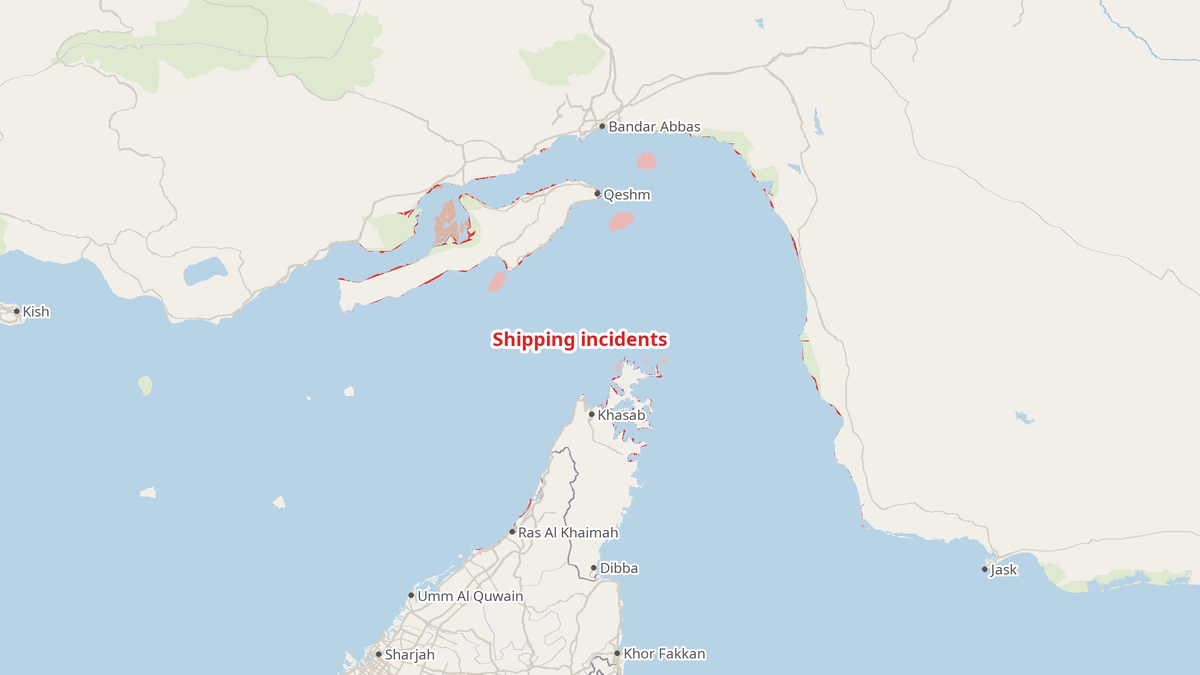
Two crude oil tankers caught fire after striking mines in the Strait of Hormuz, as Iran warned that a renewed war with the United States could spread beyond the Middle East. Iranian and Qatari officials met for a third consecutive day, seeking to end the conflict and reopen the strait to shipping.
Threats and Maritime Attacks
Iranian army spokesman Mohammad Akraminia said a new war could last longer than the previous conflict and that Washington couldn’t dictate its timing or terms. Revolutionary Guards spokesman Hossein Mohebbi warned that there would be “no geographical limitations” to the battlefield.
Manouchehr Mottaki, a former Iranian foreign minister and Tehran parliament representative, said, “If another war starts against Iran, it will spread to Europe.” He added, “Removing geographical limitations means our missiles will reach Europe.” Mottaki accused the United Kingdom, Italy, Portugal and Germany of allowing the United States to use military bases to attack Iran. “These countries are also complicit in America's crimes,” he said.
Iran's Islamic Revolutionary Guard Corps Navy said the two tankers that caught fire had taken an “unauthorised route” and “exploded after striking mines,” according to Iranian state media. Separately, the United Kingdom Maritime Trade Operations agency said a tanker was struck by two unknown projectiles on its port side at 23:47 GMT on Sunday, about 72 nautical miles east of Ras Al-Khafji, Saudi Arabia. All crew were accounted for, and officials reported no environmental impact.
US Central Command accused Iran of deliberately striking civilian infrastructure and residential neighborhoods in neighboring Gulf countries, rejecting Iranian Foreign Minister Abbas Araghchi's denial. CENTCOM also alleged that Iranian attacks at sea had killed more than 20 civilian mariners in recent months; that reported toll hasn't been independently verified. Saudi Arabia and the UAE condemned attacks on maritime targets, and Gulf nations also condemned Friday's attack on a Qatari LNG carrier.
Strikes, Negotiations and Israel
US President Donald Trump renewed threats to strike Iran at an Iowa campaign rally on Sunday, saying he had held back to avoid further casualties. “The only reason why I'm not finished with Iran is I want to be nice. I want to try and save all those lives if I can,” he told supporters. “But at some point we're going to have to give them the hammer.” Trump said the war would end “very soon, one way or the other,” but gave no timetable or details of a settlement.
Trump said the United States had “obliterated” Iran's nuclear enrichment capacity, navy, air force, anti-aircraft radar and leaders. He blamed Iran for starting the war and said the United States was “finishing it.” On Saturday, he named Pickaxe Mountain, a suspected underground nuclear complex, as one of the remaining targets. The United States could act “in 10 minutes,” he said.
Trump and Israeli Prime Minister Benjamin Netanyahu spoke Saturday about Iran and negotiations. Axios cited one US and one Israeli official who said Netanyahu pressed for strikes immediately after the US midterm elections on November 3, while Trump wanted talks to continue. Trump called the conversation “very good”; the Israeli source described it as “tough,” and the American source called it “direct.” US Secretary of State Marco Rubio said Trump hadn't decided whether to launch new strikes and preferred a diplomatic resolution.
The Jerusalem Post reported a split between US and Israeli officials over the goals of a possible operation. Netanyahu continued to discuss regime change, while officials described the Israel Defense Forces' focus as reducing specific threats. The outlet said potential targets included Pickaxe Mountain, ballistic-missile production facilities and the recovery of uranium enriched to 60% beneath the rubble of three previously bombed nuclear sites.
Hormuz and the Cost of Escalation
Iranian negotiators met Qatari mediators in Doha on November 1. Araghchi said the sides were discussing a revised two-day plan: “on the first day, the U.S. implements a set of measures, and on the second day, the Strait of Hormuz reopens and transit returns to its previous state.” He said talks were “moving toward implementation,” but no definitive agreement had been reached, and the United States hadn't publicly accepted the proposal. Iran had also sought the release of frozen assets, an end to the US naval blockade of its ports, sanctions relief and a comprehensive end to the fighting.
Oil prices had topped $100 a barrel as disruptions hit Gulf shipments through Hormuz. Reuters reported that Brent crude fell $1.51 to $111.92 a barrel and US West Texas Intermediate fell $1.78 to $102.34 in early Asian trading on Monday. Trump called higher US fuel prices “a very small price to pay” for security and predicted prices would fall after hostilities ended.
The US-Israel campaign against Iran began on February 28, and eight months had elapsed by November 2, 2026, according to the source reporting. Trump has pursued military operations while also seeking a deal and a full reopening of Hormuz. The strait remains central to negotiations and to the risk of further attacks on shipping and renewed strikes.
- iran
- united states
- strait of hormuz
- donald trump
- israel
- iran war
- nuclear negotiations
- oil prices