
Saudi Arabia said it intercepted drones in the Eastern and Riyadh regions and destroyed two ballistic missiles launched toward Khamis Mushait on Sunday, Oct. 18. Riyadh residents received a mobile-phone alert warning of a “hostile aerial threat” and telling them to stay indoors or find somewhere safe, away from windows and doors. The alert ended a few minutes later. The state’s security apparatus moved quickly, and residents followed its instructions.
Major General Turki Al-Maliki, spokesperson for the Coalition to Restore Legitimacy in Yemen, said the coalition had intercepted and destroyed the unmanned aerial vehicles and missiles. The Saudi Press Agency reported the announcements. The coalition also released footage that it said showed two ballistic missile launch platforms destroyed after they were detected firing toward Saudi Arabia.
Security orders, disrupted movement
A second account of the fighting came from Houthi military spokesman Yahya Saree, who said a day earlier that the group had shot down a Saudi Apache helicopter near Najran during what he described as hostile operations along the border. The coalition, meanwhile, said a reconnaissance AH-6i helicopter crashed in the Najran region after a technical malfunction, killing both crew members. Coalition spokesman Brigadier General Turki al-Maliki said the crash happened in an area under the Saudi National Guard Ministry’s jurisdiction. The accounts might not refer to the same aircraft.
The consequences reached far beyond the claims made by military spokespeople. Operations at King Khalid International Airport in Riyadh remained suspended, while airports in Jeddah and Dammam reported delays and cancellations. The United States Embassy in Riyadh urged American citizens to use extreme caution at Saudi airports. U.S. government employees need special authorization from the Chief of Mission to use any Saudi airport, and the embassy advised citizens to follow Saudi Civil Defense alerts and check their flight status.
The UK Foreign, Commonwealth and Development Office advised against all travel within 10km of the border with Yemen and all but essential travel elsewhere in Saudi Arabia. It warned that travel insurance could be invalidated if British nationals travelled against official advice and urged them to stay away from King Khalid International Airport after a serious incident there on Oct. 10, 2026, at about 3 p.m. local time. The office said further attacks on airports, travel disruption and flight cancellations were very likely. British nationals seeking to leave were advised to consider travelling by land to a neighbouring country and flying from there.
Diplomacy and military claims
Iranian Foreign Minister Abbas Araghchi said Tehran was ready for dialogue with the United States on the basis of mutual respect and credible guarantees, but it wouldn’t surrender its sovereign rights under pressure. Speaking at an Organisation of Islamic Cooperation meeting in Baghdad, he said Iran had submitted a seven-day plan through Qatar to reopen the Strait of Hormuz, with the decision resting with Washington.
Iran’s Deputy Foreign Minister Saeed Khatibzadeh called for fighting to end across the region, including in Lebanon. He accused the United States and Israel of violating a June memorandum of understanding by striking Iran and Lebanon, and said Washington must ensure Israel honours any ceasefire. The FCDO also said the possibility of renewed Iranian attacks remained despite a U.S.-Iran memorandum announced on June 17.
U.S. President Donald Trump said the Iran war would end “very quickly” and predicted U.S. fuel prices would fall below pre-war levels once hostilities ceased. He defended U.S. strikes on Iranian nuclear sites, saying they had crippled Tehran’s nuclear capabilities, and said American forces could stay in the Middle East longer to prevent Tehran from rebuilding them. Israeli Prime Minister Benjamin Netanyahu left open the possibility of further military action against Iran. U.S. Vice President JD Vance said the conflict couldn’t be considered over until Tehran made a firm commitment not to rebuild its nuclear programme, tying continued U.S. involvement to energy security and shipping through the strait.
Fires, attacks and civilians
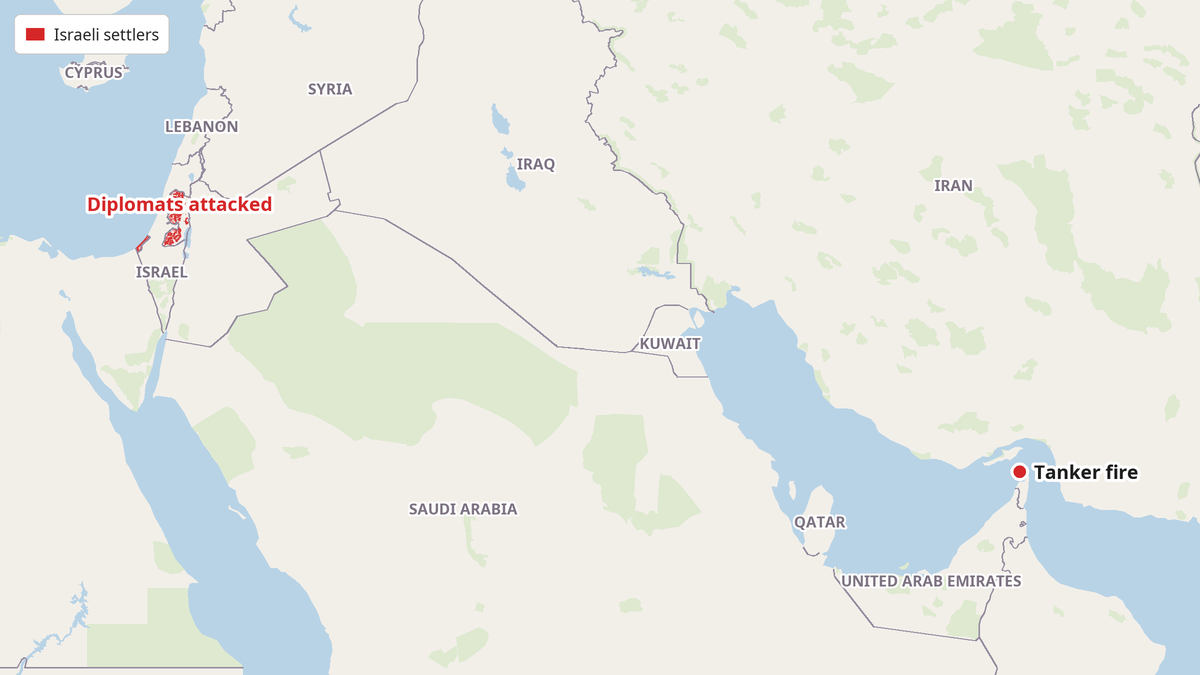
Reports of fires and attacks at sea didn’t establish a single cause for all the incidents. Al Jazeera reported fires on three tankers in the Strait of Hormuz and the Sea of Oman. Iran’s navy said an oil tanker caught fire in the Sea of Oman after the Islamic Revolutionary Guard Corps reported that a second oil supertanker struck a naval mine and caught fire in the Strait of Hormuz. Iran International reported other tanker attacks, citing the United Kingdom Maritime Trade Operations and its reports of incidents northeast of Al Jubayl, in the Arabian Sea and in the Persian Gulf.
The UK Maritime Trade Operations agency said two unknown projectiles struck a tug travelling southbound northeast of Khor Fakkan in the United Arab Emirates. The vessel suffered damage but continued on its route, and one person had minor injuries. Authorities were investigating and advised vessels to transit with caution and report suspicious activity.
Al Jazeera reported that masked Israeli settlers attacked European diplomats in the occupied West Bank, assaulting a French mayor and damaging cars. The delegation also included officials from Belgium and Poland. Gulf News reported Israeli police were investigating an alleged attack on French, Belgian and Polish diplomats. Gulf News also reported Israeli strikes killed four people across Gaza, including a 14-year-old boy. The region’s armed authorities issued warnings, made military claims and called for diplomacy. Civilians caught among those orders and operations weren’t the ones deciding them.
- saudi arabia
- iran
- houthi attacks
- strait of hormuz
- missile attacks
- tanker attacks
- israel-iran war
- yemen