
Saudi Arabia said it destroyed two ballistic missiles launched toward Khamis Mushait on Sunday, Oct. 18, and intercepted drones over the Eastern and Riyadh regions. Major General Turki Al-Maliki, spokesperson for the Coalition to Restore Legitimacy in Yemen, said the coalition intercepted and destroyed the drones and missiles. It also released footage that it said showed two ballistic missile launch platforms destroyed after they were detected firing toward the kingdom.
Riyadh residents received a mobile-phone alert early Sunday warning of a “hostile aerial threat,” AFP journalists reported. The message urged people to stay indoors, away from windows and doors. A few minutes later, officials lifted the alert.
The Threat Picture
The attacks don’t come from nowhere. The Wall Street Journal, citing people briefed on intelligence from Saudi Arabia and Yemen’s anti-Houthi alliance, reported that Iran has helped the Houthis target Saudi Arabia and its Yemeni allies with drone and missile attacks. It has also provided training, intelligence and tactical guidance for strikes. The Houthis aren’t improvising. They’re being coached.
The human and economic costs are already visible. King Khalid International Airport in Riyadh remained closed Sunday, while airports in Jeddah and Dammam reported delays and cancellations. The U.S. Embassy in Riyadh urged American citizens to use extreme caution at Saudi airports. U.S. government employees need special authorization from the Chief of Mission to use any of them.
The UK Foreign, Commonwealth and Development Office went further. It advised against all travel within 10km of the Yemen border and all but essential travel elsewhere in Saudi Arabia. It also told Britons to stay away from King Khalid International after a serious incident there on Oct. 10, 2026. Further attacks on airports, travel disruption and flight cancellations were “very likely,” the office said. It added that renewed Iranian attacks remained possible despite the U.S.-Iran memorandum of understanding announced on June 17.
The coalition said a reconnaissance AH-6i helicopter crashed in the Najran region after a technical malfunction, killing both crew members. Houthi military spokesman Yahya Saree had said a day earlier that the group shot down a Saudi Apache helicopter near Najran. It wasn’t clear whether the accounts referred to the same aircraft.
Shipping Under Fire
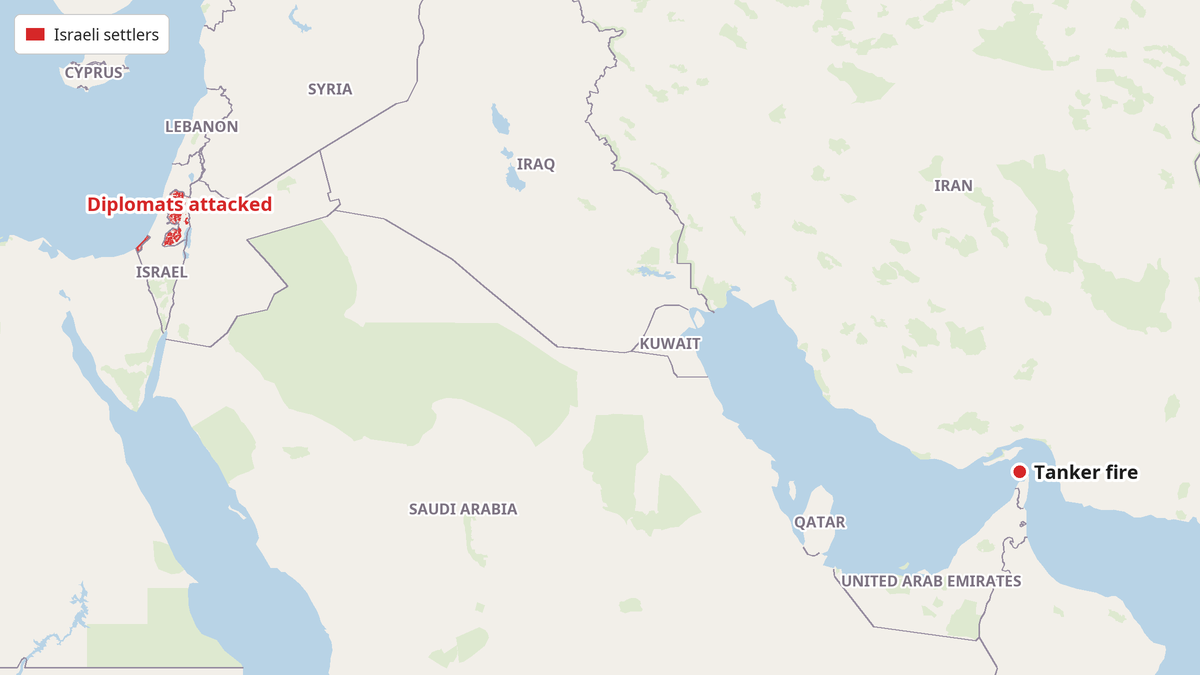
The Gulf’s sea lanes are burning too. Iran’s navy said an oil tanker caught fire in the Sea of Oman after the Islamic Revolutionary Guard Corps reported that a second oil supertanker struck a naval mine and caught fire in the Strait of Hormuz on Saturday. Al Jazeera reported fires on three tankers across the two waterways. Iran International, citing the UK Maritime Trade Operations agency, reported that two tankers came under attack northeast of Al Jubayl, Saudi Arabia, on Friday. The accounts didn’t establish a single cause for all the incidents.
On Sunday, two unknown projectiles struck a tug northeast of Khor Fakkan in the United Arab Emirates. The vessel kept going. One person suffered minor injuries.
Tehran, meanwhile, is claiming the waterway as its own. Ali Shirazi, head of the ideological and political organization of Iran’s police force, said, “A new order has been imposed on the management of shipping and energy transit in the Persian Gulf and the Strait of Hormuz without the slightest US intervention,” according to the IRGC-linked Tasnim news agency.
Diplomatic Signals
Iranian Foreign Minister Abbas Araghchi said Tehran was ready for dialogue with Washington based on mutual respect and credible guarantees, but wouldn’t surrender its sovereign rights under pressure. He said Iran had submitted a seven-day plan through Qatar to reopen the Strait of Hormuz. Deputy Foreign Minister Saeed Khatibzadeh accused the United States and Israel of violating the June memorandum by striking Iran and Lebanon.
Iranian hardliners are using a different tone. The Kayhan newspaper, whose editor-in-chief is appointed by Iran’s supreme leader, said Iran should strike Israeli nuclear facilities in response to any U.S. attack on Pickaxe Mountain, a fortified underground complex near Natanz. Iran calls it a centrifuge assembly facility. A lack of inspector access has raised questions about whether it could have other nuclear uses.
U.S. Vice President JD Vance said the conflict couldn’t be considered over until Tehran made a “final firm commitment” not to rebuild its nuclear programme. President Donald Trump said American forces could remain in the Middle East longer to prevent that. Israeli Prime Minister Benjamin Netanyahu left open further military action, warning the threat would return unless it was removed.
Others want talks. Egypt’s and Turkey’s foreign ministers called for renewed U.S.-Iran negotiations, and Gulf News reported that Egypt offered to defend Saudi Arabia if requested. Lebanon’s President Joseph Aoun said a military delegation would join a meeting with Israel and the United States in Tampa, Florida, on Oct. 20.
Other Fronts
Israeli police were investigating an alleged attack by masked settlers on French, Belgian and Polish diplomats in the West Bank, Al Jazeera and Gulf News reported. A French mayor was assaulted, and cars were damaged. The Washington Post photographer Heidi Levine underwent surgery after an alleged settler attack. Gulf News also reported Israeli strikes killed four people across Gaza, including a 14-year-old boy.
Why This Matters: The Saudi interceptions show how Iran’s proxy network keeps pressure on Gulf states even while Tehran talks about dialogue and guarantees. Airport closures, tanker fires and mined waterways hit global energy supplies, which is why Vance tied U.S. involvement to gasoline prices. From a security standpoint, the central question is whether any deal will bind Iran on its nuclear programme and on the proxies it trains and arms. Without verifiable commitments, Israel and its Gulf neighbors have little reason to assume the attacks will stop. The settler assault on European diplomats is a separate problem that Israeli authorities are investigating, and one that hands Israel’s critics ammunition at a delicate diplomatic moment.
- saudi arabia
- iran
- houthi attacks
- strait of hormuz
- missile attacks
- tanker attacks
- israel-iran war
- yemen