
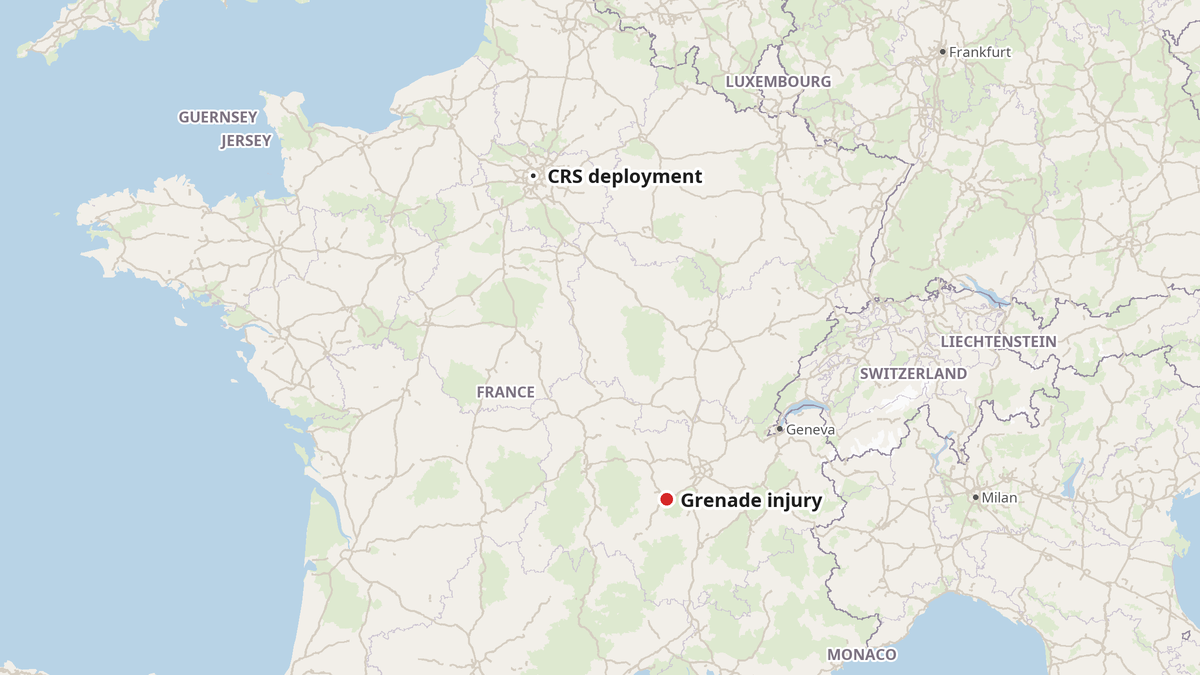
More than 2,000 people were arrested and about 600 police officers, firefighters and paramedics suffered injuries on Saturday, Oct. 17, as protests over living costs and public services gave way to arson, looting and clashes in cities across France. In Saint-Étienne, a crowd-control grenade cost a 17-year-old boy his right hand.
The night's violence overshadowed a very different start to the day. Channel 4 reported that more than 500,000 people were thought to have joined demonstrations. The Irish Times said tens of thousands marched peacefully, while violence and looting took place separately in Paris, Bordeaux, Nice and Marseilles.
The Marchers' Demands
Students, workers, parents, teachers and grandparents joined the peaceful marches. They demanded more teachers, repairs to deteriorating schools and increased funding for public services, while protesting the high cost of living. The marches followed four weeks of street protests and school barricades. Banners said the government wasn't listening. On Sunday, hundreds returned to Paris's Place de la République, where police maintained a heavy presence.
Violence on the Streets
Separate groups moved from place to place, setting fires, barricading streets and acting violently, while masked looters smashed shopfronts and took goods. In Paris, some looters appeared to be children; witnesses also saw masked adult men smashing shopfronts. Police said officers had arrested a record 855 people in the capital. Burnt barricades made of bicycles, bins and other materials, smashed windows and the remains of torched cars remained on Paris streets Sunday. Socialist deputy mayor Lamia El Aaraje said the city had seen “a level of violence that we have never seen before, I believe”.
Public buildings also came under attack. Fire destroyed Limoges' 19th-century town hall, and part of its roof collapsed. Mayor Guillaume Guérin said those who stormed it “were not demonstrators that defend causes” but “people organised for war”. He said attackers threatened to kill a caretaker and told elected officials they would “burn”. Municipal police were present in number, but, Guérin said, they could no longer fight the rioters at about 3.30pm because they had run out of ammunition. He called it “a colossal failure of the state”.
In Marseilles, masked groups stormed city hall and a police station. Socialist mayor Benoît Payan told BFMTV: “I have no words ... I never thought I'd ever live through something like this. Hordes of rioters and looters attacked our common [state] buildings ... with no real demands, but with the sole aim to wreck the demands of those who had demonstrated legitimately.” He said people should question policing tactics. Attackers also targeted town hall buildings elsewhere, including in Lille.
Local Voices Urge Nuance
Lyons' Green mayor, Grégory Doucet, told Le Monde: “I'm stunned by the violence against public and state property. I saw and heard fear and anger. Shop owners felt abandoned.” He called for a “sense of nuance” and urged the government to examine events while “avoiding stereotypes”, respond politically to peaceful demonstrators' long-running social demands, and investigate the roots of the violence.
Traders' unions said rioters had ransacked more than 1,500 shops and businesses, causing damage worth tens of millions of euros. A Paris shoe-shop owner said: “This had nothing to do with the peaceful protesters. These were organised groups who were breaking things and looting. We'd never seen anything like it.”
Government Under Fire
Opposition politicians questioned policing tactics, saying the state lacked intelligence. Politicians from the left and right called for Interior Minister Laurent Nuñez to resign, arguing that the government appeared surprised by the scale of the violence.
President Emmanuel Macron wrote on social media that France had “no place for violence”. In a separate statement reported by DW, he said nothing justified the “unbridled violence”, vowed to punish rioters and vandals, and urged people to distinguish protesters from vandals. He planned to address the nation on Sunday night. Channel 4 reported that the government was expected to declare a state of emergency, while the Irish Times said crisis talks were under way on Sunday.
Macron's centrist government and Marine Le Pen, described as the far-right front-runner in the presidential election, blamed what they called “ultra-left” groups. Prime Minister Sébastien Lecornu said the government wouldn't be “intimidated”, then answered critics: “Laying the responsibility for violence on heads of police is a dangerous and cynical reversal of responsibilities.” Radical-left presidential candidate Jean-Luc Mélenchon, who joined Saturday's peaceful demonstration in Paris, accused the government of organisational failings that had “opened the door to chaos”.
Why This Matters: The facts point in two directions, and both deserve weight. Hundreds of thousands marched peacefully for teachers, school repairs and public funding; mayors from the Socialist and Green parties say looters actively damaged those demands. Yet marchers had already spent four weeks on the streets, carrying banners that said the government wasn't listening. Doucet's call to meet peaceful protesters' long-running social demands while investigating the roots of violence captures the test facing Paris: firm action against arson and looting, alongside a real political response on schools and living costs. A state of emergency alone would address only one half of that.
- france
- protests
- cost of living
- public services
- emmanuel macron
- paris
- arson
- police