
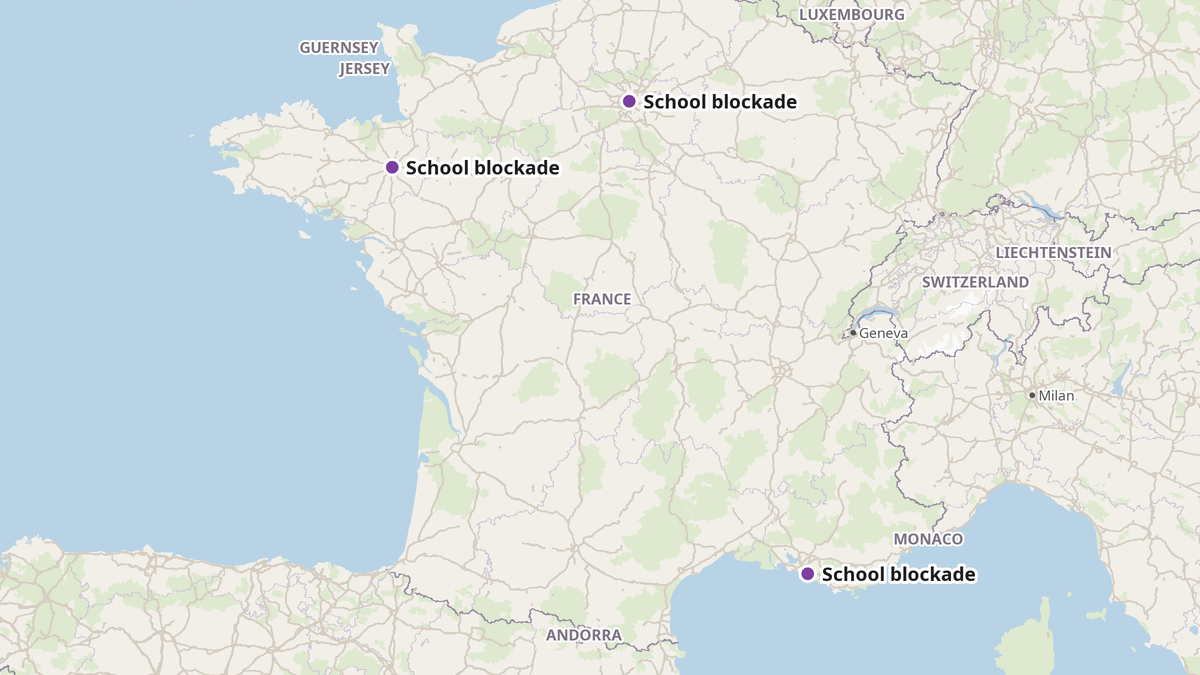
France’s government faces renewed school protests, but it has little room for extra spending as pressure to rein in debt grows and the economy teeters on the brink of recession. By 08:30 GMT on Monday, Nov. 2, students had blockaded 41 high schools—about 1% of the country’s 3,700 lycées for students aged 15 to 18—the Education Ministry said.
Protests returned after the autumn holidays. The scale remained far below the hundreds of schools blockaded in the weeks before the break, though attempts to block entrances were reported in Paris, Marseille and Rennes. Television footage showed police at schools, but officers weren’t wearing full anti-riot gear.
The government’s room to respond
Education Minister Édouard Geffray announced proposals last week, after the government laid out measures during the holiday break. He offered to cap classes at 28 pupils, spend €4 billion ($4.47 billion) renovating schools, create 15,000 new higher-education places and introduce a new university admissions system by 2028.
The government had also announced changes to university admissions, more teachers and a limit on pupils per class. Student representatives said the offers weren’t enough and that protests would continue. They want aging schools renovated, more teachers hired, extra university places and an end to an admissions system they consider socially unfair.
The proposals come as the European Union’s second-largest economy stands on the brink of recession and the government faces pressure to rein in debt. The spending dispute is national in scope: officials have limited room to find additional money for the measures students demand.
Attendance and the protests
Protests began in the Paris suburbs in September, then spread across France. Students first focused on learning conditions and inequality. Later, they expanded their demands to include the cost of living, drawing in trade unionists and activists. Some demonstrations turned violent.
Hundreds of thousands of people, students among them, took to the streets on the Saturday before classes resumed, during a third consecutive weekend of demonstrations. The previous month, protests in several cities degenerated into clashes with police and riots, and shops were looted. The unrest tested President Emmanuel Macron’s minority government.
In Marseille, several garbage bins stood stacked in front of a high school entrance. “We've resumed the movement because we were supposedly given answers, but... it's clearly not enough,” 16-year-old Meriem told AFP, perched on a dumpster.
Classes and national policy
Education Minister Édouard Geffray said protests were permitted, but blocking access to schools was illegal. “In terms of blockades – or rather, attempted blockades – the phenomenon is very marginal. We're talking about just a handful of units, a few individual schools,” he told France Inter.
Geffray urged students to return to class so they wouldn’t fail exams. “I have students who are sitting the baccalaureate at the end of the year and several hundred thousand of them haven't attended classes for four or five weeks,” he said. President Emmanuel Macron also called for classes to resume calmly, saying “young people have been heard.”
So-called “Gen Z” protests have also swept across Germany, Italy, Belgium and Albania. Reported grievances include the cost of living, poor school conditions and perceived corruption. In France, the immediate dispute remains focused on school conditions, university access and whether the government can fund its response while facing economic and debt constraints.
- french high schools
- student protests
- france
- education
- school blockades
- édouard geffray
- university admissions
- cost of living