
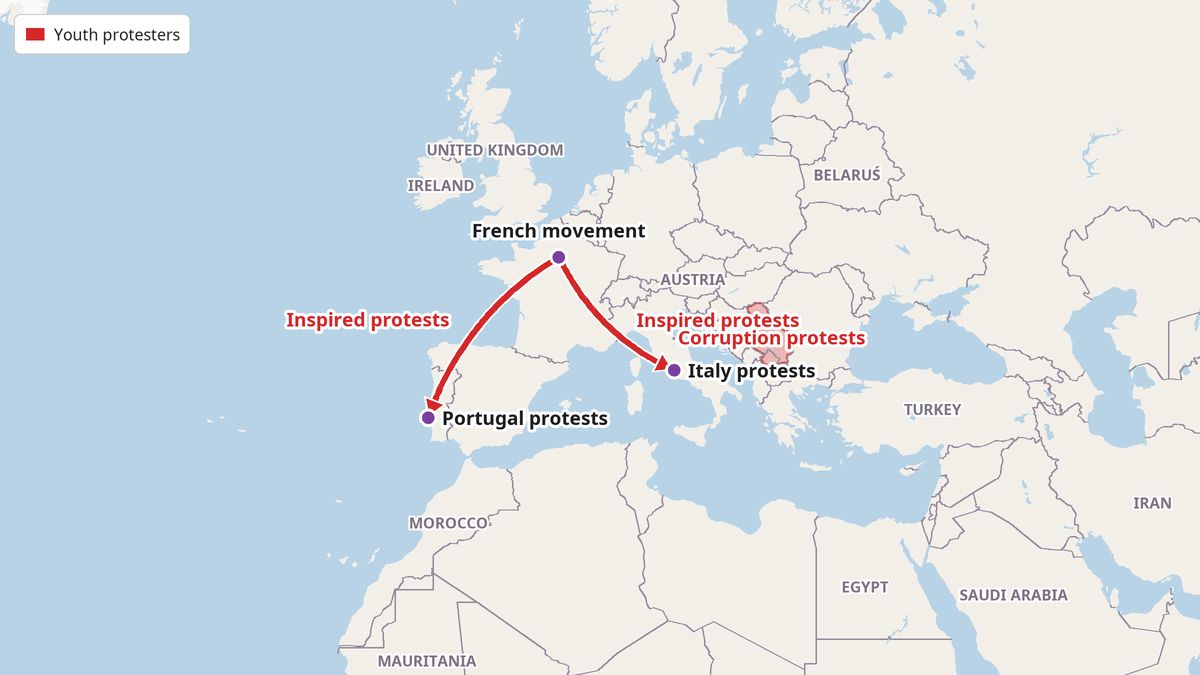
Three hundred and twenty thousand people marched in France on Saturday, according to the interior ministry. It was the third straight weekend. Across Portugal, Italy and Germany, hundreds of thousands more joined youth-inspired rallies on October 31, and in several cities the day ended in violence.
The base facts are stark. Protests that started in France have spread to Portugal, Italy, Germany, Belgium, Spain and Albania. Most marches were peaceful. Not all of them stayed that way.
Who Is Marching, and Why
In Germany, the largest rallies were led by a youth initiative whose name roughly translates as "Gen Z has got this." Demonstrators demanded better education and healthcare, stronger climate protection and a more affordable cost of living. They also rejected any return to compulsory military service. Protests in several major German cities turned violent toward the end of the day, particularly in Frankfurt.
In Lisbon, thousands marched to demand more affordable housing, carrying signs aimed at the government of Prime Minister Luis Montenegro. Riot police removed protesters by force overnight from Rossio, an iconic square in the downtown, where a few hundred had camped out. Police moved in early Sunday, pulling down tents and pushing people away. A few were detained. Portuguese demonstrators have been protesting for weeks over rising living costs, housing above all.
Unrest and Arrests
bne IntelliNews reported clashes in Milan, Turin and Bologna. In Spain, Catalan police raised their alert to the highest level after rioting in Barcelona on October 24 led to about 130 arrests, most of them minors. In Albania, students have been on the streets since October 13 demanding the resignation of Prime Minister Edi Rama.
The triggers differ by country. Schools in France and Belgium. Housing in Spain and Portugal. The cost of living in Italy. Corruption in Serbia. Thomas Fazi, writing in UnHerd on November 1, put it this way: "These are the protests of a generation that believes it has been robbed of its future." The social contract their parents knew has collapsed, according to Fazi.
The Cost to Our People
bne IntelliNews traced the unrest to a cost-of-living crisis that began with an energy shock. Governments, it reported, have worsened the squeeze by diverting money to rearmament and the war in Ukraine. Young people are asking why housing, schools and hospitals are unaffordable and underfunded while public money flows elsewhere.
The political signal is already in the polling. A third of French under-25s backed the Rassemblement National in 2024, according to the report. More than a quarter of young German men voted for the Alternative for Germany, which tops national opinion polls, according to Fazi.
The Questions Left Unanswered
The base reporting names housing, schools and living costs as the grievances. It does not say what share of public budgets goes to which priorities, nor how population pressure bears on housing demand in Lisbon, Barcelona or Milan. Those are the numbers governments have not put in front of the marchers.
What the reporting does establish is the scale: a generation across a dozen countries, voting one way at the ballot box and now marching in the streets, telling its governments that the future they were promised has gone. The protesters want affordable homes, working schools and a say in how their countries spend their money. In Frankfurt, Lisbon and Barcelona, those demands ended the weekend with riot police and detentions.
- youth protests
- europe
- germany
- france
- portugal
- housing costs
- cost of living
- student protests