
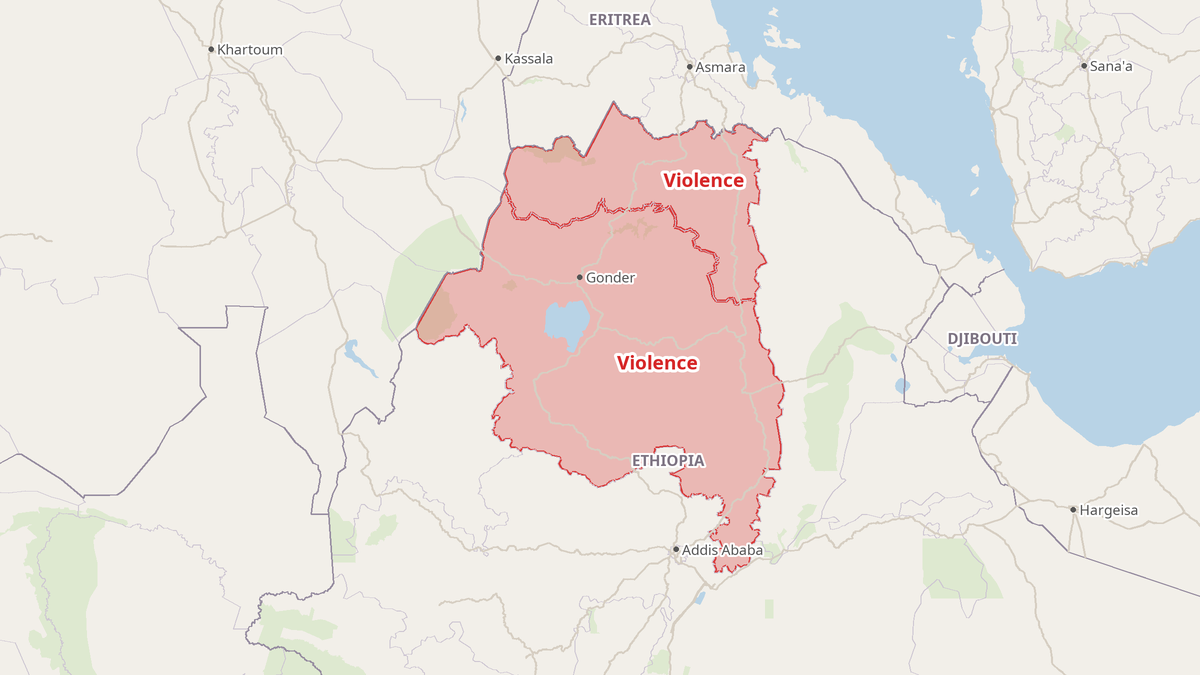
At least 16 civilians died and 22 were injured when a drone struck the Hayiq Jari 2 Turk displacement camp in Amhara on October 29. The latest Ebola outbreak in Africa has killed 5,376 people. War and disease are straining health systems, while ordinary people bear the consequences.
Camp residents told Addis Standard that those killed included women, children and elderly people, among them an eight-year-old girl, three pregnant women and students. Witnesses said a drone struck the camp at least five times while displaced people sheltered there. More than 20 household shelters reportedly caught fire, leaving families without shelter or belongings.
Civilians Under Fire, Care Out of Reach
On October 30, a drone strike killed at least 12 civilians in Rama town, Central Tigray, local sources told Addis Standard. People had gathered to collect sorghum scattered from a grain truck that an earlier drone strike had hit. A separate witness told AFP that 13 people died. A medical source at a nearby hospital confirmed 11 fatalities and said two more deaths had been reported.
World Health Organization Director-General Tedros Adhanom Ghebreyesus (PhD) called civilian casualties in Amhara and Tigray “deeply disturbing.” He said drone attacks and civilian casualties had “tragically become frequent across Ethiopia” and warned: “The violence in northern Ethiopia is pushing an already fragile health system closer to collapse.”
Hospitals lack health workers, medicines and equipment. Ambulance services remain severely limited, and insecurity blocks life-saving medical supplies from reaching some areas. WHO and United Nations partners are working to deliver additional supplies, while Tedros warned that continued fighting could deny people emergency services, maternal and child health care, and disease treatment. “Civilians must be protected. Health workers and humanitarian supplies must be allowed to reach those in need,” he said.
Renewed fighting between Ethiopian Government forces and rebel groups resumed in Amhara, Tigray and Afar in September 2026, nearly four years after a peace deal. UN Secretary-General António Guterres warned of escalation and wider destabilization. A statement from his spokesperson urged the parties to spare civilians and critical infrastructure and agree to a cessation of hostilities as a first step toward ending the conflict.
An Outbreak Without an Approved Vaccine
The Bundibugyo strain has infected about 10,444 people in the Democratic Republic of the Congo (DRC), Uganda and Kenya, with a death rate above 50%. The DRC, the outbreak’s epicentre, declared its 17th and largest Ebola outbreak in mid-May 2026. The outbreak has killed 5,372 people in the DRC and two each in Kenya and Uganda, according to Africa Centres for Disease Control and Prevention data reported Monday.
Uganda recorded 20 cases, almost all among people who had travelled from the DRC, before declaring itself Ebola-free in August 2026. Kenya recorded two deaths and nine infections in October 2026, its first recorded Ebola cases. Abuja reported its first imported case in October 2026, its first in more than a decade, with no deaths. Nigeria also reported negative results from two rounds of tests on two suspected cases in the northeast. France reported one case in July 2026 involving a health worker returning from the DRC.
No approved treatments or vaccines exist for the rare Bundibugyo strain. Clinical trials began in recent weeks with the Ervebo vaccine, which has proved effective against the more common Zaire strain.
Growth Forecasts Meet the Cost of War
The International Monetary Fund forecasts real growth of 9.2% for Ethiopia’s 2025–26 fiscal year, driven in part by agriculture, mining and electricity generation. But London-based financial analyst Abdulmenan Mohammed warned: “If there is a major conflict [...] the current economic growth will not be sustainable.” Sectors and regions outside conflict zones can keep growing even as affected areas suffer.
A World Bank-backed damage and needs assessment put damage caused by several conflicts between November 2020 and December 2021 at more than $22.6 billion (€20.2 billion), with economic losses of around $6 billion. The estimated $19.7 billion for reconstruction and recovery is the total funding need, not an annual cost or a measure of damage from the current escalation. A reconstruction plan covers 2023 to 2028, but whether it can be fully funded and completed on time remains uncertain.
Mohammed warned that military spending on personnel, equipment and logistics could divert resources from public needs: “a substantial share of government resources would be tied up in military spending that would otherwise be available for infrastructure, education and social services.” The impact depends on the scale and duration of renewed conflict. A prolonged war could delay business investment and leave less funding for roads, energy infrastructure and other development projects.
The IMF forecasts average inflation of 11.7% for 2025–26. Mohammed said: “If the conflict escalates further, inflation is likely to rise.” Rising prices and uncertain incomes would hit poorer households especially hard. Tedros said: “The most courageous choose peace. The best medicine is peace.”
- ebola outbreak
- democratic republic of the congo
- ethiopia
- health systems
- drone strikes
- tigray
- amhara
- world health organization