
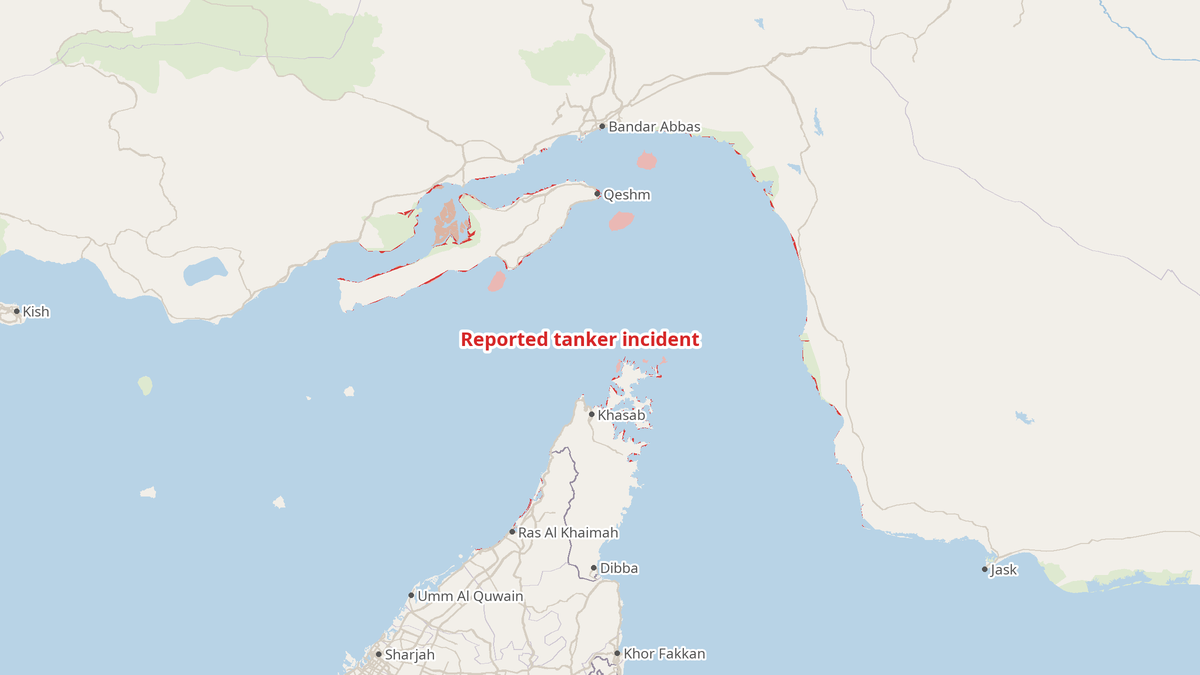
A tanker carrying more than 2 million barrels of crude oil exploded and caught fire in the Strait of Hormuz on Saturday after striking what Iran's Revolutionary Guards described as a naval mine, Iranian media reported. The initial reporting says nothing about the crew. Nothing about casualties, injuries or rescue. That silence matters: a loaded crude carrier is a workplace for sailors who have no say in the politics of the waterway they cross.
The claim comes with a heavy caveat. The material available offers no independent verification, and the Guards' account remains the only version on the record so far.
What Iran Says Happened
The Revolutionary Guards said the tanker was trying to pass through the strategic waterway on a route Iran had not authorized, according to Iranian media. The Guards are linking the blast to the vessel's choice of path. The reporting doesn't say who laid a mine, when it was laid, or how the Guards determined the tanker had strayed from an approved route. Those answers could show whether this was an accident in a militarized waterway or something more deliberate.
The National's live updates carried the same Guards claim that a tanker exploded after striking a mine. They also listed a separate incident: a tanker hit by an unknown projectile off the Saudi coast, in a report attributed to the UKMTO. The accounts treat the two events separately, and nothing in the material links them. Together, though, they sketch a sea where commercial vessels are being struck, while crews aboard bear the risk.
A Waterway Still Choked
The National's updates reported that Strait of Hormuz transits remained 70% below pre-conflict levels. That figure is the quiet headline. Shipping hasn't recovered, and every new explosion gives owners, insurers and crews another reason to stay away. Fewer ships moving means slower deliveries of fuel and goods that economies, including fragile ones, depend on.
The same live updates carried other signs of a region in motion. Araghchi arrived in Baghdad for an OIC summit, with diplomacy running alongside military action. A coalition also claimed it had destroyed missile launchers in Yemen's Saada. The reporting doesn't connect these developments to the tanker blast, and they shouldn't be read as connected. Diplomacy and force are unfolding at the same time, on October 17, 2026.
What Remains Unknown
The gaps are large. The reporting doesn't name the tanker, its flag, its owner or its crew. It doesn't say whether anyone was hurt or killed. Nor does it say whether the fire is still burning or crude is leaking into the water. If breached, a cargo of more than 2 million barrels would carry environmental consequences for coastal communities with no part in the dispute.
Until independent confirmation arrives, the Guards' account remains what it is: a claim from a party with its own interests in how the waterway is described. That's not a reason to dismiss it. It's a reason to keep asking who verifies the claim and who is counting the people on board.
Why This Matters:
When a loaded tanker burns in one of the world's most important shipping lanes, the first cost is human, and the reporting so far offers no word on the crew. The second is economic: with transits still 70% below pre-conflict levels, every new incident deepens disruption that ordinary people feel at the pump and in the market. The third is diplomatic. A mine claim, a projectile strike off the Saudi coast and a coalition strike in Yemen all came on the same day Araghchi arrived in Baghdad for an OIC summit. Diplomacy is moving, but so is violence, and mariners are caught between them. Independent verification isn't a technicality here. It's the difference between an accident, a warning and an escalation.
- strait of hormuz
- oil tanker
- naval mine
- iranian revolutionary guard
- oil spill
- maritime incident
- crude oil