
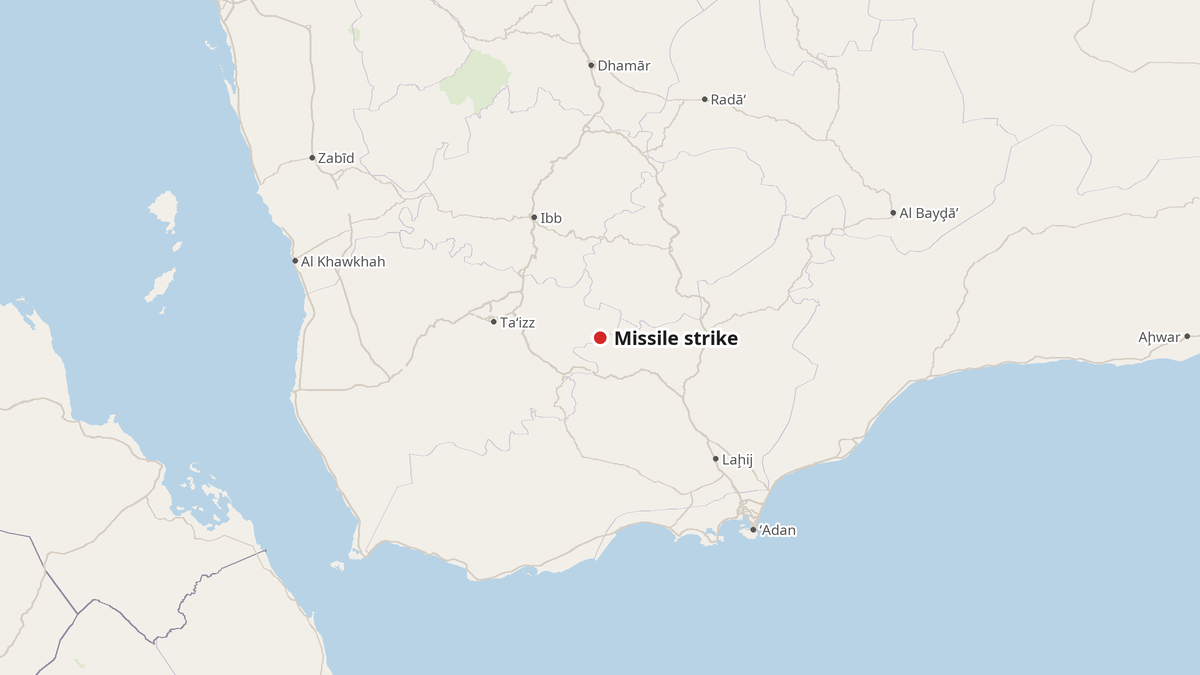
At least 53 people were killed and 200 injured on Monday, October 19, when three ballistic missiles fired by the Iran-aligned Houthis hit the Al Alam military training camp in Yemen's Shabwa province, local authorities told several reports. The recruits were training to join internal security forces. L'Orient Today reported more than 30 killed and at least 70 wounded; Shabwa authorities said their preliminary toll could rise.
Majed al-Nuzaili, spokesperson for the Yemeni armed forces, wrote on X that the camp trained security and police services. A Yemeni military official, speaking anonymously because they weren't authorized to talk to the media, said the missiles struck as recruits lined up for training. The Houthis acknowledged targeting the camp. Civilians and new recruits remain beneath the calculations of armed organizations competing for territory and control.
The apparatus answers with escalation
The provincial government called the strike an “extremely critical military escalation and a blatant aggression on the security and stability of Shabwa province.” It urged Yemen's president, the Saudi-led coalition and the government to expedite air-defense and early-warning systems. The response sought more military capacity; no account in the report described a protection system that could keep recruits out of the firing line.
Rashad al-Alimi, head of Yemen's ruling Presidential Leadership Council, promised a “firm response.” He said the attack reflected the Houthis' “approach of resorting to cowardly terrorist attacks whenever they face pressures or their Iranian-backed sabotage plots falter.” Rival authorities speak in the language of security and retaliation. Forces and people caught among them bear the consequences.
A military source in Shabwa told AFP the army feared the strikes could precede a ground offensive “similar to what happened in Mocha,” referring to the Houthis' seizure of the strategic port city near the Bab al-Mandab strait. The source said the Houthis cut a road linking government-held Shabwa with Houthi-controlled Al-Bayda province on Sunday. Locals said they couldn't use it. Armed power decided who could move.
A cease-fire gives way to rival campaigns
The attack came amid intensified fighting between the Houthis and Yemen's internationally recognized government, backed by a Saudi-led coalition. In September, the Houthis advanced toward territory near the Bab el-Mandeb Strait, a shipping chokepoint at the mouth of the Red Sea. Government forces began a campaign this month to recapture Houthi-controlled areas and regain ground near the strait. The Houthis besiege Taiz, the last major urban stronghold of anti-Houthi forces in Yemen's southern highlands, while the Saudi-led coalition launched a major offensive this month to dislodge the rebels from the strategic Red Sea coast.
The fighting shattered a 2022 cease-fire deal that had largely halted the civil war, according to Daily Sabah; L'Orient Today said the truce had largely held since 2022 before collapsing. The war began in 2014, when the Houthis seized the capital, Sanaa, and drove the government south. A Saudi-led military intervention followed in 2015, producing a bloody stalemate before the truce. Agreements paused the fighting. They didn't remove the armed powers contesting Yemen.
Regional power, local casualties
The fighting has become another front in the wider war involving the United States, Israel and Iran. U.N. and other experts say Iran and its allies in Lebanon and Iraq provide the Houthis with expertise, training and sophisticated weapons; Iran denies arming the group, which would violate a U.N. embargo. Saudi Arabia joined the war in 2015 after the rebels seized much of northern Yemen, including Sanaa, fearing a well-armed ally of Shiite Iran on its border.
A separate airstrike blamed on Saudi-led forces killed at least nine people in the Houthi-held northern province of Saada on Sunday, the Houthi-run Health Ministry said. Five children and two women were among those killed. The rebels said several strikes over the weekend killed or wounded more than 30 people. Saudi Arabia made no immediate comment.
Yemen is already one of the world's worst humanitarian crises, and aid agencies warn conditions are deteriorating rapidly. Shabwa, an energy-rich province overlooking the Gulf of Aden, is home to the Balhaf liquefied natural gas facility, Yemen's largest industrial investment. Reuters-verified video from Shabwa showed injured people and bloodied bodies scattered across the ground. Armed campaigns continue. People on the ground are counted afterward.
- houthis
- yemen
- shabwa province
- missile attack
- yemen civil war
- saudi-led coalition
- bab el-mandeb strait
- iran