
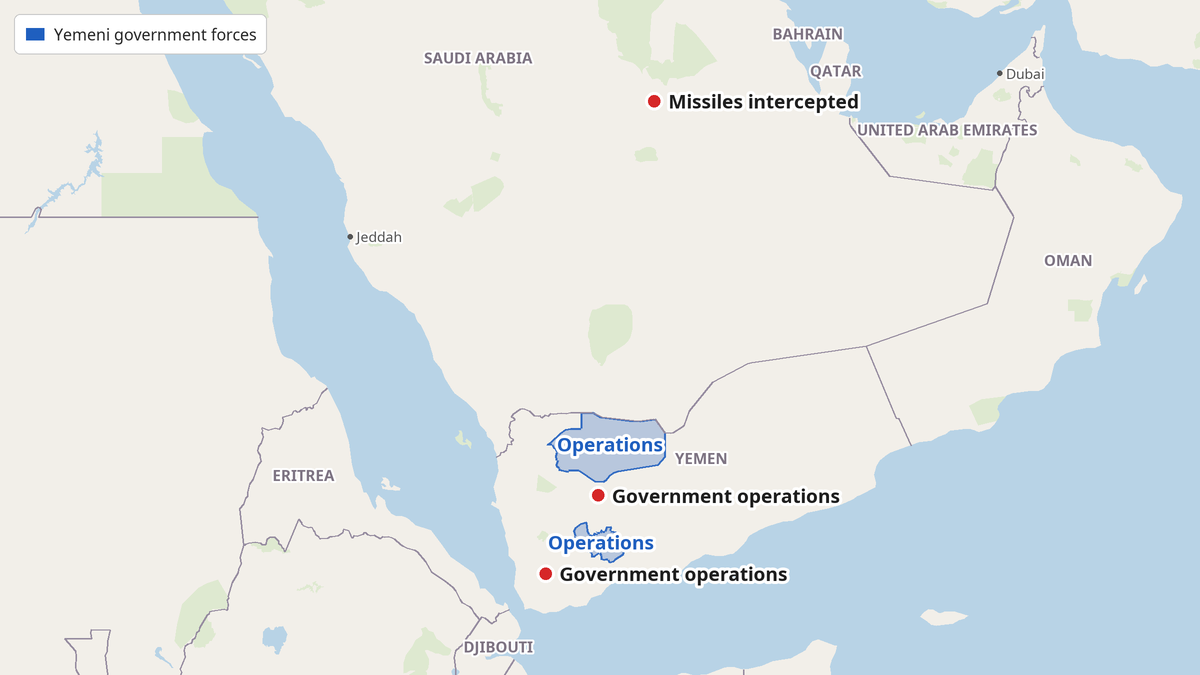
Yemeni government forces said Wednesday they carried out 773 field artillery bombings, 44 drone strikes, 37 rocket attacks and 23 air strikes against the Houthis, killing and wounding 138 fighters and damaging 86 heavy weapons and military vehicles. The tally came from Majed Abdullah al-Nuzaili, a spokesperson for Yemen's government forces, in a post on X.
The numbers are large. The context is larger. Middle East Eye reported separately that the Houthis, who are aligned with Iran, are bombing Saudi Arabia as they look to extend their territory in Yemen. That's an Iran-backed force striking a sovereign neighbor while pushing to widen its grip on Yemeni ground.
The Jihadist Axis on the Saudi Border
Nuzaili said operations against the Houthis continue in al-Jawf, Marib, al-Bayda, Taiz and the southern sectors. Five fronts. One militia, known as Ansar Allah, Arabic for "Supporters of God," pressing outward from its territory.
The Houthis don't fight in isolation. The base reporting describes them plainly as aligned with Iran, and Tehran's posture toward the war tells its own story. The Saudi-backed, internationally recognised government is the party fighting to stop the expansion. The Iran-aligned militia is the party seeking to extend its territory and striking the kingdom to do it.
Tehran Offers to Mediate Its Own Ally's War
Iran's response to the fighting came from Mohammad Bagher Ghalibaf, the Iranian parliament speaker and top negotiator. He told Al Jazeera that on the fighting in Yemen between the Saudi-backed government forces and the Houthis, "no one should interfere."
Then he added an offer. "If both the government in Yemen and Saudi Arabia were to ask for our help, we would certainly offer our assistance to help resolve their conflict," Ghalibaf said.
Read that again. The patron of the militia bombing the kingdom casts itself as a neutral helper, available if the victims of the attacks come asking. Iran made a similar move in October, when it offered to facilitate talks between Saudi Arabia and the Houthis following a series of deadly attacks on the kingdom, about one month ago. The pattern holds: the attacks come first, the mediation offer follows.
What the Warning Means
Ghalibaf's line that "no one should interfere" carries weight when set beside the facts above. The Houthis are an Iran-aligned force bombing Saudi territory. Tehran tells the world to stay out of the fight and positions itself as the one party able to settle it.
The Saudi-backed government's offensive, by its own count, hit Houthi fighters and equipment across multiple provinces in a single day. The Houthis, meanwhile, keep striking the kingdom as they seek more ground in Yemen.
The same Iranian leadership now brokering is the leadership whose aligned militia is doing the bombing. Gulf states and their Western partners are left to ask who benefits when the arsonist offers to help put out the fire.
Some details from the day's reporting, including accounts of intercepted missiles toward Riyadh, airport damage, a G7 statement, a Yemeni minister's remarks on foreign commanders and the Sanaa bakeries, could not be retrieved and are not reported here.
- houthis
- yemen
- saudi arabia
- yemeni government forces
- iran
- mohammad bagher ghalibaf
- majed abdullah al-nuzaili
- military strikes