
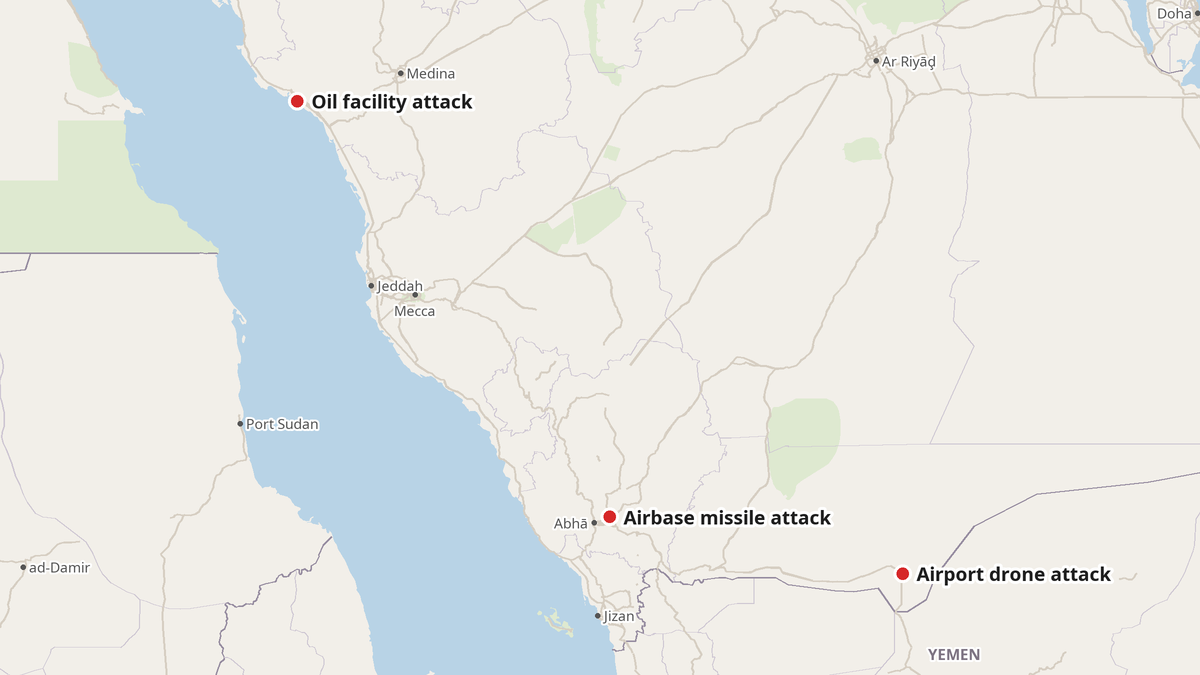
Yemen's Houthis said on Thursday they had struck a pumping station on the Saudi East-West oil pipeline, an oil facility in the Red Sea city of Yanbu, and an Aramco building in Riyadh. The attacks fall inside a regional war that, by the base reporting's own account, began when the US and Israel attacked Iran in February. It's now the ninth month of that conflict.
Houthi military spokesperson Yahya Saree said in a post on X that one operation "targeted Pumping Station No. 7 on the East-West Pipeline using a drone," while a second "targeted the Yanbu oil facility using a ballistic missile." He claimed two further strikes on a Saudi airport and an airbase near the Yemeni border, including a ballistic missile that "scored a direct hit" on Khamis Mushait airbase. There were no immediate reports of damage at Aramco's Riyadh headquarters. The Houthis didn't say which day they carried out the attacks.
A War Opened by Washington and Tel Aviv
The group has been firing missiles and drones at Saudi airports, ports and oil installations, which the base article describes as turning US ally Saudi Arabia into a pressure point in a war that began with the US and Israel attacking Iran. The wartime shutdown of the Strait of Hormuz has crippled exports from Saudi Arabia's neighbours. Riyadh says it has rerouted about 4 million barrels of crude per day through the East-West Pipeline to Yanbu, roughly 4% of global supply. The pipeline has spared the world's biggest exporter the worst of the shutdown, which is why the Houthis keep targeting it.
The Houthis seized Sanaa 12 years ago, and Saudi Arabia intervened militarily the following year, 11 years ago, in support of the internationally recognised government. A UN-brokered truce four years ago largely froze the conflict. Fighting resumed in July, about four months ago, and Saudi Arabia has since been regularly targeted, along with Riyadh's financial district. The escalation now threatens the Bab el-Mandeb Strait, a key shipping route linking the Red Sea and the Gulf of Aden.
Interceptions and Denials
The Saudi-led coalition said it intercepted and destroyed two drones, one over the Riyadh region and one over the Eastern Province. It also reported destroying two ballistic missiles aimed at western Saudi Arabia on Wednesday night, plus two more drones in the south and around Mecca. Saudi civil defence said missile debris fell in the village of Sabouha, about 35 kilometres (22 miles) from Mecca. Saree rejected the claim that Mecca was targeted as a "grave falsehood." The Houthis have repeatedly denied targeting Mecca and Medina.
Saudi-backed forces say they're confronting the Houthis on all frontlines. Yemen's Defence Ministry, citing the Saudi-backed Presidential Leadership Council, said the battle was moving toward its "desired objectives." A ministry meeting in Marib governorate discussed operations in the Dawn of Yemen offensive.
The Security Council and Western Backing
On Thursday the UN Security Council voted unanimously to extend Yemen sanctions for one year, including asset freezes and travel bans, and demanded an end to Houthi attacks on Saudi Arabia. The Panel of Experts mandate was also extended. The council backed the territorial integrity of Saudi Arabia and Yemen and called on all parties to refrain from escalatory actions. Its statement said the measures don't apply to humanitarian assistance or supplies for civilians' basic needs.
China's envoy Fu Cong said the sanctions "are merely a means, not an end in themselves," and hoped for de-escalation "as soon as possible."
The UN Office for the Coordination of Humanitarian Affairs said more than 333,000 people have been displaced in Yemen since the start of August, including more than 24,000 in the past week.
Saudi Arabia is pressing the European Union to adopt a Parliament resolution designating Ansar Allah a "terrorist organisation," Reuters reported, citing sources. European officials told Reuters the bloc fears this could undermine a future peace process. EU spokesperson Anouar El-Anouni declined to comment on specific discussions.
Britain's Minister of State for the Middle East, Stephen Doughty, told Asharq Al-Awsat that launching missiles and drones at airports and places where civilians live and work was unacceptable. He said Britain had deployed air-to-air refuelling aircraft, fighter jets and military advisers to support Saudi defensive operations. Saudi Arabia's Foreign Minister Faisal bin Farhan Al Saud discussed the attacks and de-escalation with Chinese envoy Zhai Jun.
- houthi
- saudi arabia
- aramco
- east-west pipeline
- yemen
- drone attacks
- un security council
- yanbu