
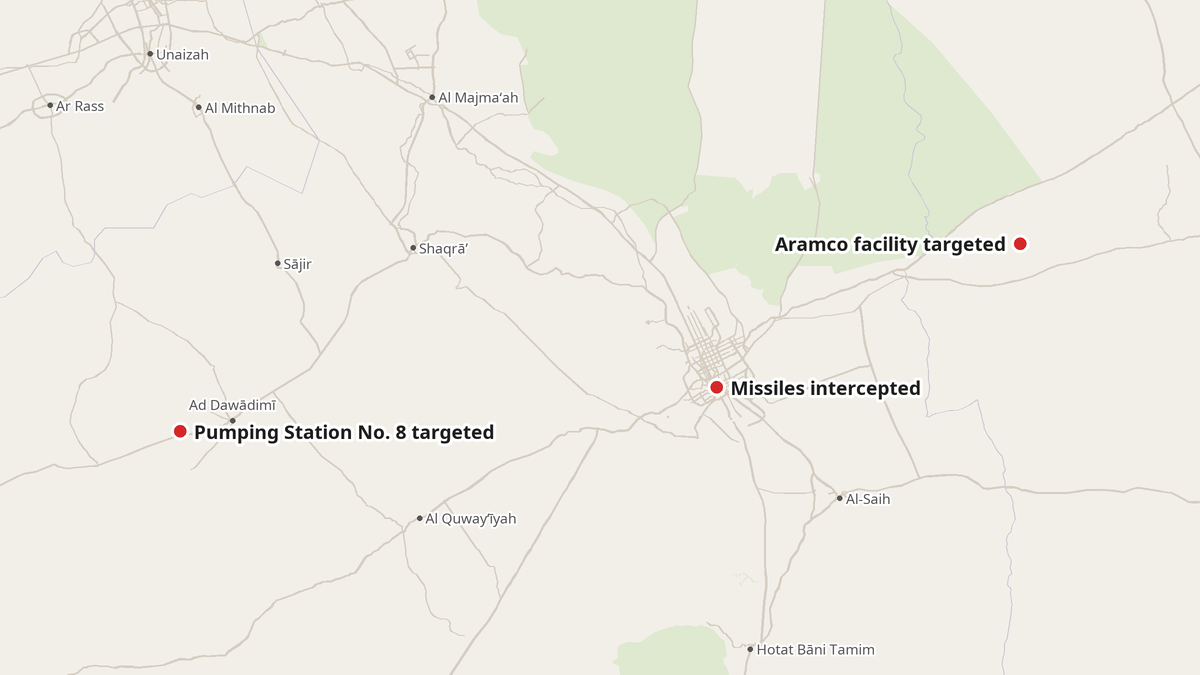
Loud booms rolled across Riyadh on Sunday, November 8, 2026, after the Iran-aligned Houthis fired ballistic missiles at the Saudi capital. The Saudi-led coalition said its air defenses intercepted and destroyed two of them.
Major-General Turki al-Maliki, the coalition's spokesperson, announced the interceptions in a post on X. Saudi Civil Defence had issued an early-warning alert in the Riyadh region shortly before the blasts, according to a Reuters witness. Authorities later said the threat had passed.
It wasn't the only launch. The coalition later said it had also intercepted and destroyed two cruise missiles over Riyadh and the southern region. Earlier, al-Maliki confirmed the interception of another ballistic missile aimed at the kingdom's Eastern Province. Al Jazeera counted three ballistic missiles in all: two toward Riyadh and one toward the Eastern Province. A drone launched toward Saudi Arabia's southern region was also shot down.
The Strike Zone
One projectile got through, or at least landed. A tower in Riyadh's King Abdullah Financial District was damaged on Sunday, Reuters reported, citing a witness and three people briefed on the matter. Saudi authorities didn't immediately respond to requests for comment, and the Reuters report did not identify where the projectile came from.
The Houthis have been open about what they're targeting. Military spokesman Yahya Saree said Saturday the group carried out six operations with ballistic and cruise missiles and drones against targets in Saudi Arabia and Yemen. He named Khalid International Airport and Aramco facilities in Riyadh and Khurais, along with Pumping Station No. 8 in Dawadmi. He said Houthi forces also hit Saudi troops in Najran and in Yemen's Al-Jawf and Ma'rib provinces, claiming numerous deaths and injuries.
An international airport, oil installations and a pumping station. Those are civilian and economic targets, and the Houthis have targeted Saudi airports, ports and oil facilities with missiles and drones since hostilities resumed in July, according to the base reporting.
Civilian Toll, Contested Claims
The human cost in Yemen is mounting, and the claims are contested. The Houthi-run Health Ministry spokesperson, Anees al-Asbahi, said 33 people, including eight women and 13 children, were killed Saturday in coalition air attacks on the village of al-Shariyah near Sanaa. He said at least 39 others were wounded. Al Jazeera could not independently verify the reports. The coalition didn't immediately comment, though another report said Saudi authorities stated they were investigating the reported strikes.
The figures come from a ministry run by the group that is itself firing missiles at Saudi cities. That doesn't make them false, and the investigation Saudi authorities announced matters. It does mean the numbers sit unverified.
A second incident shows how murky attribution gets. On Friday, an attack on a market in Taiz province killed 30 people. The Houthis blamed Saudi air strikes. Yemeni government forces accused the Houthis of firing a ballistic missile at the site. Saree also claimed the coalition had carried out 105 air strikes and missile attacks over 24 hours, a figure that comes from the Houthis themselves.
A Truce Gone, a Front Widening
The fighting has shattered a UN-brokered truce that had largely held since 2022, which began four years ago. Saudi Arabia led a coalition of Arab states into Yemen in 2015, 11 years ago, to restore the internationally recognised government after the Houthis seized Sanaa. The ceasefire collapsed about four months ago, in July, when the Houthis announced a blockade of Saudi ports.
The conflict has now become a front in the wider Middle East war triggered by US and Israeli attacks on Iran about nine months ago, in February. Government forces launched the Dawn of Yemen operation last month, aimed at retaking Houthi-held territory including Sanaa. In September, the Houthis seized much of Yemen's Red Sea coast in a lightning offensive. According to the United Nations, more than 1,600 people have been killed and almost 300,000 displaced since the 2022 ceasefire collapsed.
Why This Matters: A group that answers to Tehran's strategic orbit is now striking the airports, pipelines and financial towers of the world's largest oil exporter, and the damage in Riyadh's financial district shows interception isn't airtight. The Houthi blockade of Saudi ports and the seizure of the Red Sea coast put shipping and energy infrastructure under direct pressure. The collapse of the truce also shows how fragile diplomacy is when one side holds the leverage of missiles and the other can only absorb or intercept them. For Gulf states and Israel alike, that is the lesson of a war in which Iran's partners keep several fronts open at once.
- houthis
- saudi arabia
- yemen
- riyadh
- ballistic missiles
- saudi-led coalition
- cruise missiles
- missile attacks